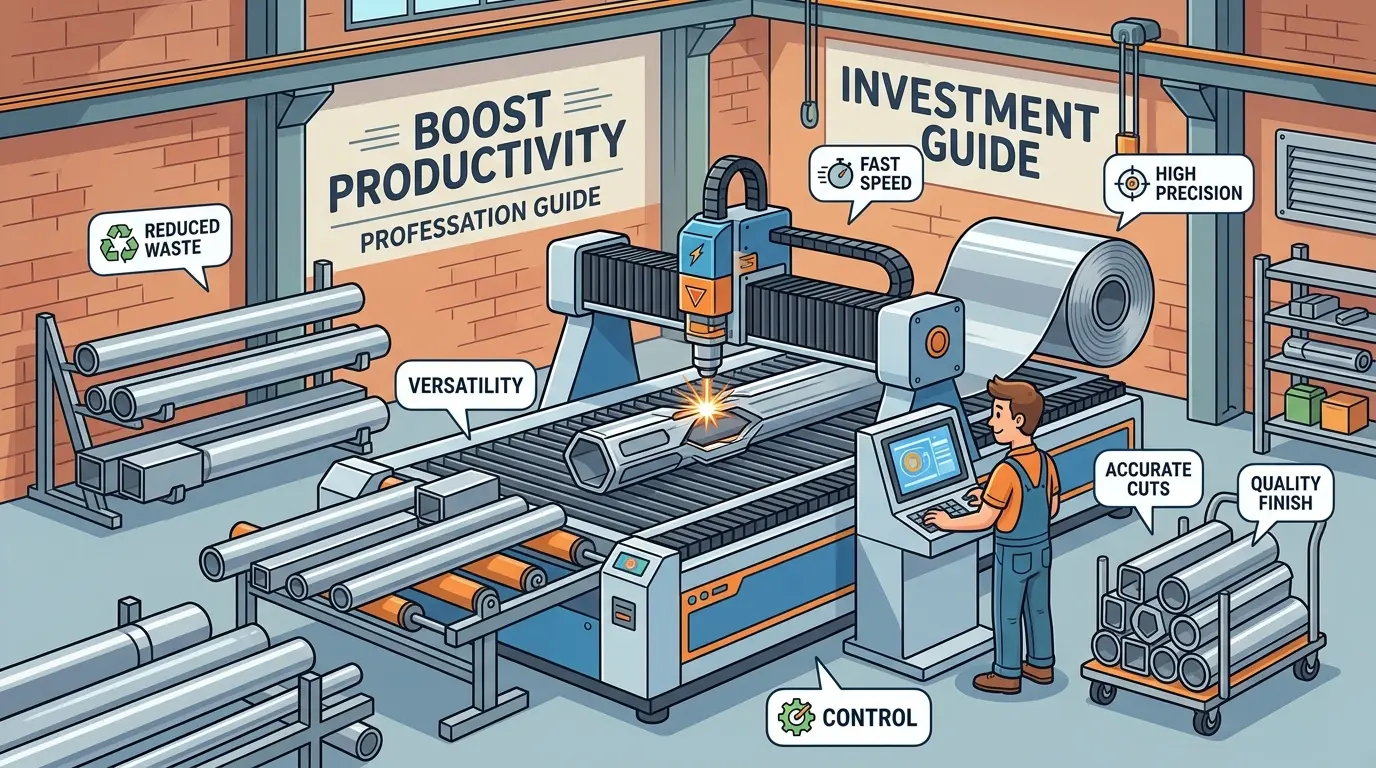
For many fabrication shops, tube and pipe cutting becomes a bottleneck long before welding or assembly does. The problem is usually not whether material can be cut at all. The problem is how consistently the shop can process round tube, square tube, rectangular profiles, and other structural sections without losing time to manual handling, secondary operations, or poor part fit downstream.
That is why buying a laser pipe cutting machine should be treated as a workflow decision, not just a machine purchase. A good system does more than cut profiles. It affects material flow, hole accuracy, joint preparation, weld fit-up, and how efficiently the shop moves from raw stock to finished assemblies.
Why Fabrication Shops Look at Laser Pipe Cutting in the First Place
Pipe and tube work tends to create friction in production when the shop is relying on multiple disconnected steps such as sawing, drilling, marking, coping, or manual layout. That approach can still work in lower-volume environments, but it often becomes harder to scale when part variety increases or tolerances tighten.
Laser pipe cutting is commonly evaluated when a shop wants to reduce manual transfer steps and make profile processing more repeatable. In many cases, the machine is considered not only for cutting speed, but for how well it helps standardize tube preparation before welding, bending, or assembly.
Which Shops Usually Benefit Most
Laser pipe cutting machines are often considered by fabrication businesses that process profile materials as a regular part of production rather than as occasional custom work.
Typical examples include:
- Structural fabrication shops producing frames, supports, and welded assemblies
- Furniture and fixture manufacturers working with tube-based products
- Equipment manufacturers using pipe and profile parts in machine frames or guards
- Handrail, rack, and display fabricators managing repeated profile cuts
- General fabrication shops serving mixed industrial customers
The more frequently the shop handles profile cutting, feature holes, complex intersections, or recurring part families, the more important process stability usually becomes.
Start With the Real Part Mix, Not the Most Impressive Demo
One of the most common buying mistakes is evaluating a tube laser based on a polished demonstration sample instead of on the actual production mix. A fabrication shop should begin by reviewing what it really cuts every week.
That includes:
- Profile shapes such as round, square, rectangular, or specialty sections
- Typical material types used in customer orders
- Common wall thickness ranges
- Standard cut lengths and raw-stock handling needs
- Whether parts require slots, holes, tabs, miters, or joint-preparation features
- Whether jobs are repetitive, high-mix, or project-based
Without that information, it is easy to choose a machine that looks strong in a sales presentation but creates compromises in daily production.
The Most Important Buying Factors
The best laser pipe cutting machine for a fabrication shop is rarely the one with the most aggressive headline claim. It is usually the one that fits the actual part profile, material flow, and labor structure of the business.
| Buying Factor | What To Evaluate | Why It Matters in Production |
|---|---|---|
| Profile Range | Round, square, rectangular, and specialty shapes actually processed | A machine should match the real section mix, not just the broadest theoretical range |
| Material Mix | The metals the shop handles most often | Material mix affects cut behavior, process settings, and overall fit |
| Part Features | Holes, slots, miters, notches, and connection geometry | The more feature-rich the part, the more valuable integrated processing becomes |
| Raw Stock Handling | Loading method, support stability, and material movement | Poor handling can cancel out the benefits of a capable cutting head |
| Cut Repeatability | Consistent part quality across long runs | Repeatability affects weld fit-up, assembly speed, and scrap risk |
| Automation Level | Manual loading versus more automated material flow | The right level depends on labor availability, batch size, and production rhythm |
| Software and Programming | Ease of nesting, setup, and job switching | Better programming flow supports faster response to mixed orders |
| Downstream Fit | How parts move into welding, coating, and assembly | The machine should reduce downstream friction, not just produce cut parts |
This table matters because fabrication shops rarely win on cutting alone. They win when the cut part reaches the next operation in a cleaner, more consistent, and more usable condition.
How Profile Variety Changes the Machine Decision
Some shops process mostly one type of profile, while others move constantly between round tube, square tube, rectangular tube, and occasional specialty sections. That difference has a major impact on machine fit.
If the profile range is narrow and predictable, the buying decision can focus more on throughput and handling simplicity. If the shop serves many industries or runs a high-mix order book, flexibility becomes more important. In those cases, the machine has to support frequent changeovers without turning setup time into a hidden cost.
This is especially important for job shops, contract fabricators, and manufacturers with changing product lines. They often need a system that handles variation smoothly, not just one specific profile well.
Why Integrated Feature Cutting Matters So Much
Fabrication shops do not usually buy a pipe laser just to separate stock into shorter pieces. They buy it because many tube and pipe parts also need features that would otherwise require secondary work.
That can include:
- Connection holes for fastening or assembly
- Slots for joining or locating parts
- End cuts for cleaner weld preparation
- Complex cutouts for fitted intersections
- Repeated geometry that benefits from programmed consistency
When those features can be processed within the same profile-cutting workflow, the shop may reduce manual marking, drilling, and repositioning. The practical gain is often less labor handling and more consistent fit at the welding or assembly stage.
Manual Loading Versus Higher Automation
Automation level should be matched to the shop’s production reality rather than treated as a prestige feature. Some fabrication shops genuinely benefit from more automated loading and unloading, especially when they process long runs or have labor constraints around raw-stock handling.
Other shops run smaller batches, more frequent job changes, or more variable materials. In those environments, too much automation can add cost and complexity without solving the main problem.
The better question is not, “How automated is the machine?” It is, “Where are we losing time today?” If the real delay comes from raw material loading, support repositioning, or unloading finished parts, automation may be valuable. If the real delay comes from quoting, programming, or downstream welding, the answer may lie elsewhere.
How To Judge ROI More Accurately
Shops often start with purchase price, but the more useful ROI calculation usually comes from process change.
A laser pipe cutting machine can create value through:
- Less manual layout and measuring
- Fewer secondary drilling or coping steps
- Better repeatability in welded assemblies
- Faster movement from raw stock to prepared parts
- Lower handling effort between operations
- More stable output on recurring jobs
- Better response time on mixed or custom orders
If the current process already relies on several disconnected steps, even moderate improvements in handling and consistency can matter more than a single headline productivity claim.
Questions Fabrication Shops Should Ask Before Requesting Quotes
Before talking seriously with suppliers, a fabrication shop should prepare a short internal brief. That usually produces better recommendations and fewer bad assumptions.
Use questions like these:
- What profile shapes make up most of our weekly workload?
- Which parts require complex end geometry or integrated holes and slots?
- Where do we currently lose the most labor time: loading, setup, cutting, or secondary operations?
- Do we run long repetitive batches, high-mix orders, or both?
- How important is fast job changeover to our business model?
- Which downstream process suffers most from inconsistent cut quality?
- Do we need more automation, or do we need better control over part preparation?
- What level of service and operator support do we need to protect production continuity?
Those questions help keep the buying process grounded in real production rather than in overly generic equipment comparisons.
Common Buying Mistakes To Avoid
Several mistakes appear repeatedly when fabrication shops buy profile-cutting equipment.
The first is buying for maximum capability instead of daily use. If most orders fall into a narrow operating range, the machine should be judged on how well it supports that range consistently.
The second is underestimating material handling. A strong cutting platform can still create frustration if loading, support stability, or unloading interrupts the flow of work.
The third is ignoring downstream value. The machine may look efficient on its own, but the real benefit comes from how well parts fit the next step in welding, coating, or assembly.
The fourth is treating software as secondary. In high-mix environments, programming speed and job management can influence productivity almost as much as cutting performance.
How To Make the Final Decision
The right laser pipe cutting machine for a fabrication shop is the one that improves total profile-processing flow, not just isolated cut quality. That means matching the machine to the shop’s actual section mix, feature requirements, labor constraints, and downstream process needs.
If the shop handles frequent profile variation, recurring fabricated assemblies, and time-consuming secondary tube operations, a well-matched laser system can improve consistency and reduce manual process friction. If the workload is narrower or less demanding, the decision should still be made around production fit rather than around the broadest equipment claim.
For teams comparing profile-cutting investment with other machinery priorities across a broader capital-planning cycle, the Pandaxis product catalog provides a broader view of industrial machinery categories.
In the end, the best buying guide is your own production history. The more clearly a shop understands what it cuts, where it loses time, and how parts move downstream, the easier it becomes to choose a machine that supports real fabrication performance.