When a part needs a permanent mark on a surface that does not tolerate much heat, the real decision is not whether a laser can make something visible. The real decision is whether the process can hold contrast, edge definition, and cosmetic control without warping thin plastics, damaging coatings, or turning a traceability step into a reject source.
That is why UV laser marking is usually evaluated as a quality-control tool first and a speed tool second. In production, it tends to make the most sense when marks are small, surfaces are sensitive, and the cost of thermal damage is higher than the cost of a slower or more tightly controlled process.
Why Buyers Turn to UV Marking
UV laser marking is commonly considered when standard marking methods create too much heat around the mark zone. In practical terms, buyers usually start looking at UV when they are trying to improve one or more of the following:
- Fine Text Or Dense Codes On Small Parts
- Cleaner Marking On Coated Or Painted Surfaces
- Better Cosmetic Control On Appearance-Sensitive Components
- Reduced Distortion On Thin Or Heat-Sensitive Materials
- More Stable Mark Definition Where Rougher Thermal Response Creates Rework
The process logic is straightforward. If the surrounding surface matters almost as much as the mark itself, UV becomes more relevant. If the job is dominated by deep removal, wide mark fields, or raw throughput, UV often becomes less attractive.
Best Applications for UV Laser Marking
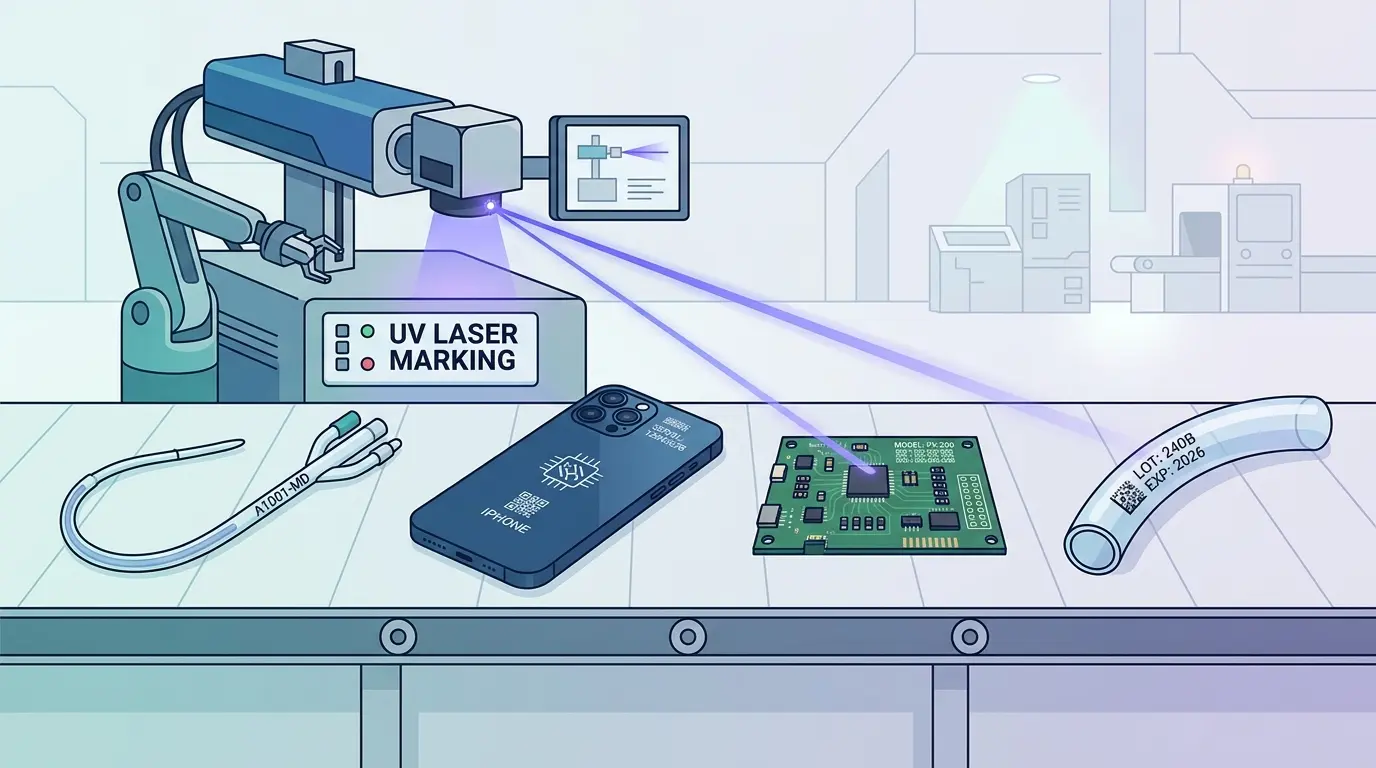
The strongest UV use cases usually share the same pattern: sensitive substrates, compact mark areas, and real cost attached to surface damage or inconsistent contrast.
| Application Area | Why UV Is Commonly Considered | Main Production Benefit | Limitation To Validate |
|---|---|---|---|
| Small Plastic Components | Fine marks are often needed on thin housings, covers, or molded parts that can show heat damage quickly | Better control of mark edges and less visible surrounding damage | Polymer family, additives, and colorants can change contrast significantly |
| Coated Or Painted Surfaces | The mark must stay readable without making the finish look rough or overprocessed | Cleaner branding, serial marking, or traceability on appearance-sensitive parts | Coating chemistry can change how consistently the surface responds |
| Films, Labels, And Thin Laminates | Thin materials can distort, wrinkle, or discolor if the process is too aggressive | Better chance of holding readable marks on delicate substrates | Material handling and recipe stability still matter greatly |
| Glass, Ceramics, And Brittle Decorative Parts | Buyers often need a controlled surface mark where cracking or rough breakout is unacceptable | Improved cosmetic control on delicate parts | Brittle materials still require careful trials, fixturing, and inspection |
| High-Density Traceability Zones | Compact codes and small characters need clean definition in limited space | Better readability in small marking windows | A mark that looks readable may still fail scanner validation |
These applications make sense because the value of UV is usually tied to reduced thermal side effects, not to aggressive material removal. The more appearance-sensitive the part becomes, the easier it is to justify a process built around control rather than brute throughput.
Where UV Marking Usually Reaches Its Limits
UV laser marking is not a universal answer. It has real process limits, and buyers usually make better decisions when those limits are treated as part of the initial evaluation rather than as a surprise after installation.
- Deep Material Removal: UV is usually not the first choice when the workflow depends on pronounced engraving depth or broad surface removal.
- Large Filled Mark Areas: Wide logos, large solid fills, and other area-heavy marks can make throughput less attractive than buyers expect.
- High-Takt Production Without Stable Presentation: Small, precise marks do not tolerate inconsistent fixturing, dirty surfaces, or drifting focus conditions.
- Mixed Materials Under One Recipe: A process that works on one plastic or coating may not transfer cleanly to another with the same visual result.
- Applications That Rely on Surface Aggression Rather Than Surface Control: If the job needs forceful interaction with the material instead of controlled cosmetic marking, UV may be the wrong fit.
In other words, UV usually looks strongest when the mark is delicate and the substrate is sensitive. It usually looks weaker when the job becomes deeper, larger, faster, or less tolerant of recipe changes.
Material Variation Matters More Than Many Buyers Expect
One of the most common purchasing mistakes is to treat a substrate category such as “plastic” or “coated part” as though it behaves like one material. In real production, it does not. Surface finish, resin family, fillers, pigments, additives, coating chemistry, and even lot-to-lot variation can change the result.
That is why material qualification should sit at the center of the buying process. A clean sample on one part family does not prove stable performance across the full production queue.
Before moving too far into supplier comparison, buyers should clarify:
- Which Exact Materials Consume the Most Machine Hours
- Whether the Mark Is Functional, Cosmetic, Or Both
- Whether the Part Is Marked Before Or After Coating, Cleaning, Or Assembly
- How Small the Code, Logo, Or Text Actually Needs To Be
- How Much Variation Exists Between Material Lots, Colors, Or Finishes
- Whether the Surface Is Flat, Curved, Textured, Or Difficult To Fixture Consistently
The tighter these answers are, the easier it is to judge whether UV marking is solving a real process problem or just sounding technically attractive.
The Process Controls That Still Decide Mark Quality
UV does not remove the need for process discipline. It reduces some risks, but it does not replace recipe control, clean handling, or verification.
The daily production factors that usually matter most are:
- Stable Part Presentation: Small positional drift can turn a readable code into a marginal one.
- Material-Specific Recipes: Different polymers, coatings, and finishes should not be treated as one interchangeable process family.
- Surface Cleanliness: Residue, oil, dust, or inconsistent pre-cleaning can change contrast and appearance.
- Focus Stability: Fine marks depend on process consistency, not just nominal machine capability.
- Code Validation: Visual inspection alone is not enough when the output must be machine-readable.
- Fume Extraction And Housekeeping: Residue control still affects consistency, cleanliness, and repeatability.
This is especially important in mixed production. A line that switches between coated housings, thin labels, brittle decorative parts, and small molded components will only stay stable if the process window is managed by material family, not by a single catch-all setting.
When a Broader Non-Metal Laser Workflow Makes More Sense
Some buyers start with UV because they know they need “laser processing,” but the real production need turns out to be something else. If the actual workload is dominated by contour cutting or broader engraving on wood, acrylic, and similar substrates, standard laser cutters and engravers belong in a separate evaluation track from UV marking.
That distinction matters because a shop can waste time comparing unlike processes. Delicate, low-heat marking should be judged on cosmetic control, code quality, and material sensitivity. Broader non-metal cutting and engraving should be judged on cutting workflow, edge quality, part size, and production mix. Facilities making a larger equipment decision should place that discussion inside the broader Pandaxis product catalog so marking is evaluated alongside the rest of the factory workflow rather than as an isolated purchase.
Questions to Resolve Before You Compare Quotes
Before comparing suppliers or sample results, buyers usually get better outcomes by answering a few operational questions first:
- Is the Main Goal Traceability, Branding, Cosmetic Marking, Or Fine Text Legibility?
- Which Materials Are Most Sensitive to Heat in the Current Queue?
- How Much of the Workload Involves Small Mark Fields Versus Large Filled Areas?
- What Is the Real Cost of Rejects From Burn, Haze, Discoloration, Or Poor Contrast?
- How Stable Is the Current Fixturing And Part Presentation Method?
- Does the Mark Need Human Readability, Scanner Readability, Or Both?
- Is the Production Problem Actually Mark Quality, Or Is It a Larger Workflow Problem Involving Cutting, Handling, Or Downstream Inspection?
These questions usually reveal whether UV belongs at the center of the solution or whether it is being considered for a problem that really belongs to another process category.
Practical Summary
UV laser marking fits best when a production line needs fine, controlled marks on materials or finishes that do not respond well to rougher thermal processes. The most practical use cases tend to involve compact codes, small text, coated surfaces, thin films, delicate plastics, and other applications where appearance and heat control matter as much as basic readability.
Its limits are just as important as its strengths. UV is usually harder to justify when the work shifts toward deep removal, large filled marks, unstable part presentation, or high-throughput jobs where speed matters more than surface control. The best buying decision comes from matching the process to the actual material mix, the true reject cost, and the specific job the mark has to do.