
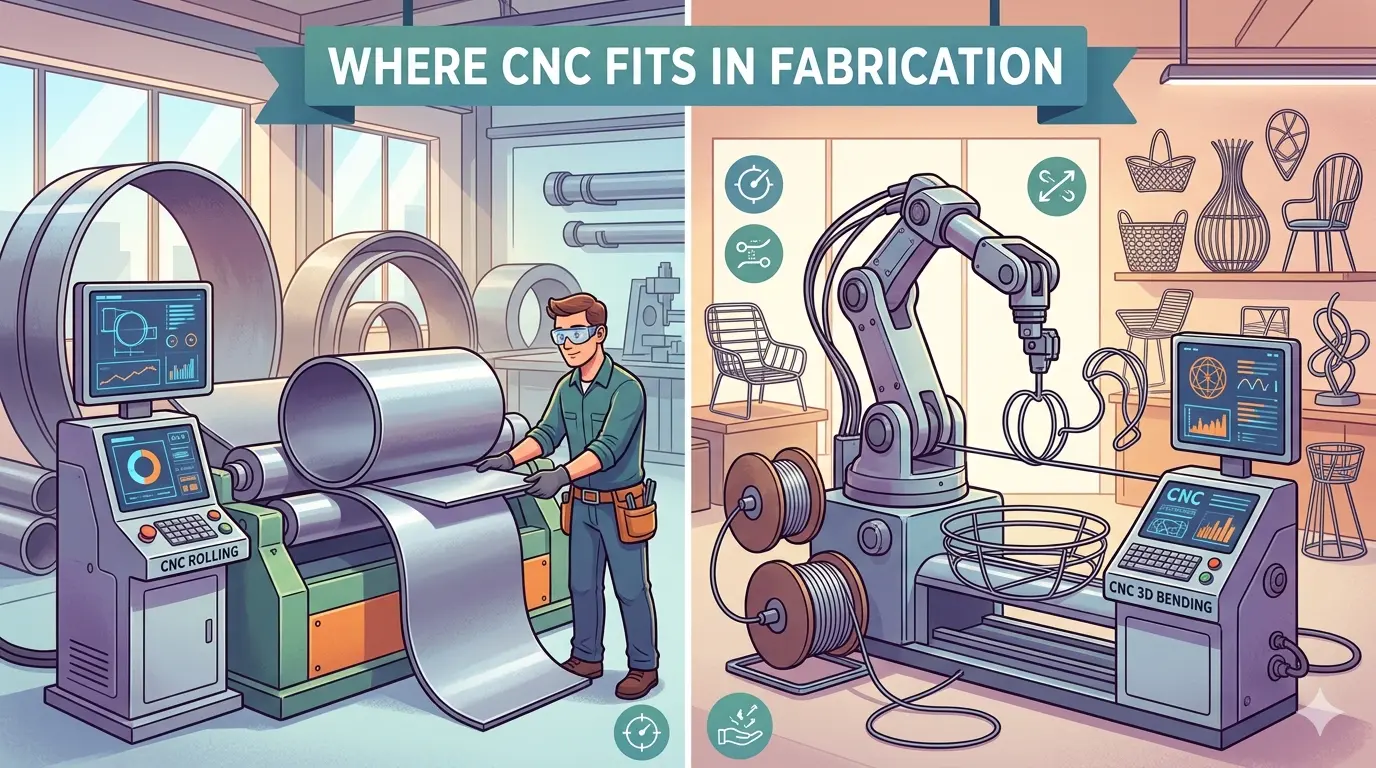
Rolling machines and 3D wire bending machines can look related only from a great distance. Both start with straight metal and end with curved geometry, but that similarity is too broad to guide an equipment decision. In fabrication terms, they belong to different routes, solve different shape problems, and create payback under very different production conditions.
The cleanest way to separate them is not by control screen, machine appearance, or the broad phrase metal bending. It is by looking at two facts that should be obvious before any quote is requested: what the material looks like before the first forming step and what the part still needs to do after the last one.
Once buyers stay disciplined on those two questions, the shortlist usually becomes much simpler. Rolling belongs where larger sections must become controlled curves ready for fit-up, welding, or structural use. 3D wire bending belongs where wire or rod must become repeated formed parts with predictable shape from piece to piece. The mistake is trying to compare them as if they were neighboring versions of the same machine.
Start With Incoming Stock, Because The Material Usually Decides The Route First
If the starting stock is plate, sheet, bar, profile, tube-adjacent section, or another larger form that must become a shell, ring, cone, cylinder, or structural arc, rolling belongs in the conversation immediately. The process is about progressively shaping a larger section into controlled curvature while preserving enough dimensional consistency for what comes next.
If the starting stock is wire or rod that will be fed, bent, redirected, and repeated into smaller formed shapes, 3D wire bending belongs in the conversation instead. Now the production logic is not about shaping a large continuous section. It is about creating repeatable wire-form parts efficiently and consistently.
This sounds almost too simple, but that is why it works. Many confusing sourcing discussions begin only because the buyer starts from the vague category of bending instead of from the honest form of the incoming material.
Rolling Machines Usually Belong To Fabricated Curves, Not Small Repeated Forms
Rolling machines are usually chosen when the business must make larger curved sections that still behave like fabricated components rather than like discrete formed-wire products. Typical jobs include cylinders, shells, cones, rings, curved guards, ducts, structural arcs, and other parts where radius consistency and fit-up quality matter more than high-count part repetition.
In those jobs, the production burden often sits in a familiar cluster of concerns:
- Achieving the right radius without excessive correction.
- Supporting larger material during forming.
- Controlling pass progression so the section stays usable.
- Delivering a shape that fits the welding or assembly stage cleanly.
- Handling awkward or heavy parts without damaging the geometry just created.
That is why rolling is not just a forming decision. It is often a fabrication-readiness decision. The part is valuable not merely because it is curved, but because it arrives at the next station close enough to the intended shape that downstream work does not turn into manual compensation.
3D Wire Bending Usually Belongs To Repeated Wire-Form Production
3D wire bending lives in a different manufacturing world. The machine feeds wire or rod and converts it into consistent forms with multiple bends, direction changes, and repeatable geometry. The part family is often much smaller, the cycle logic is more repetitive, and the economic case usually depends far more on part-to-part repeatability than on one-off geometric necessity.
Common examples include hooks, frames, racks, baskets, supports, clips, wire displays, appliance components, and other shaped-wire products. Here the goal is not to create a large curved shell for later weld-up. The goal is to turn continuous feedstock into repeated formed products with as little variation and manual intervention as the application allows.
That means the value case is different too. In wire bending, the machine becomes stronger when repetition is real, output expectations are sustained, and the plant can exploit the consistency of an automated forming route across many parts.
The Finished Part Usually Tells You Which Family You Are Really Buying
If the finished part still reads as a larger section that must be joined, fitted, welded, or assembled into a larger fabricated structure, rolling is usually the natural route. If the finished part reads as a compact repeated wire form that stands on its own or enters product assembly as a discrete component, 3D wire bending is usually the better starting family.
This is why representative parts are so useful. One honest sample usually resolves more confusion than a long discussion of features. When the part is put on the table, the production logic becomes much easier to see. Buyers only get lost when they keep the conversation abstract.
The Two Investments Create ROI In Different Ways
Rolling machines are often justified because the geometry itself demands the route. A factory may not need extreme volume if the work simply cannot be produced cleanly enough by manual approximation or outsourcing. In that sense, rolling often earns its place through process necessity and through the quality of the curved section it enables.
3D wire bending machines are often justified more by repetition. Their economics usually get stronger when the same wire-form families run often enough for automation, programming logic, and stable output to pay back. If the expected demand is still speculative or the part family keeps shifting, the investment case becomes weaker much faster than buyers expect.
So the two machines do not only shape different parts. They also need different commercial proofs. Rolling can make sense because the shape is hard to produce any other way at acceptable quality. Wire bending usually needs stronger evidence that repeat demand really exists.
Downstream Pain Usually Reveals Which Route Actually Fits
One of the best ways to test machine fit is to ask what happens after forming. The correct machine family is often the one that creates less pain in the next station.
For rolling, downstream trouble often appears in welding, fitting, structural alignment, or later machining when the curved section is inconsistent. The part may be technically curved but still commercially weak because assembly crews spend too much time correcting it.
For 3D wire bending, downstream trouble often appears in fixture mismatch, coating inconsistency, assembly difficulty, or simple part-to-part variation that becomes expensive once production scales. The machine may be fast, but if the formed parts do not arrive consistently enough for the rest of the route, the labor savings disappear downstream.
That is why the buyer should never stop at “can the machine make the shape?” The stronger question is “can the machine make the shape in a way that protects the next operation from correction work?”
The Handling Burden Is Different Even Before Production Scales
Rolling and wire bending also create different handling realities. Rolling often involves larger and less convenient sections that must be supported, repositioned, and preserved through forming and transfer. Handling discipline matters because the part can lose useful geometry after the rolling step if the shop treats it carelessly.
3D wire bending usually creates smaller components, but now the burden shifts toward repeat control, output consistency, and efficient collection or transfer of many parts. The risk is less about moving one awkward shell and more about letting high-count output become unstable, mixed, or difficult to stage cleanly.
This is another reason the machines should not be treated as close substitutes. Their labor pattern is different even before the first capital calculation begins.
A Process Map Usually Clarifies The Shortlist Faster Than Generic Comparison Language
| Starting Material | Finished-Part Identity | What The Factory Usually Cares About Most | The Shortlist Usually Starts With |
|---|---|---|---|
| Plate, sheet, profile, or larger section | Shell, ring, cone, cylinder, or structural curve | Radius control, fit-up quality, and weld-ready geometry | CNC Rolling Machines |
| Wire or rod feedstock | Repeated multi-bend wire form | Part-to-part consistency and efficient repeat output | 3D Wire Bending Machines |
| Larger curved fabricated section | Predictable curvature for assembly or structural use | Low correction burden at welding or fit-up | CNC Rolling Machines |
| High-count wire component family | Stable shape across repeated production | Automated forming consistency and output discipline | 3D Wire Bending Machines |
This kind of process map is more useful than a generic “which bending machine is better?” discussion because it routes the buyer from real work toward the correct equipment family instead of letting the conversation stay broad and misleading.
The Bigger Risk Is Usually Buying A Process Before The Demand Is Honest
One common mistake is overestimating future opportunity. A shop imagines entering larger rolled fabrication or repeated wire-form production without confirming whether the commercial pipeline is actually strong enough to support the investment. Another mistake is assuming that modern controls make a process commercially justified even when representative parts and realistic order patterns are still unclear.
That is why both machine families should be screened against three practical tests before quotation begins:
- Representative parts that reflect what the plant really expects to run.
- Realistic volume or repeat expectations, not optimistic future scenarios.
- Clear downstream requirements that show why the new process improves the route.
If those three items stay vague, buyers may end up shopping a process concept rather than a real production requirement.
Quote Review Should Stay Tied To Representative Work, Not To Broad Capability Claims
When proposals arrive, the comparison should stay anchored to the real problem the plant is trying to solve: stock form, part family, curvature or bend complexity, output expectation, tooling assumptions, startup scope, and service support. It helps to compare machinery quotes line by line so scope differences and support boundaries become visible. If the source is factory-direct or outside the buyer’s normal support model, the usual factory-direct verification steps matter here too.
At plant level, management may also need to step back and ask whether this forming investment is solving the most expensive recurring bottleneck or whether another part of the workflow deserves capital first. That is where what makes industrial CNC equipment worth the investment becomes the more useful framing.
The Decision Usually Becomes Obvious Once The Stock Form And The Business Model Stop Pretending To Overlap
That is the practical answer. Rolling machines and 3D wire bending machines are not neighboring versions of one general bending idea. They start from different materials, create different part families, and earn capital in different ways.
If the buyer defines the incoming stock honestly, shows representative parts, and checks whether real demand exists for the route being considered, the shortlist usually becomes obvious very quickly. Most confusion disappears as soon as the fabrication path is described in actual production terms instead of in broad category language.