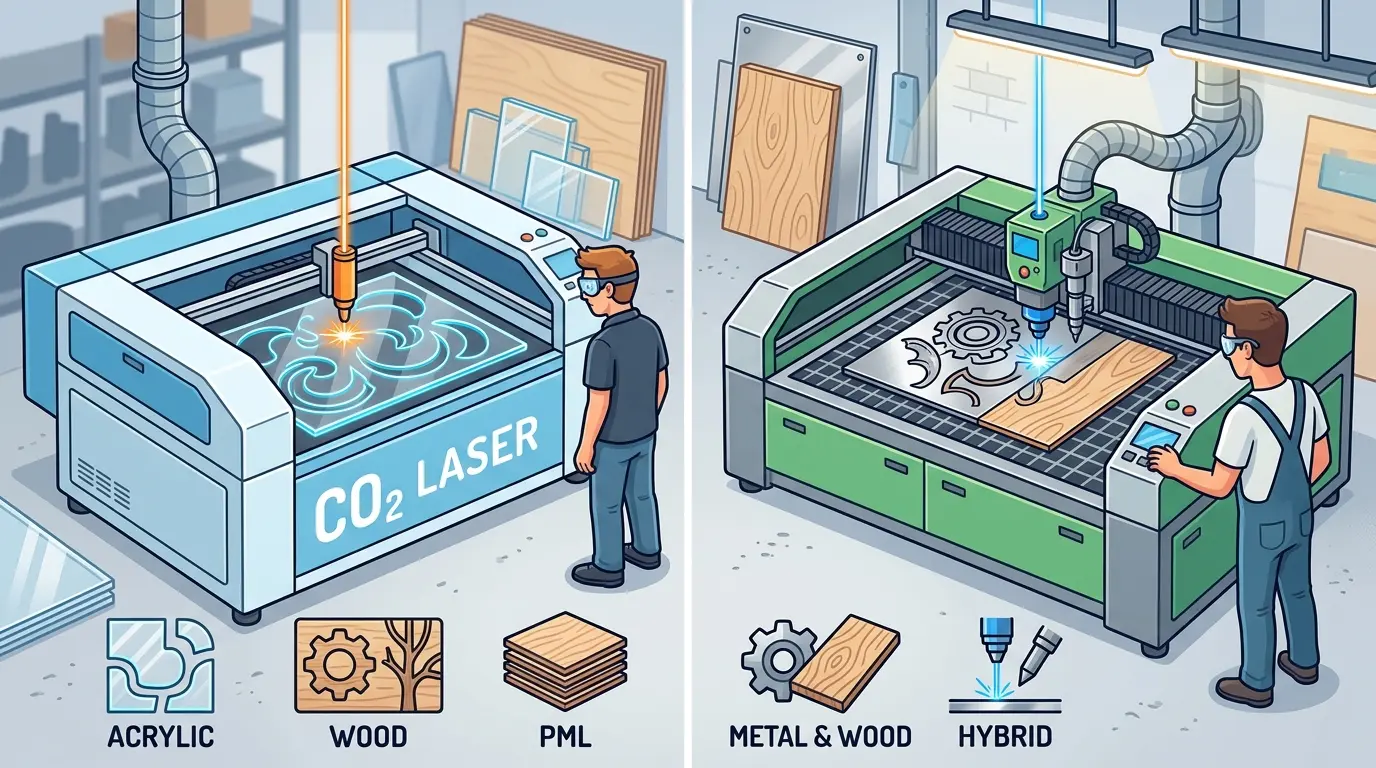
Buying a CO2 laser cutting machine for acrylic and wood is usually straightforward until the production queue stops being simple. A demo may look convincing on one acrylic sheet or one plywood sample, but real factory output depends on how reliably the machine moves between different materials without repeated setup drift, edge-quality problems, and operator intervention.
For manufacturers evaluating laser cutters and engravers for acrylic, wood, and similar non-metallic work, the real question is not whether the beam can cut more than one material. The real question is whether the full workflow can stay stable when the product mix changes.
Why Mixed-Material Production Changes the Buying Decision
Single-material production is easier to optimize because the process window stays narrow. Once a shop starts switching between acrylic display parts, plywood components, MDF inserts, veneered panels, and other similar substrates, the machine is no longer judged only by cut quality on one sample. It is judged by how quickly it can return to a stable output condition after each material change.
That changes the buying criteria in several practical ways:
- Material Changeovers Matter More Than Headline Cutting Speed
- Edge Quality Must Stay Acceptable Across Different Substrates
- Smoke Extraction and Air Assist Stability Become More Important Over Long Runs
- Recipe Management and Operator Repeatability Affect Throughput Directly
- Scrap Risk Increases When the Queue Mixes Decorative and Functional Parts
In other words, mixed-material production exposes weaknesses faster. A machine that looks productive in isolated trials may lose efficiency when operators must move between clear acrylic parts that demand cleaner visual edges and wood-based parts that react differently to heat, glue content, density, and surface finish.
What Changes Between Acrylic, Wood, and Similar Non-Metallic Materials
CO2 laser cutting remains attractive because it is commonly well suited to non-contact processing, fine contours, and detailed part geometry. But acrylic and wood do not respond the same way under the beam, and that difference affects both machine selection and daily process control.
| Material Group | What Buyers Usually Prioritize | What Commonly Changes in Production | Main Workflow Risk |
|---|---|---|---|
| Acrylic | Cleaner edges, dimensional consistency, visually finished parts | Heat response, edge appearance, film handling, cut-path cleanliness | Cosmetic rejects that still consume full machine time |
| Plywood | Reliable cut-through, reasonable edge cleanliness, repeatable shaped parts | Glue-line behavior, smoke load, variation between sheets | Incomplete cuts or darker edges that slow unloading and finishing |
| MDF and Similar Engineered Boards | Stable separation and predictable output | Heavy residue, higher smoke generation, more cleanup pressure | Throughput loss from maintenance and rework rather than visible cut speed |
| Veneered or Decorative Wood Panels | Face quality and limited visible heat effect | Surface sensitivity, appearance standards, more inspection | Usable parts becoming non-saleable because of visible face damage |
| Mixed Small-Batch Non-Metallic Work | Fast setup and repeatable job changes | Frequent parameter changes, more operator decisions, interrupted flow | Productivity loss during changeovers instead of during cutting itself |
This is why the best CO2 laser setup for mixed materials is rarely the one optimized for the most aggressive single recipe. It is usually the one that gives the operator a wider stable window across the actual materials in the queue.
The Machine Features That Matter Most in Real Production
When buyers compare CO2 laser machines for acrylic, wood, and mixed materials, the useful conversation is not about features in isolation. It is about which features protect throughput and quality when production conditions are less than perfect.
| Feature to Evaluate | Why It Matters in Production | Especially Important When |
|---|---|---|
| Stable Motion and Positioning | Helps hold contour accuracy and repeatability across long runs and repeated jobs | Small parts, detailed geometry, or tightly nested layouts are common |
| Consistent Focus Control | Supports cleaner cutting conditions across material families and sheet variation | The shop changes thickness or substrate type frequently |
| Effective Air Assist | Helps clear debris and reduce cut-zone contamination | Acrylic appearance and wood edge stability both matter |
| Strong Smoke Extraction | Protects cut quality, operator visibility, and day-long process stability | MDF, plywood, and other higher-smoke materials are common |
| Practical Working Area and Sheet Handling | Reduces wasted time around loading, alignment, and part removal | The machine must support production batches rather than occasional samples |
| Repeatable Job Setup Workflow | Helps operators return to stable results faster after material changes | Several materials or part families run on the same shift |
| Maintainable Optics and Routine Access | Makes it easier to preserve output quality before drift becomes scrap | The machine runs daily rather than only for short custom jobs |
Notice that most of these points protect process stability, not just raw beam capability. That is the right mindset for mixed-material buying. A machine that is easy to keep stable often produces more good parts per shift than a machine that only looks faster under ideal conditions.
When CO2 Laser Is the Right Fit and When Another Process May Work Better
CO2 laser cutting is commonly a strong fit for acrylic parts, decorative wood work, detailed contour cutting, and jobs where non-contact processing helps protect part geometry or visual finish. But it is not automatically the best answer for every sheet-processing task.
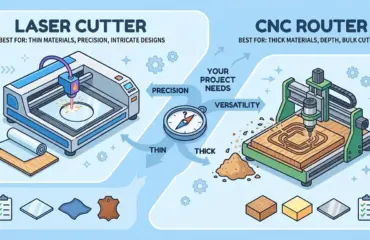
For factories also comparing laser workflows with CNC nesting machines, the real decision depends on what the part needs before and after cutting.
| Production Priority | CO2 Laser Cutting | CNC Nesting or Mechanical Cutting |
|---|---|---|
| Fine Detail and Tight Internal Shapes | Strong Fit | Often Less Efficient for Very Fine Geometry |
| Acrylic Display Parts With Visual Edge Requirements | Strong Fit | Application Dependent |
| Decorative Wood Panels and Cut-and-Engrave Work | Strong Fit | Limited in the same workflow |
| Thick Panel Breakdown for Cabinet Production | Application Dependent | Often Stronger Fit |
| Integrated Routing and Drilling in One Pass | Limited | Strong Fit |
| High-Volume Structural Panel Processing | Application Dependent | Often Stronger Fit |
| Mixed Small-Batch Non-Metallic Parts | Strong Fit | Application Dependent |
This comparison matters because many buyers over-apply laser to jobs that are really driven by panel throughput, mechanical machining, or downstream assembly preparation. In those cases, the better production answer may be a different process. Laser earns its place when detail, flexibility, and non-contact cutting provide real workflow value.
How To Build a Stable Mixed-Material Workflow
Even a well-chosen CO2 laser machine will underperform if the workflow treats every sheet as a new experiment. Mixed-material output improves when the process is organized around material families, appearance standards, and repeatable setup discipline.
Practical improvements usually include:
- Grouping Jobs by Material Family and Thickness Instead of Mixing the Queue Randomly
- Separating Visual-Grade Acrylic Work From Utility Parts With Lower Finish Demands
- Standardizing Approved Recipes for Repeated Material Types
- Measuring Good Parts Per Shift Instead of Only Watching Travel Speed
- Keeping Optics, Nozzles, and Extraction on a Preventive Cleaning Schedule
- Reducing Unnecessary Stops Between Loading, Cutting, and Part Removal
The key idea is simple: mixed-material productivity is often won between jobs, not only during the cut. Better sequencing, better preparation, and cleaner maintenance habits can raise output without forcing the process into a narrower and riskier operating window.
Common Buying Mistakes
Shops often make the same avoidable errors when choosing a CO2 laser cutting machine for acrylic and wood:
- Judging the Machine Only on One Ideal Material Sample
- Treating Acrylic and Wood as If They Share the Same Quality Priorities
- Focusing on Peak Speed Instead of Finished Good Output
- Ignoring Extraction and Maintenance Burden in Higher-Smoke Materials
- Buying for Rare Jobs Instead of the Weekly Production Mix
- Assuming Laser Should Replace Every Mechanical Cutting Process in the Plant
These mistakes usually lead to disappointment not because the machine cannot cut the material, but because the machine was selected without enough attention to workflow fit. Production efficiency depends on how often the machine returns good parts at a repeatable pace, not on how many different materials appear in a brochure or demo discussion.
What Buyers Should Clarify Before Making the Decision
Before choosing a CO2 laser system for acrylic, wood, and mixed materials, it helps to answer a few operational questions clearly:
- Which Material Family Will Actually Consume the Most Machine Hours?
- Are Customers More Sensitive to Edge Appearance or to Delivery Speed?
- How Often Will Operators Switch Between Acrylic and Wood-Based Sheets?
- Does the Product Mix Include Decorative Work, Structural Parts, or Both?
- Would Some Panel Jobs Be Better Routed to Another Machine Category?
- Is the Shop Prepared To Maintain Stable Extraction and Optics Condition Daily?
These questions do more than narrow the shortlist. They reveal whether the machine should be optimized mainly for appearance, for throughput, or for flexible mixed-material changeovers.
Practical Summary
A CO2 laser cutting machine can be a practical production tool for acrylic, wood, and similar non-metallic materials when the workflow truly benefits from detailed geometry, non-contact cutting, and flexible job changes. The better buying decision usually comes from understanding how different materials change edge expectations, maintenance pressure, and setup rhythm rather than from asking whether one machine can technically cut them all.
If your queue mixes acrylic display parts, decorative wood components, and other non-metallic jobs that reward detail and process flexibility, CO2 laser can be a strong fit. If the workload is dominated by heavy panel breakdown, routing, drilling, or furniture-line throughput, another process may carry more of the production burden. The right setup is the one that stays stable across the real material mix and delivers good parts without turning every changeover into a new troubleshooting cycle.