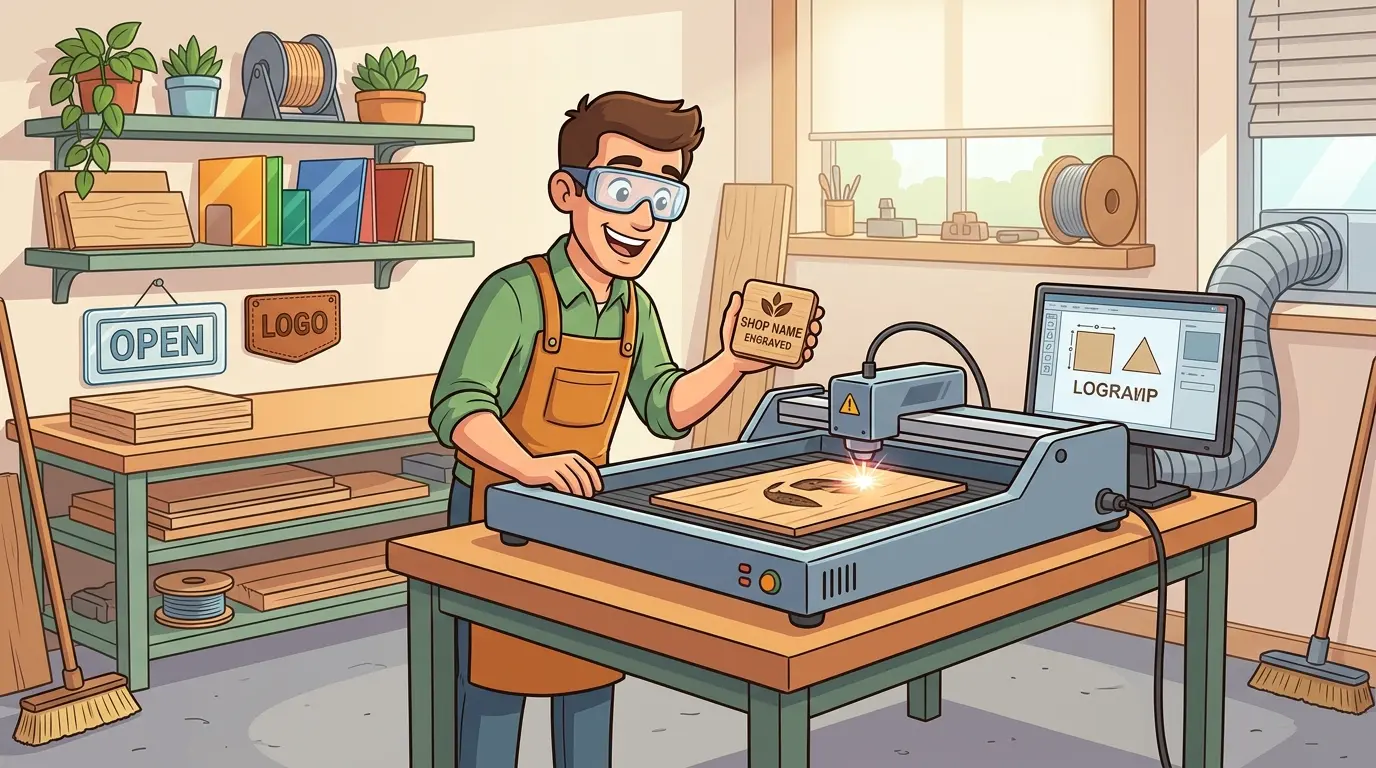
A DIY laser engraver usually begins as a cost-saving idea. The real pressure shows up later, when smoke control, unstable alignment, inconsistent results, and slow material handling start taking more time than the engraving itself. For a small shop, prototype team, or custom manufacturer, the important question is not whether a DIY setup can work. The important question is whether it can support the actual workflow without turning every job into a calibration exercise.
That is why the best place to start is not with the machine frame, the controller, or the advertised power range. It is with the work itself: what materials will be processed, how often jobs will repeat, how clean the finish needs to be, and whether the setup is meant for learning, sampling, or paid production.
Start With the Real Job Mix
Before choosing parts or planning an enclosure, define what the setup will actually do week after week.
Five questions usually make the answer clearer:
- What Materials Will Be Processed Most Often?
- Are Most Jobs Engraving-Only, Or Will They Also Need Shape Cutting?
- Will The Work Be One-Off Custom Jobs, Short Runs, Or Repeated Batches?
- How Important Are Cosmetic Consistency And Repeatable Positioning?
- Will One Skilled Operator Run The Machine, Or Will Several People Need To Use It Reliably?
For shops working with wood, acrylic, and similar non-metal materials, those answers usually matter more than the first hardware list. A DIY setup that feels acceptable for occasional samples can become a weak link very quickly once the work includes repeated branding, customer-facing decorative parts, or scheduled short-run production.
If the long-term goal includes metal marking or metal cutting, treat that as a separate equipment decision rather than assuming the same DIY logic will scale into that application later.
DIY Setup Can Mean Very Different Things
Not every DIY laser engraver project is trying to solve the same problem. Some are built to learn the process. Others are low-cost production experiments. Some are upgrades to an existing light-duty platform. Others are fully custom assemblies intended to reduce upfront purchase cost.
That difference matters because the risks change with the intended role.
| DIY Setup Type | Typical Goal | Where It Can Fit | Main Risk |
|---|---|---|---|
| Entry-Level Self-Built Platform | Learn Laser Basics And Test Simple Jobs | Training, Sampling, Occasional Prototyping | Setup Time Can Exceed Productive Time |
| Upgraded Light-Duty Engraver | Improve Usability Or Add Specific Functions | Small Custom Shops With Predictable Work | Incremental Upgrades May Not Solve Core Stability Limits |
| Enclosed DIY Workstation | Improve Safety And Smoke Control | Controlled Small-Batch Environments | Enclosure Quality Does Not Automatically Fix Process Repeatability |
| Production-Intent Custom Build | Lower Capital Cost Compared With A Dedicated System | Narrow, Well-Defined Workflows With Strong Technical Oversight | Maintenance Burden And Operator Dependency Can Grow Faster Than Expected |
A DIY project is easier to justify when the job mix is narrow and the team understands exactly which limitations it is accepting. It becomes much harder to justify when the workload is mixed, deadlines are fixed, and multiple operators need the same result every time.
When DIY Makes Sense And When It Starts Working Against You
DIY setups are not automatically the wrong choice. The mistake is assuming low upfront cost always means lower total cost.
| Situation | DIY Fit | Why |
|---|---|---|
| Process Learning And Material Testing | Strong | The value comes from experimentation rather than throughput |
| One-Off Samples And Concept Prototypes | Reasonable | Occasional recalibration is easier to tolerate |
| Small Custom Personalization Jobs | Conditional | It can work if setup time stays controlled and finish quality is acceptable |
| Repeated Batch Engraving | Weak | Small variation becomes visible rework very quickly |
| Shared Shop Use With Multiple Operators | Weak | Process consistency usually depends too much on individual experience |
| Customer-Facing Production With Tight Lead Times | Weak | Downtime, cleanup, and unstable repeatability start affecting delivery performance |
The more the business depends on predictable output, the less room there is for a machine that still behaves like a project.
Material Fit Is More Important Than First-Time Builders Expect
Many DIY projects are evaluated around whether the machine can mark a test piece. That is not the same as asking whether it can support a stable production routine.
Wood, acrylic, and similar non-metal materials do not all respond the same way. Some jobs are sensitive to edge darkening, surface residue, smoke staining, or visual inconsistency across a batch. Others look simple until repeated loading, cleaning, and refocusing expose how hard it is to keep output stable.
This is where many first-time builders underestimate the difference between proof of concept and workflow fit:
- Material Behavior Changes The Cleanup Burden.
- Surface Finish Expectations Change How Visible Small Process Variation Becomes.
- Mixed Materials Increase Setup Complexity.
- Decorative Work Usually Exposes Inconsistency Faster Than Hidden Utility Parts.
If the business depends on presentable finished parts rather than internal experiments, the setup should be judged by repeatable results, not by one successful sample.
Safety And Extraction Are Not Optional Add-Ons
DIY laser engraver discussions often focus on optics, motion, and electronics first. In real shop use, safety and extraction have just as much impact on whether the machine is practical.
At a minimum, the setup should be evaluated around:
- Smoke Extraction That Keeps Residue From Building Up Around The Process Area.
- An Enclosure Strategy Appropriate To The Work Environment.
- Stable Electrical Setup And Cable Management.
- Fire Readiness And Clear Shutdown Procedures.
- Routine Cleaning Access For Optics And Process Components.
These are not side issues. Poor extraction affects finish quality, cleaning intervals, operator comfort, and inspection consistency. Weak enclosure planning affects where the machine can actually be used. Weak maintenance access turns ordinary housekeeping into lost production time.
The Hidden Costs Usually Sit Outside The Frame
Most DIY budgets focus on the visible build cost. Small shops usually feel the real cost somewhere else.
- Calibration Time: If alignment, focus, or positioning needs repeated adjustment, the machine consumes labor before it creates value.
- Fixturing Time: A setup that cannot reference parts consistently will struggle with repeated branding, panel placement, or design alignment.
- Cleaning Time: Residue management affects uptime more than many first-time builders expect.
- Scrap And Rework: Output inconsistency is expensive because it wastes both material and schedule space.
- Operator Dependency: If one experienced person is the only one who can get stable results, the setup is not truly scalable.
For paid work, those costs matter more than the initial savings. A lower-cost system that behaves unpredictably can be more expensive than a more stable setup once labor, rework, and delays are included.
Software, Process Control, And Job Preparation Matter More Than Raw Hardware Ambition
Many DIY projects fail in practice not because the motion system is unusable, but because the process around the machine never becomes repeatable.
Shops should think about:
- How Job Files Will Be Prepared And Organized.
- Whether Operators Can Reuse Proven Settings Instead Of Rebuilding Them Each Time.
- How Different Materials Will Be Separated And Documented.
- How Placement, Referencing, And Inspection Will Be Standardized.
The more varied the order mix becomes, the more valuable process discipline becomes. Hardware experimentation may be acceptable during learning, but production work needs settings, positioning, and cleanup routines that can be repeated without guesswork.
Think Beyond The Machine And Into The Workflow
A DIY engraver is rarely limited by the engraving head alone. In shop use, the bottleneck often sits before or after the laser cycle.
Look at the full path:
- Material Is Prepared And Loaded.
- The Job Is Positioned And Referenced.
- The Engraving Is Run.
- The Part Is Cleaned, Checked, And Unloaded.
- The Next Job Is Prepared Without Losing Too Much Time In Setup.
If that sequence depends on constant manual correction, the machine may still work, but the workflow will remain fragile. That is why many shops eventually compare a DIY setup against dedicated laser cutters and engravers once they start processing wood, acrylic, and similar non-metal materials on a regular schedule. The decision is no longer about whether the process is possible. It becomes a question of whether the process is stable enough to support production.
Signs The DIY Phase Is Over
At some point, improving the build no longer improves the business. That is the point where the shop should stop asking how to upgrade the project and start asking what kind of production asset it actually needs.
Common signs include:
- More Time Is Spent Tuning Than Producing.
- Output Quality Changes Too Much Between Operators Or Between Days.
- Smoke And Housekeeping Start Affecting Daily Throughput.
- Repeat Jobs Still Require Too Much Manual Setup.
- Backlog Growth Makes Downtime More Expensive.
- The Business Needs A Machine That Behaves Like A Standardized Workstation, Not A Technical Experiment.
That transition is normal. A DIY system can still be useful as a learning platform, test station, or low-pressure sample maker even after the production workflow has outgrown it.
Practical Summary
A DIY laser engraver setup can make sense when the goal is process learning, sample making, or limited custom work with a predictable material range and enough tolerance for hands-on adjustment. It becomes a weaker choice when the shop needs repeatability, faster operator handoff, cleaner presentation quality, and more stable scheduling.
Before starting, define the actual workload, judge the setup by total workflow cost rather than frame cost alone, and treat extraction, safety, fixturing, and process control as core parts of the system. The better decision is not always the lowest-cost build. It is the setup that helps the shop produce acceptable results consistently without making every order harder to run.