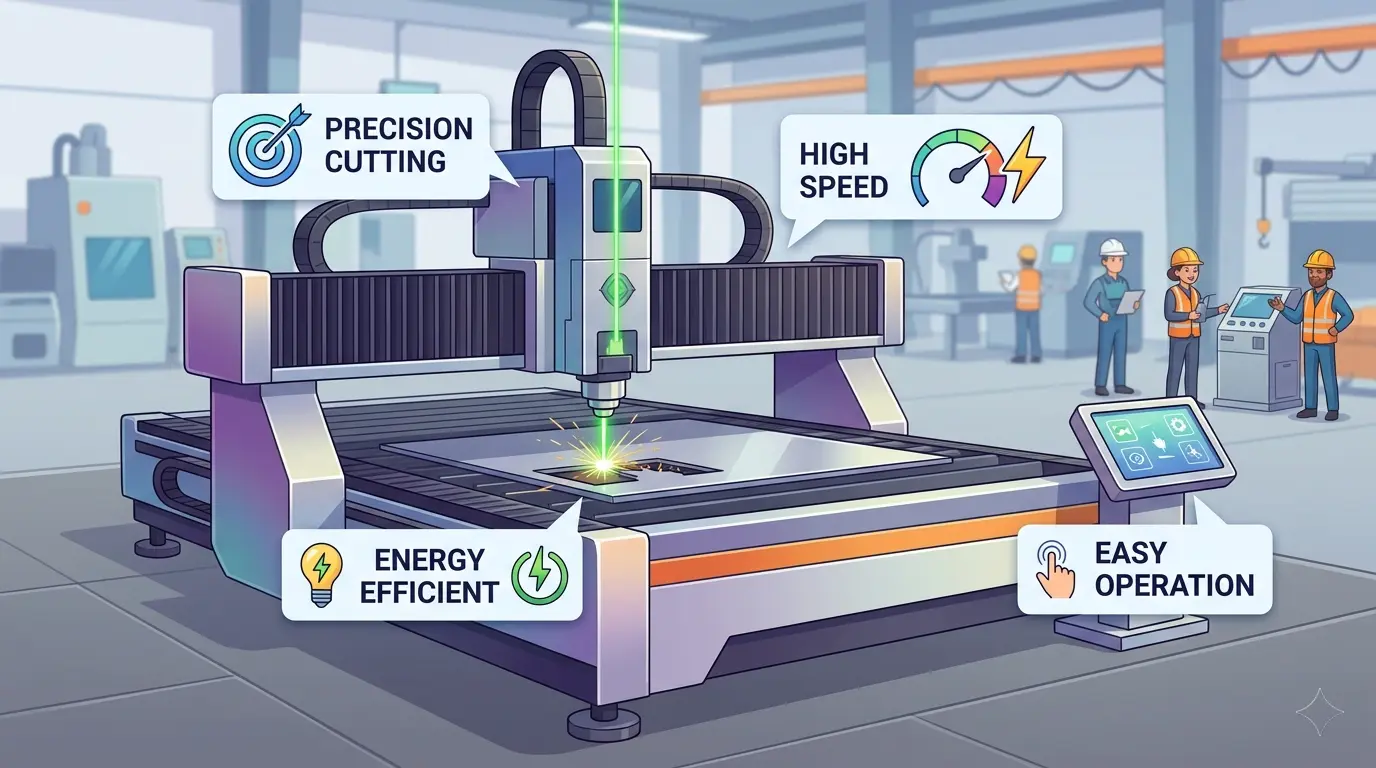
When industrial buyers compare fiber laser cutting machines, the discussion often gets reduced to power level, top speed, and price. In practice, those headline points rarely explain how the machine will perform inside a real production flow. What matters more is whether the system can hold cut quality across shifts, support stable throughput, reduce manual intervention, and stay predictable when order mix changes.
That is why a strong buying decision should start with workflow pressure, not brochure claims. If rework is coming from poor edge quality, unstable hole geometry, slow loading, difficult programming, or unplanned downtime, the right machine features are the ones that solve those bottlenecks directly.
Why Feature Comparison Should Start With The Production Constraint
Two fiber laser cutting machines can look similar on paper and still perform very differently in daily use. A buyer running short batches with frequent changeovers will value different features than a plant focused on long, repeat production runs. Likewise, a shop feeding bending and welding operations downstream will judge machine value differently from a shop where cutting is the main bottleneck.
This is why industrial buyers should ask a more useful question than “Which machine has the strongest headline specification?” The better question is “Which machine features improve our actual production stability, cut consistency, and labor efficiency?”
A Practical Feature Matrix For Industrial Buyers
| Feature Area | What Buyers Should Check | Why It Matters In Production | Risk If It Is Under-Specified |
|---|---|---|---|
| Laser Source Stability | Source quality, operating consistency, suitability for the real material mix | Supports repeatable cutting conditions and more stable part output | Inconsistent quality, harder setup control, and more process drift |
| Cutting Head And Height Control | Autofocus response, height sensing stability, nozzle management, collision protection | Affects edge condition, hole quality, pierce stability, and scrap risk | More rework, nozzle crashes, unstable quality on mixed jobs |
| Motion System And Machine Frame | Rigidity, acceleration behavior, drive quality, vibration control | Helps maintain accuracy, corner quality, and repeatable geometry at production pace | Lost precision, rougher edges, and weaker repeatability over time |
| Controller And Programming Workflow | Ease of programming, nesting logic, parameter management, operator usability | Reduces setup time and improves consistency between jobs and shifts | Slower changeovers, more operator dependence, and programming errors |
| Gas Delivery And Process Control | Gas management, pierce logic, cut parameter stability | Influences cut cleanliness, dross control, and operating efficiency | Poor edge finish, unstable piercing, and avoidable consumable waste |
| Material Handling And Automation | Loading, unloading, part sorting, sheet transfer, integration with upstream and downstream flow | Directly affects throughput and labor efficiency in higher-volume environments | The laser becomes idle while operators handle material manually |
| Monitoring And Recovery Features | Alarm handling, process monitoring, tip-up detection, restart logic | Helps reduce stoppage time and protects production continuity | Small interruptions become longer downtime events |
| Maintenance Access And Serviceability | Access to wear parts, cleaning routines, service response, troubleshooting support | Improves uptime and lowers the operational burden on the production team | More downtime, slower recovery, and higher ownership friction |
Features That Most Directly Affect Cut Quality
If the main concern is part accuracy, edge finish, or downstream fit-up, buyers should look first at the cutting head, control quality, and overall process stability rather than focusing only on nominal machine speed.
Key areas include:
- Cutting Head Stability: The head should maintain reliable height control and respond cleanly to different contours and hole patterns.
- Pierce Control: Stable piercing matters because poor pierce quality often creates downstream edge defects and scrap before the full cut even begins.
- Motion Accuracy: Corner behavior, contour smoothness, and small-feature repeatability depend heavily on how well the machine structure and drives behave under load.
- Parameter Consistency: A machine that produces good samples only after expert adjustment is less valuable than one that stays stable under routine production conditions.
For many industrial buyers, cut quality is not judged at the cutting table alone. It is judged later, when parts move into bending, welding, hardware insertion, coating, or assembly. Clean geometry and repeatable hole placement usually create more value downstream than a marginal gain in quoted cutting speed.
Features That Most Directly Affect Throughput
Throughput is often misunderstood as a simple cutting-speed issue. In real factories, the laser may spend less time cutting than buyers expect. Programming delays, sheet loading, unload handling, and job transitions can reduce effective output far more than a small difference in headline speed.
Industrial buyers should pay close attention to:
- Acceleration And Dynamic Motion: Fast job completion depends on how the machine handles real part geometry, not only straight-line speed.
- Nesting And Programming Efficiency: Better nesting and smoother programming workflows support more usable output from the same material and shift time.
- Loading And Unloading Capacity: In many plants, throughput gains come from reducing idle time between sheets rather than increasing pure cutting speed.
- Part Handling Logic: If operators spend excessive time sorting, unloading, or separating cut parts, the cutting cell may still underperform even when the laser itself is productive.
This is where tradeoffs become important. A highly automated setup may make clear sense for stable, higher-volume output. A high-mix job shop may instead prioritize easier programming, flexible scheduling, and faster changeovers over maximum automation depth.
Features That Most Directly Affect Operating Cost
The purchase price of a fiber laser cutting machine is only one part of the decision. Industrial buyers should also examine the features that shape daily operating cost, maintenance burden, and downtime exposure.
The most relevant areas usually include:
- Consumable Management: Nozzle condition, setup stability, and process control all affect how often operators need intervention.
- Gas Efficiency: Gas use has a direct effect on operating cost, especially in production environments with longer runtime and varied part mixes.
- Maintenance Simplicity: Routine cleaning, access to wear points, and preventive maintenance workflow matter because hard-to-service machines create hidden production losses.
- Fault Recovery: A machine that helps the team diagnose and recover from interruptions quickly can protect output more effectively than one with stronger headline specs but weaker serviceability.
Buyers should be careful not to confuse low initial price with low ownership cost. A cheaper machine that creates more scrap, more operator intervention, and slower maintenance can become the more expensive choice in day-to-day production.
How Feature Priorities Change By Factory Type
Different production models naturally change which features deserve the most attention.
- High-Mix Job Shops: Usually benefit most from easier programming, faster changeovers, stable cut quality across varied parts, and flexible recovery after interruptions.
- Batch Production Plants: Often prioritize automation depth, sheet handling efficiency, repeatability, and shift-to-shift consistency.
- Precision Part Suppliers: Commonly care more about contour quality, hole accuracy, and process stability because downstream forming and assembly are highly sensitive to cutting variation.
- Labor-Constrained Operations: Often gain more from automation, simplified operator routines, and better monitoring than from a purely speed-focused machine upgrade.
No single feature package is universally best. The right priority set depends on whether the factory is trying to protect quality, raise throughput, reduce labor dependence, or lower total operating friction.
Questions Buyers Should Ask Before Comparing Quotes
Before narrowing a supplier list, industrial buyers should define the real operating conditions the machine must handle.
- What Portion Of Our Order Mix Is Stable Repeat Work Versus Frequent Changeover Work?
- Which Downstream Processes Suffer Most When Cut Quality Drifts?
- Is Our Current Bottleneck The Cutting Stage, Material Handling, Programming, Or Part Sorting?
- How Much Operator Skill Is Required To Keep The Machine Running Consistently?
- What Happens When A Nozzle Issue, Tip-Up Event, Or Alarm Interrupts Production?
- Which Features Actually Reduce Labor, Scrap, Or Rework In Our Existing Workflow?
- How Fast Can Routine Maintenance And Common Recovery Tasks Be Completed?
These questions make quote comparison more useful because they move the discussion away from generic claims and toward real production fit.
A Better Way To Evaluate A Fiber Laser Cutting Machine
A fiber laser cutting machine should be evaluated as a production system, not just as a cutting device. The best machine for an industrial buyer is usually the one that balances cut quality, changeover efficiency, handling flow, uptime, and serviceability in a way that matches the plant’s real workload.
For teams reviewing laser investment as part of a broader equipment roadmap, the Pandaxis shop offers a broader view of industrial machinery categories and production-focused equipment planning.
In practical terms, the most valuable features are the ones that improve repeatability, reduce downtime, and make downstream operations more stable. That is the standard industrial buyers should use when deciding which fiber laser platform is actually the right fit.