In panel furniture production, the wrong cutting machine creates problems that show up everywhere else. Parts reach edge banding late, drilling queues build up, operators re-check dimensions, and assembly loses rhythm. A panel saw can solve those issues, but only when the shop has reached the stage where dedicated panel sizing improves the whole workflow.
The practical mistake is treating every shop the same. A small custom workshop, a growing cabinet producer, and a large batch-oriented factory do not need the same kind of cutting capacity, material flow, or process stability. The right way to choose a panel saw machine is to match it to shop scale, order mix, and the pressure on downstream operations.
Define Shop Size by Workflow, Not Just Headcount
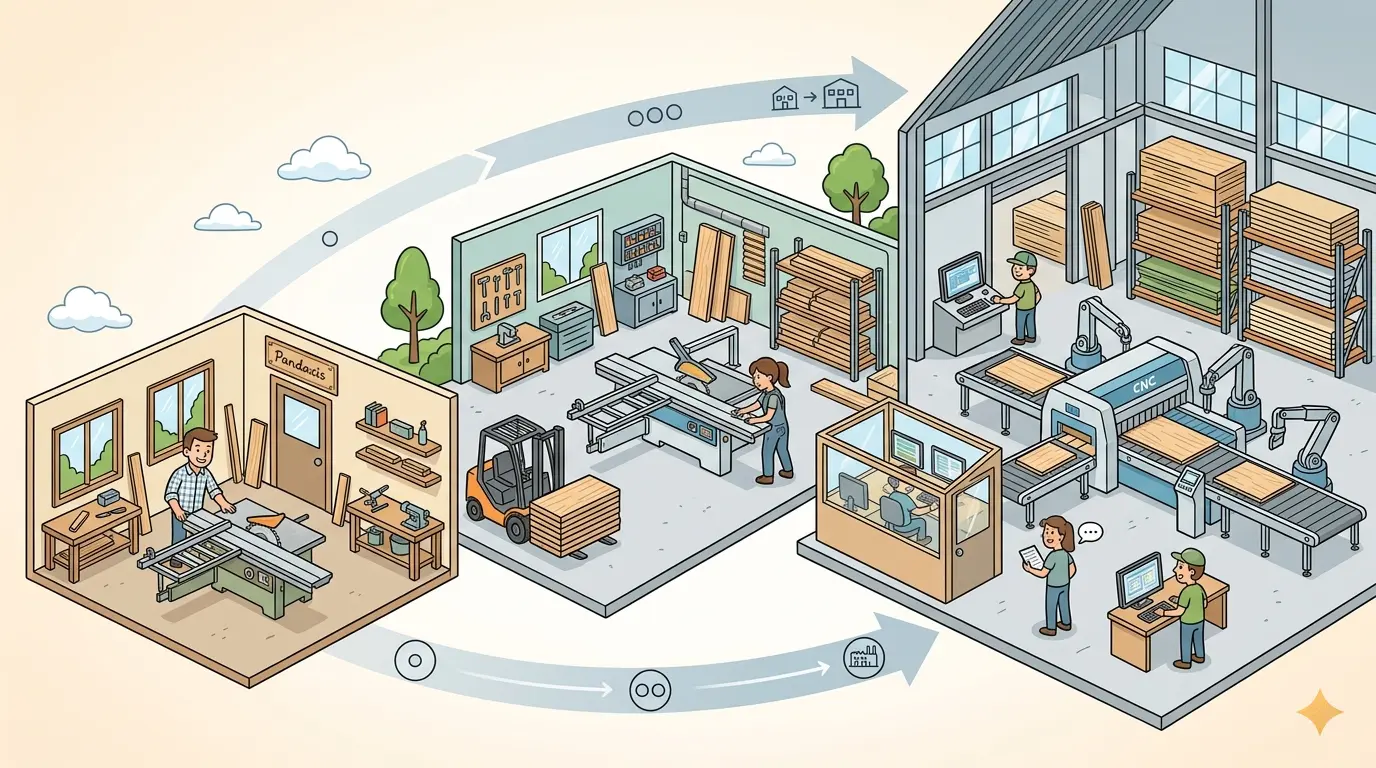
In machinery buying, “small,” “mid-sized,” and “large” are more useful when they describe production behavior rather than employee numbers alone.
| Shop profile | Typical production pattern | Main cutting need | Panel saw fit |
|---|---|---|---|
| Small shop | Mixed jobs, short runs, frequent changeovers | Flexibility and practical control | Low to moderate unless rectangular panel work dominates |
| Mid-sized shop | Growing repeat work, steadier sheet processing, more pressure on front-end cutting | Better repeatability and more stable throughput | Often strong |
| Large shop | Structured batch production, dedicated material flow, downstream dependence on stable input | High throughput, repeatability, and line balance | Very strong |
A shop can be small in headcount but still behave like a mid-sized panel producer if most daily work is repeated cabinet parts. The machine should be chosen for the workflow, not the label.
Small Shops: Prioritize Flexibility Before Dedicated Capacity
For a small shop, the biggest buying risk is locking capital and floor space into dedicated panel-cutting capacity before the work truly justifies it. If the business handles one-off joinery, mixed materials, irregular part shapes, or frequent job changes, flexibility usually matters more than maximum output.
That is why many smaller shops still do well with sliding table saws. They give operators more freedom to handle varied jobs, break down panels as needed, and adapt quickly when the day does not follow a strict cutting pattern.
A panel saw can still be the right move for a small shop when:
- Most revenue comes from cabinet, wardrobe, or modular furniture work
- Sheet goods make up the bulk of daily cutting
- Parts are mainly rectangular and repeated
- Operator-dependent variation is causing re-cuts or fit problems
- The owner wants a cleaner handoff into edge processing and assembly
If those conditions are not present, a dedicated panel saw may solve less than expected.
Mid-Sized Shops: This Is Often Where the Case Becomes Clear
Mid-sized shops are often where the panel saw decision stops being theoretical. At this stage, the business usually has enough repeat work that front-end cutting starts to affect the rest of production.
Common signals include:
- Cut lists are growing faster than the current cutting cell can handle
- Operators spend too much time rechecking dimensions or reorganizing batches
- Downstream teams wait for sized panels instead of processing them continuously
- Repeated cabinet or furniture jobs are stable enough to benefit from standardized panel sizing
In this kind of environment, panel saws become attractive not just because they cut faster, but because they make the process more predictable. More predictable cutting helps stabilize edge banding, drilling, part sorting, and assembly planning.
This is also the stage where buyers should be honest about growth. If orders are moving toward steadier batch production, buying only for today’s minimum need can create a second replacement decision sooner than expected. At the same time, buying for a large-factory workflow that does not yet exist can tie up capital without fixing the current bottleneck. Mid-sized shops need balance more than maximums.
Large Shops: Choose for Line Balance, Not Just Saw Output
In a large shop, a panel saw is not only a cutting machine. It is part of the production-control logic of the plant. When downstream operations depend on a steady flow of correctly sized parts, the value of the saw comes from consistency, batch stability, and reduced disruption across the line.
Large shops should evaluate a panel saw machine against questions such as:
- Can the cutting cell support the plant’s actual material flow?
- Will it help keep downstream processes fed at a consistent pace?
- Does it reduce variability that would otherwise show up in drilling, edge finishing, or assembly?
- Is the shop organized to stage sheets, sort parts, and move batches efficiently after cutting?
The largest mistake at this stage is comparing machines only by standalone cutting capacity. A saw can look impressive on paper and still underperform in the real plant if sheet handling, batch control, and downstream flow are not considered. For large operations, the best choice is the machine that supports the entire line, not the one that looks largest in isolation.
When Another Machine Type May Fit Better
Not every growing shop should move directly to a panel saw. If customization is increasing faster than batch repetition, or if shaped parts and process integration matter more than straight panel sizing, CNC nesting machines may be the better direction.
That is especially true when the cutting decision overlaps with routing, drilling, and high-mix production needs. A panel saw is strongest when rectangular sheet processing is the real constraint. If the business is moving toward more customized component geometry or more integrated machining, the buying logic changes.
A Practical Selection Table
| If your shop looks like this | What usually matters most | Panel saw decision |
|---|---|---|
| Custom shop with frequent changeovers and varied jobs | Flexibility, operator control, low wasted capacity | Wait unless repeated rectangular panel cutting is already dominant |
| Growing cabinet or furniture producer with repeated panel work | Better throughput, repeatability, smoother downstream flow | Often the strongest decision point |
| Larger batch-oriented plant with steady panel demand | Line balance, stable part quality, reduced disruption across departments | Usually a core production machine |
Mistakes That Lead to the Wrong Purchase
A good panel saw decision often comes down to avoiding a few common errors:
- Defining shop size only by headcount instead of production pattern
- Buying for maximum machine image rather than the real bottleneck
- Ignoring how the cutting cell affects downstream operations
- Assuming more capacity automatically means better workflow
- Overlooking floor layout, sheet handling, and part organization
The safest buying process starts with the current production constraint. If the shop loses time because panels are sized too slowly or too inconsistently, a panel saw can be a strong solution. If the real pain point sits somewhere else, the saw may only move the bottleneck.
Practical Summary
Choosing a panel saw machine for small, mid-sized, and large shops is really about matching the machine to the way the business produces. Small shops usually need flexibility first. Mid-sized shops are often where a panel saw starts delivering clear operational value. Large shops need a saw that supports whole-line stability, not just cutting speed.
The best choice is the one that fits the shop’s actual mix of sheet processing, repeat work, material flow, and downstream demands. When those conditions align, a panel saw helps turn cutting from a daily source of variation into a stable starting point for the rest of production.