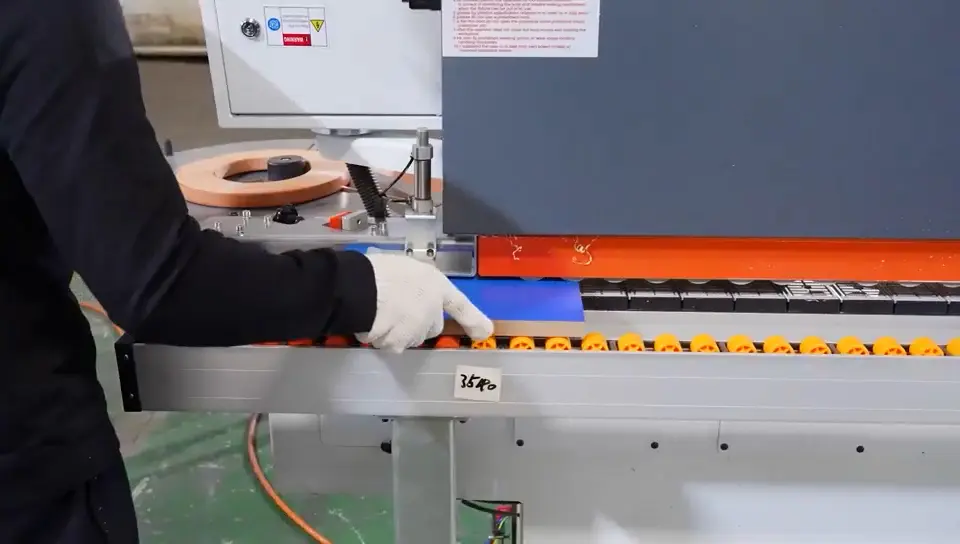
In edge processing, the wrong machine does not only slow one station. It shows up as visible glue-line inconsistency, more hand finishing, delayed panel flow, and parts that reach assembly less predictably than they should. An edge banding machine that feels adequate in a small custom shop can become the weakest point in a large factory, while a factory-oriented configuration can be unnecessarily expensive and rigid in a low-volume workshop.
That is why the useful comparison is not simply basic versus advanced. The real question is whether the machine matches the way the shop produces. Small shops usually need practical flexibility and manageable setup. Large factories need stable throughput, repeatable finish quality, and process control strong enough to keep the rest of the line moving.
The Real Difference Is Workflow, Not Just Floor Space
The terms “small shop” and “large factory” only matter if they describe production behavior.
| Production environment | Common order pattern | What the edge banding machine must do well | Main buying risk |
|---|---|---|---|
| Small shop | Short runs, mixed jobs, frequent part changes | Handle variety without excessive setup burden | Overbuying automation that stays underused |
| Growing production shop | More repeated cabinet work, steadier panel flow | Improve finish consistency and reduce manual rework | Buying only for today’s pain and missing the next growth stage |
| Large factory | Structured batches, line-based material flow, downstream dependence | Deliver stable throughput, repeatable edge quality, and predictable handoff | Underbuying process stability and creating a line bottleneck |
A shop can be small in headcount but still behave like a production line if most daily work is repeated cabinet parts. A larger plant may still need flexibility if its order mix changes constantly. The machine should be chosen for production behavior, not labels alone.
What Small Shops Usually Need From An Edge Banding Machine
In a smaller shop, the best machine is often the one that improves finish consistency without creating a complicated operating burden. The priority is usually not maximum output. It is getting reliable edges with a setup routine the team can realistically support every day.
That often means focusing on:
- Reliable Glue Application And Trimming For Common Panel Materials
- Manageable Job Changes So Short Runs Do Not Turn Into Setup Delays
- A Practical Footprint And Operating Routine For A Smaller Team
- Less Hand Scraping, Touch-Up, And Edge Correction Before Assembly
- Finish Quality That Matches The Shop’s Actual Product Standard
For many smaller cabinet and furniture shops, simplicity creates more value than a long feature list. A machine that is easy to set correctly can produce better daily results than a more complex configuration that is rarely adjusted or maintained properly.
This is also where tradeoffs should be stated honestly. Pre-milling, corner rounding, and more advanced finish stations can be valuable, but they do not pay back automatically in every low-volume environment. If the incoming cut quality is already controlled and the product mix is highly variable, a simpler automatic solution may be the better operational fit.
Why Large Factories Judge The Machine Differently
In a large factory, edge banding is not just a finishing step. It is part of line balance. Once panels start arriving in continuous batches, the edgebander has to protect flow into sorting, drilling, hardware preparation, and final assembly. If edge quality or feed stability drifts, the cost spreads beyond the edge banding station.
That is why larger plants usually judge the machine by questions such as:
- Can It Hold A Stable Pace Across Long Repeated Runs?
- Does It Keep Edge Quality Consistent From The First Panel To The Last?
- How Much Does Output Still Depend On Individual Operator Adjustment?
- Will It Reduce Rework Enough To Protect Downstream Capacity?
- Can Changeovers Be Managed Without Disrupting The Whole Schedule?
In a factory environment, a slightly unstable edge process does not remain a local problem. Operators start checking panels again. Finished parts need touch-up. Assembly teams adapt to variation that should have been removed earlier. That is why larger operations usually place more weight on process consistency than on headline machine size alone.
Which Features Matter Differently At Each Scale
The same feature can have very different value depending on the production model.
| Feature or capability | Small shop value | Large factory value |
|---|---|---|
| Basic automatic feeding and edge application | Often enough when volume is moderate and job variety is high | Usually only a baseline, not a differentiator |
| Pre-milling | Helpful when incoming panel edges vary or finish expectations are rising | Often much more important because edge preparation affects glue-line consistency at scale |
| Corner rounding | Useful for visible-finish products and selected furniture styles | More valuable when repeat production demands a uniform finished edge with less handwork |
| Changeover speed | Important because batch sizes are often small | Critical because each slow change interrupts line flow |
| Maximum feed speed | Less important than stable setup and good daily output | Important, but only if quality remains consistent at working pace |
| Maintenance simplicity | Important because fewer people cover more roles | Still important, but downtime cost is much higher because more departments are affected |
That is why buyers comparing edgebanders should focus on which functions remove the most rework in their own workflow, not on which machine carries the longest options list.
When A Small Shop Should Move Beyond A Basic Configuration
A small shop does not need factory-level automation just to look more advanced. But there are clear moments when a more capable edge banding machine starts making practical sense.
Those signals usually include:
- Most Daily Work Has Become Repeated Cabinet Or Modular Furniture Panels
- Operators Spend Too Much Time Correcting Edges By Hand
- Finish Expectations On Visible Panels Are Increasing
- The Edge Banding Station Has Become The Slowest Step In The Process
- Inconsistent Edge Quality Is Creating Measurable Assembly Or Delivery Problems
At that point, features such as better edge preparation, more stable finishing units, or stronger automation are no longer cosmetic upgrades. They become workflow tools that reduce rework and protect output.
Why Large Factories Need More Than Just A Bigger Machine
Large factories often make one predictable mistake: they compare machines by top speed and assume higher speed automatically solves the bottleneck. In practice, usable throughput depends on far more than the number attached to feed rate.
A factory-scale edge process also depends on:
- Consistent Panel Quality Entering The Machine
- Stable Staging And Part Handling Around The Line
- Repeatable Setup Discipline Across Shifts
- Controlled Adhesive Application And Finish Quality
- Maintenance Routines That Prevent Drift Before It Becomes Rework
If those conditions are weak, a larger machine may still fail to stabilize production. The best factory choice is not simply the biggest configuration. It is the machine that supports the actual rhythm, finish standard, and reliability demands of the plant.
Common Buying Mistakes At Both Ends Of The Scale
The wrong edge banding purchase usually comes from one of a few familiar mistakes:
- Small Shops Buy For Factory-Style Capacity Before Their Order Mix Justifies It
- Large Factories Compare Only Maximum Speed Instead Of Usable Daily Throughput
- Buyers Expect The Edgebander To Correct Upstream Panel Problems By Itself
- Teams Underestimate Training, Setup Discipline, Glue Management, And Routine Maintenance
- Feature Lists Are Treated As Value Even When The Product Mix Does Not Reward Them
Avoiding those mistakes usually matters more than chasing the most impressive specification sheet.
Practical Summary
The difference between edge banding machines for small shops and large factories is really the difference between flexible output and standardized flow. Small shops usually need a machine that is stable, manageable, and capable of producing solid finish quality without becoming difficult to run. Large factories need a machine that protects line balance, reduces rework, and keeps edge quality repeatable over long production runs.
The best decision comes from asking what the edge banding station is expected to do in the real workflow. If the goal is adaptable daily production, simplicity and reliable setup often matter most. If the goal is steady factory flow, process stability and repeatability matter far more than feature count alone.