Edge finishing problems often look similar at the end of production. A visible glue line, extra hand sanding, or inconsistent edge appearance can all show up on the finished part. But the root cause is not always the same. A factory processing repeated straight panels is solving a very different problem from one processing curved, radiused, or irregular parts.
That is why edgebander selection should start with part geometry, not just output targets. Straight panels usually reward continuous, repeatable edge-banding flow. Shaped panels often force a broader process decision involving how the part is cut, how the edge is guided, and how much finishing labor the factory is willing to absorb.
Why Straight Panels Favor Standard Automatic Edgebanding
Straight panels are where automatic edge banding usually makes the most operational sense. Cabinet sides, shelves, tops, bottoms, drawer components, and many door parts move through production with clear reference edges and predictable part flow. That gives the edge-banding process a stable starting point.
In this environment, the main benefits are usually practical rather than theoretical:
- More Consistent Glue-Line Appearance Across Repeated Parts
- Better Repeatability From Shift To Shift
- Less Operator Compensation During Trimming And Finishing
- Smoother Handoffs Into Drilling, Assembly, Or Packaging
- Lower Rework On High-Volume Rectangular Components
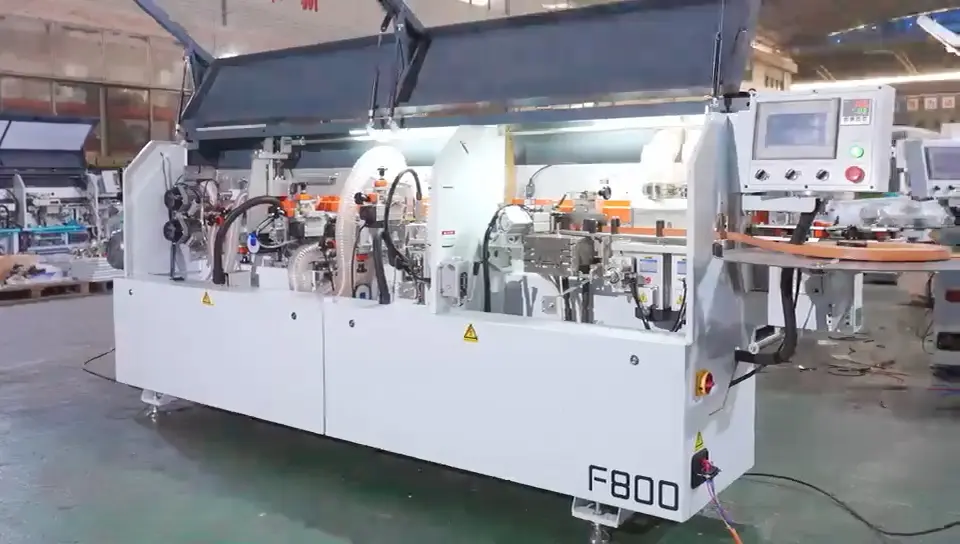
Factories comparing edgebanders are often trying to improve edge quality and daily throughput at the same time. Straight-line automatic processing fits that goal because the machine logic matches the part geometry. Feed direction stays predictable, pressure can remain more consistent across the edge, and finishing steps are easier to standardize.
This is also where options such as pre-milling or corner rounding typically become meaningful as workflow upgrades. They are not just feature boxes. They help clean up the starting edge, improve finish consistency, and reduce touch-up on finished rectangular panels.
Why Shaped Panels Change The Process
Once a part edge becomes curved, angled, radiused, or irregular, the edge-banding question changes. The challenge is no longer only how to apply edge material. It becomes a guidance and finishing problem as well.
Shaped panels usually create pressure in areas such as:
- Maintaining Stable Contact Along A Changing Edge Path
- Keeping Trimming Quality Consistent Around Curves Or Transitions
- Handling Smaller, Narrower, Or Less Stable Part Sections
- Preventing Extra Touch-Up Where The Edge Geometry Changes Direction
- Holding Finish Quality Steady In Higher-Mix Production
A straight-line automatic edgebander is usually at its best when the exposed edge stays straight from entry to exit. If the final visible perimeter is shaped, forcing the same straight-line workflow onto that part family often creates more manual correction than expected. The factory may still complete the part, but repeatability and labor efficiency can change quickly.
This is why shaped panels should be treated as a separate process category, not just as an exception inside a straight-panel line.
A Practical Comparison Table
| Production Condition | What Straight-Panel Edgebanding Usually Delivers | What Shaped-Panel Edge Work Usually Adds | Buying Implication |
|---|---|---|---|
| Repeated Cabinet And Wardrobe Panels | Stable throughput, predictable trimming, easier standardization | Little added complexity if most exposed edges stay straight | A standard automatic edgebanding workflow is often the logical priority |
| Mostly Straight Parts With Occasional Radiused Components | Strong efficiency on the bulk of daily output | Secondary handling or special processing for exceptions | Buy for the dominant straight-panel workload, then plan exceptions separately |
| High-Mix Custom Parts With Irregular Perimeters | Limited benefit if straight-line flow is not the real bottleneck | More guidance, more finishing variation, and more operator dependence | Evaluate the whole shaped-part process, not only the edgebander |
| Premium Visible Curves Or Decorative Shapes | Good only where edges remain truly linear | Finish expectations usually become harder to hold consistently | Quality standards may matter more than straight-line throughput numbers |
When It Makes Sense To Band Before Final Shaping
Some factories reduce edge-processing complexity by keeping the edge-banding stage on straight blanks before the final contour is cut or routed. That approach can work when the part design allows it and when the final exposed edge sequence still matches the product requirement after shaping.
The practical advantage is clear: the factory keeps the speed and consistency of straight-line edge banding for as much of the job as possible. That can help reduce manual intervention later and simplify scheduling when shaped parts are only a small share of total output.
But this should not be treated as a universal answer. If the final exposed edge follows the contour itself, or if the part geometry changes which edges remain visible after shaping, the process may still need edge treatment after the part reaches its final form. In those cases, straight-panel efficiency upstream does not eliminate the shaped-edge problem downstream.
When Shaped Panels Need A Different Edge Strategy
If shaped parts are a core product type rather than an occasional exception, buyers should resist comparing machines only on straight-panel throughput. The real decision becomes broader:
- How Much Of Daily Output Uses Final Curved Or Irregular Edges
- How Much Manual Finishing The Factory Can Sustain Without Bottlenecks
- How Visible The Finished Edge Will Be In The End Product
- How Repeatable The Shaped-Edge Process Must Be Across Batches
- Whether The Factory Needs A Dedicated Solution For Contoured Parts Rather Than A Faster Straight-Line Machine
In other words, a factory dominated by shaped panels is not just buying edge application capacity. It is buying control over a more complex finishing path. That usually deserves a separate evaluation from the one used for cabinet sides, shelves, and other linear components.
Look Upstream Before You Decide
The edgebanding decision is often linked to how parts are created in the first place. If most output begins as repeated rectangular cut parts, the edge-banding line usually deserves direct attention. If production is driven by nested layouts, routed outlines, and more complex geometry, the edge question is tied closely to upstream shaping.
That is why factories running more geometry-driven workflows often need to review the relationship between edge processing and CNC nesting machines, not just the edge-banding station on its own. If the part shape is defined by routed contours, the best improvement may come from aligning cutting, shaping, and finishing decisions instead of expecting one straight-line edgebander to solve everything.
This is also where buyers should be honest about the dominant production pattern. If straight panels make up most of the workload, buy for that reality. If shaped parts are central to the business model, process fit matters more than the headline speed of a standard linear machine.
Questions Buyers Should Ask First
Before choosing an edgebanding solution, it helps to pressure-test the workflow with a few direct questions:
- What Percentage Of Daily Output Is Truly Straight Rectangular Panel Work?
- Are Shaped Parts Occasional Exceptions Or A Core Revenue Category?
- Does The Final Visible Edge Need To Follow A Curve Or Irregular Outline?
- Can The Factory Safely Band Straight Blanks Before Final Shaping On Some Part Families?
- Is The Current Bottleneck Throughput On Straight Panels Or Rework On Shaped Parts?
- How Much Manual Correction Is Acceptable After Edge Application?
- Is The Required Finish Standard Commercial, Architectural, Or Premium Furniture Grade?
These questions usually reveal whether the factory needs faster straight-line automation, a better exception-handling strategy, or a different process plan for shaped components.
Practical Summary
Straight panels and shaped panels should not be treated as the same edgebanding problem. Straight-panel production usually benefits most from automatic, repeatable, straight-line edge processing because the geometry supports stable feed, trimming, and finishing. Shaped panels often require a more careful process decision because the edge itself changes how the part must be guided, finished, and controlled.
For factories built around repeated cabinet and furniture panels, a standard automatic edgebanding workflow is often the most efficient place to invest. For factories where curved or irregular parts define the product, the better decision is usually to evaluate edge processing as part of a larger shaped-part workflow rather than forcing every job through a straight-panel logic. The safest choice is the one that matches the real geometry mix on the factory floor.