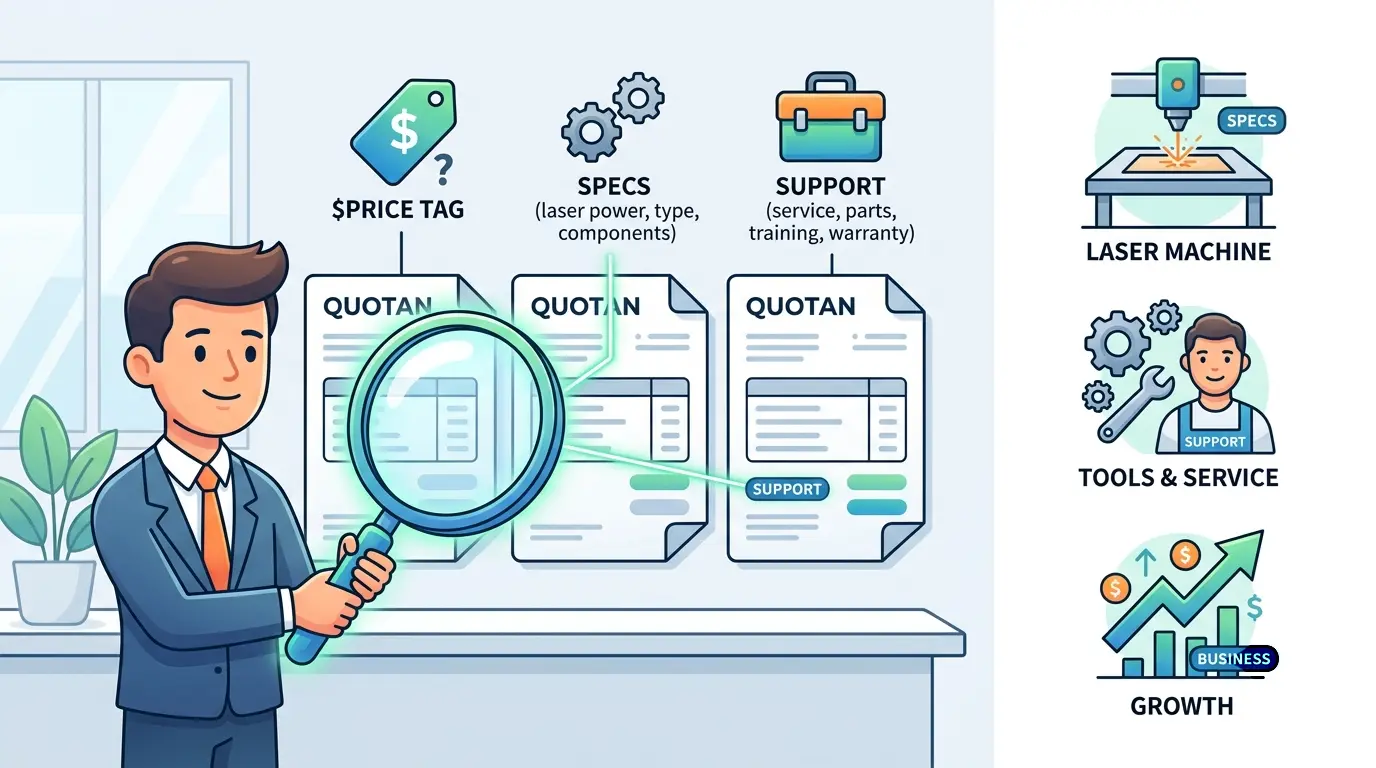
The biggest mistake in laser equipment buying is comparing headline prices before confirming that each supplier is quoting the same production job. One quote may include the machine, cooling, exhaust, software, training, and commissioning. Another may show only the base platform and leave the operational pieces outside the number. On paper, the cheaper option looks attractive. In production, it can become the more expensive decision.
That is why quote comparison should start with workflow fit, not sticker price. Before you negotiate, normalize the scope, define the actual jobs you need to run, and identify which costs affect uptime, cut quality, operator dependence, and rework.
Start By Confirming That The Quotes Cover The Same Job
Two laser machine quotes are not comparable if the suppliers are solving different production problems.
Before reviewing pricing, confirm that each supplier understands:
- The Primary Materials You Need To Process
- The Typical Part Sizes And Batch Sizes
- Whether The Work Is Mainly Cutting, Engraving, Or A Mix Of Both
- The Edge Quality Or Surface Finish You Expect
- Your Daily Or Shift-Level Throughput Target
- Whether The Machine Must Fit Into An Existing Workflow Or Run As A Standalone Cell
A quote for decorative engraving work, short-run acrylic cutting, and repeat batch production will not be structured the same way. The same applies when one supplier is quoting a more manual setup and another is pricing a more production-ready configuration.
For buyers evaluating laser cutters and engravers for wood, acrylic, and similar non-metallic applications, this first step prevents the most common comparison error: assuming all quoted machines are interchangeable because they share the word “laser.”
Build A Quote Comparison Sheet Before Discussing Price
Once the job scope is clear, place every quote into the same evaluation framework.
| Comparison Area | What To Check | Why It Matters |
|---|---|---|
| Application Fit | Material type, part complexity, cut versus engraving balance, expected finish | Prevents buying a machine that looks competitive on price but is mismatched to the job |
| Core Machine Scope | Working area, motion configuration, cutting or engraving setup, control platform | Ensures you are comparing like-for-like machine capability |
| Included Equipment | Cooling, exhaust, air assist, worktable, software, safety items, accessories | Reveals whether the low quote is truly complete |
| Throughput Assumptions | Setup time, nesting or file prep, operator intervention, unloading rhythm | Separates lab-style speed claims from real shift output |
| Support Package | Installation, commissioning, operator training, remote support, spare parts | Reduces startup delays and future downtime risk |
| Operating Cost | Consumables, maintenance routines, replacement intervals, service visits | Affects actual cost per acceptable part |
| Commercial Terms | Lead time, payment schedule, warranty scope, acceptance conditions | Protects the buyer after the purchase order is signed |
This table is where many buying teams discover that the cheapest quote is only cheaper because several important items are missing or vaguely described.
Check What Is Actually Included In The Machine Scope
Laser machine quotes often differ most in the equipment surrounding the machine, not the machine body itself.
Items that are commonly handled differently between suppliers include:
- Cooling Or Chiller Equipment
- Exhaust, Smoke Extraction, Or Filtration
- Air Supply Or Air-Assist Components
- Workholding Or Table Configuration
- Rotary Or Specialized Attachments
- Autofocus Or Positioning Aids
- Safety Enclosure Or Operator Protection Features
- Software License, Upgrade Terms, Or File-Processing Tools
- Initial Spare Parts And Consumables
- Packaging, Installation, And On-Site Setup
If one supplier includes these items and another excludes them, the quotes should not be compared at face value. Add the missing items back into the cheaper quote before judging cost.
This is also where vague wording becomes dangerous. Phrases such as “standard accessories included” or “software provided” are not detailed enough for a final buying decision. Ask for a line-by-line scope list.
Separate Speed Claims From Usable Throughput
Laser quotes often highlight motion speed or cutting speed, but production output depends on more than a single technical claim.
Real throughput is influenced by:
- File Preparation And Job Setup Time
- Material Loading And Unloading Rhythm
- Changeover Between Different Jobs
- Edge Quality And How Much Rework Is Needed
- Operator Skill Required To Maintain Stable Output
- Machine Stops For Cleaning, Alignment, Or Consumable Changes
A machine that looks faster in a brochure may deliver lower usable output if the process requires more operator intervention or produces more rejected parts.
The better question is not, “Which quote shows the highest speed?” It is, “Which configuration gives the most acceptable parts per shift with the least disruption?”
Ask each supplier to explain throughput using a sample job that resembles your own production. If possible, request the estimate in parts per shift, not just technical speed language.
Compare Control, Maintenance, And Operator Dependence
Two quotes can look similar until the machine starts running every day.
Operational differences often appear in:
- Ease Of Job Setup For Operators
- Control Interface Clarity
- Calibration And Alignment Routine Complexity
- Lens, Mirror, Or Optical Maintenance Access
- Cleaning Frequency And Downtime Exposure
- Documentation Quality
- Remote Diagnosis And Technical Response Process
These factors matter because a machine that is harder to maintain or harder to run consistently can raise labor cost and increase production variability. In smaller shops, this may create dependence on one experienced operator. In larger factories, it may slow training and reduce scheduling flexibility.
When reviewing quotes, ask not only what the machine can do, but how reliably an average trained operator can keep it doing that work over a full week of production.
Do Not Ignore Installation, Training, And Acceptance Terms
Many buying teams focus heavily on machine price and miss the commercial terms that determine whether startup goes smoothly.
Review these points carefully:
- Delivery Scope And Packaging Responsibility
- Installation And Commissioning Responsibility
- Operator And Maintenance Training Coverage
- Warranty Length And What It Excludes
- Remote Support Availability
- Spare Parts Response Expectations
- Site-Readiness Responsibilities Such As Power, Air, Ventilation, Or Extraction
- Acceptance Criteria For Final Sign-Off
Acceptance terms are especially important. If the quote does not define how the machine will be accepted, disagreements can appear after delivery. A stronger quote usually makes it clear what tests, sample outputs, or operating conditions determine successful handover.
Watch For Quote Structures That Hide Real Cost
Some quote formats make the entry number look low while shifting risk to the buyer.
| Red Flag In The Quote | What It Usually Means | Why It Should Concern You |
|---|---|---|
| Key accessories listed as optional without guidance | The base price is being kept artificially low | Your true project cost will rise after clarification |
| Support language is general rather than specific | Service obligations may be weak after delivery | Downtime risk becomes your problem |
| Warranty is mentioned but exclusions are unclear | Coverage may not extend to the parts that fail most often | Future repair cost is difficult to predict |
| Performance language is broad but tied to no sample job | The machine may not be validated against your actual workload | You may be buying theoretical capability rather than usable production output |
| Site requirements are not fully described | Commissioning issues can appear late | Installation delays and surprise infrastructure cost become more likely |
Low pricing is not automatically a red flag. Incomplete pricing is.
When A Higher Quote Is The Safer Buy
There are many cases where the higher quote is economically stronger.
That usually happens when the higher-priced offer gives you:
- A More Complete Delivered Scope
- Better Stability In Daily Operation
- Lower Operator Dependence
- Cleaner Output With Less Rework
- Stronger Startup Support
- Clearer Acceptance Standards
- Faster Recovery When Problems Occur
If those factors reduce disruption, scrap, manual intervention, or downtime, the higher quote may produce a lower real cost per part over time.
This is why buyers should translate each quote into operating outcomes. Ask which quote gives the most predictable production result, not simply the lowest purchase number.
Use A Practical Five-Step Decision Process
If you want a disciplined way to compare offers, use this sequence:
- Define The Production Job Clearly
- Normalize Each Quote Into The Same Scope Checklist
- Score Each Supplier On Output Quality, Throughput, Support, And Risk
- Convert Missing Items And Likely Downtime Factors Into Real Cost
- Negotiate After The Technical Scope Is Clear, Not Before
This process protects you from negotiating the wrong number. Price discussions are useful only after the quoted scope is aligned.
Practical Summary
Laser machine quotes should be compared as production systems, not as standalone price tags. The critical details are usually hidden in scope differences, support terms, throughput assumptions, and the amount of operator effort required to keep output stable.
If you normalize the job, break down the included scope, test the throughput logic, and review support and acceptance terms with the same discipline you apply to price, you will make a much safer buying decision. The best quote is the one that delivers the most reliable production result with the fewest surprises after installation.