In panel processing, many cutting mistakes and near-miss incidents begin before the first sheet enters the saw. A dirty reference surface, unstable material support, a worn blade, or unclear operator responsibilities can lead to chipped panels, dimensional variation, emergency stops, or more serious safety events.
For cabinet, furniture, and other panel-based manufacturers, panel saw machine safety and setup should be treated as one routine rather than two separate topics. The same discipline that protects operators also protects throughput, repeatability, and downstream quality.
Why Safety and Setup Must Be One Routine
On a production floor, unsafe cutting behavior and unstable cutting results usually come from the same root causes: poor preparation, rushed changeovers, and inconsistent machine setup.
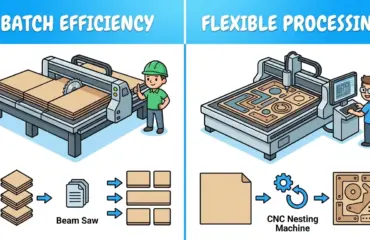
For shops using dedicated panel saws at the front of a line, that matters because the cutting cell affects everything that follows. If panels leave the saw with size variation, chipped surfaces, or unclear part identification, edge processing, drilling, assembly, and packing all become harder to control. If operators need to intervene too often during loading or scrap removal, the safety risk rises at the same time.
That is why strong setup practice is not only a maintenance concern or a quality concern. It is a production-control requirement.
Prepare the Work Area Before Power-On
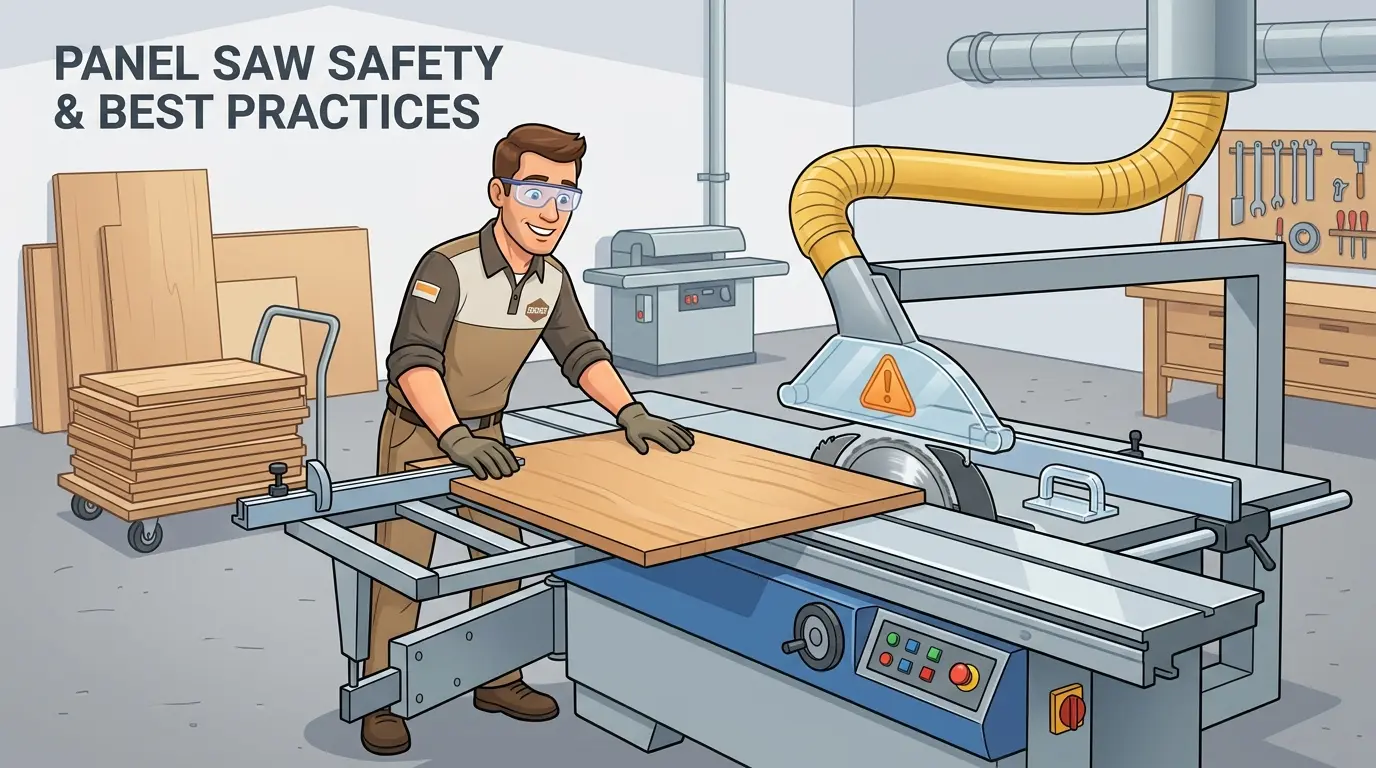
The safest cut normally starts with the area around the machine, not the blade itself. Before the first cycle of the shift, the team should confirm that the saw zone is organized for predictable movement.
Practical pre-start checks usually include:
- Clear Infeed And Outfeed Paths
- Stable Staging For Full Sheets And Cut Parts
- Offcut Collection Positioned Away From The Cutting Path
- Functional Lighting Around Loading, Control, and Unloading Points
- Dust Extraction Ready For Normal Operation
- Emergency Stops And Safety Devices Accessible And Unobstructed
This step reduces two common problems at once. It lowers the chance of an operator entering an unsafe position to manage material, and it reduces rushed handling that can damage panel edges or confuse part flow.
Check Machine Condition Before The First Cut
A panel saw can only run safely when the machine condition matches the job. Daily setup should include a disciplined inspection of the components that affect both cut quality and operator protection.
Key checks typically include:
- Blade Condition, Cleanliness, and Secure Installation
- Correct Guarding And Protective Covers In Place
- Smooth Travel Of Moving Elements Without Abnormal Noise Or Resistance
- Reliable Clamping Or Pressure-Hold Function
- Clean Reference Surfaces, Tables, and Support Areas
- Accurate Positioning Of Stops, Guides, and Measurement References
If the machine uses a scoring unit, that setup should also be confirmed before production begins. Poor alignment may not look like a safety issue at first, but it often increases manual intervention, re-cuts, and operator attempts to correct the process while the machine is still in use.
Match the Saw Setup to the Material and Job
Many panel saw problems happen because the machine is ready to cut, but not ready to cut that specific job. Material type, panel thickness, surface finish, sheet condition, and cut sequence all affect how stable the cycle will be.
Before loading material, production teams should confirm:
- The Correct Material Has Been Identified
- The Cutting List Or Program Matches The Job Release
- Face Orientation, Grain Direction, and Finished Surfaces Are Understood
- Blade Selection Is Suitable For The Material Being Processed
- Clamp Pressure Or Holding Settings Are Appropriate For The Sheet Condition
- Saw Projection, Cutting Depth, and Related Parameters Are Set Conservatively And Correctly
This is especially important in shops that switch between melamine-faced board, MDF, plywood, particleboard, and similar sheet materials during the same shift. A setup that is acceptable for one panel type may create edge damage, instability, or unnecessary operator handling on another.
Load, Support, and Clamp Panels Correctly
Large sheets create risk long before the blade engages. Poor loading technique can twist the panel, shift reference points, strain operators, and introduce cut error into the whole batch.
Good practice usually means:
- Using Appropriate Handling Aids Or Team Lifts For Large Or Heavy Panels
- Keeping Hands Clear Of Pinch Points During Positioning And Clamping
- Supporting The Sheet Fully So It Does Not Sag Or Rotate Unexpectedly
- Confirming The Panel Is Seated Properly Against The Intended Reference
- Avoiding Forced Positioning Of Warped Or Damaged Sheets Into A Cycle That Will Not Hold Them Reliably
If operators regularly need to push, lift, or correct a panel after it is already in position, the problem is often upstream. The sheet may be staged poorly, the support condition may be wrong, or the job setup may be asking the machine to process unstable material without enough control.
Control Operator Actions During Cutting
Once the cutting cycle starts, safety depends heavily on role clarity. A panel saw should not become a machine that multiple people adjust informally while it is running.
Best practice is to keep operating discipline simple:
- One Responsible Operator Controls The Cycle
- Helpers Support Material Handling Only Within Defined Safe Zones
- No One Reaches Into The Cutting Area To Correct A Part Mid-Cycle
- Scrap And Offcuts Are Removed Only When The Machine Has Fully Stopped And The Procedure Allows It
- Interlocks, Guards, and Safety Functions Are Never Bypassed For Speed
- Communication Between Loader, Operator, and Unloader Is Clear During Every Batch
This type of discipline matters in busy factories because most unsafe behavior is not intentional. It usually appears when the line is trying to recover time, rescue a bad setup, or keep output moving despite a preventable problem.
Use First-Cut Approval To Protect The Whole Batch
One of the most effective setup habits is also one of the simplest: do not trust a new setup until the first verified cut proves it.
After a changeover, blade replacement, parameter adjustment, or new material introduction, the first cut should be treated as an approval step rather than the beginning of full-speed production. The team should confirm:
- Final Dimensions
- Squareness And Reference Accuracy
- Surface And Edge Quality
- Panel Stability During The Cycle
- Correct Labeling, Sorting, or Part Identification Method
This prevents a small setup error from becoming a batch-level problem. In practical terms, a five-minute verification step can save hours of downstream rework.
Build A Shift-Based Checklist Instead Of Relying On Memory
The most reliable shops do not depend on experienced operators remembering every setup detail under production pressure. They standardize checks by shift stage.
| Shift Stage | Primary Check Focus | Problem It Helps Prevent |
|---|---|---|
| Pre-Start | Work area condition, emergency access, machine cleanliness, guard status | Unsafe movement around the saw and rushed start-up |
| First Job Setup | Material match, program or cutting list, blade condition, references | Wrong-job cutting and first-batch dimensional error |
| First-Cut Approval | Size, squareness, edge quality, panel stability | Batch rework caused by a bad initial setup |
| During Production | Clamp consistency, unusual noise, part flow, offcut handling | Gradual drift, operator intervention, and unstable running |
| Changeover | New material review, new orientation, parameter confirmation | Carryover mistakes from the previous job |
| Maintenance Or Adjustment | Isolation procedure, safe access, controlled restart | Injury risk during blade changes, cleaning, or internal adjustment |
This kind of checklist turns safety from a reminder into a system. It also makes operator training easier because expectations are tied to repeatable stages of work rather than individual memory.
Treat Maintenance and Adjustment Work as Isolated Tasks
Operating checks and maintenance work should never blur together. If the job requires blade changes, internal cleaning, alignment work, jam removal, or access near moving elements, the machine should be isolated according to the shop’s approved safety procedure.
In practice, that means maintenance and internal adjustments should be handled by trained personnel under proper lockout, power isolation, and restart control. Trying to save a few minutes during a production delay often creates the highest-risk situations in the day.
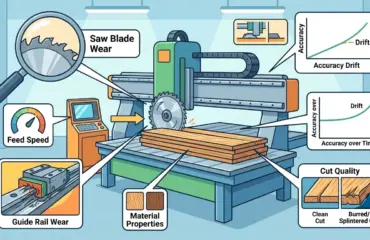
The same rule applies to troubleshooting. If the machine is showing abnormal vibration, unreliable clamping, unusual sound, poor repeatability, or inconsistent panel movement, those symptoms should be treated as setup or maintenance faults to resolve safely, not as conditions to work around informally.
Watch for Warning Signs That the Setup Is No Longer Stable
Even a well-prepared shift can drift out of control if the team ignores early signs of instability. Production managers and operators should treat the following symptoms as signals to stop and re-check the process:
- Repeated Small Size Deviations
- Chipped Or Broken Decorative Surfaces
- Panels Creeping Or Shifting During The Cycle
- More Frequent Manual Correction By Operators
- Unusual Blade Noise Or Burn Marks
- Offcuts Falling In An Uncontrolled Way
- Increased Sorting Confusion After Cutting
These are not only quality warnings. They often indicate that the current operating condition is asking people to compensate manually for a process that is no longer safe or repeatable.
Practical Summary
Good panel saw safety is not built on warnings alone. It comes from stable preparation, correct material handling, disciplined first-cut approval, and clear separation between production operation and maintenance work.
For most factories, the best practices are straightforward: control the work area, verify machine condition, match the setup to the material, keep operator roles clear, and stop early when the process begins to drift. When those habits are built into daily routines, the result is not only a safer saw cell, but also cleaner cuts, fewer re-cuts, and more dependable panel flow through the rest of production.