Buying a CO2 laser machine looks simple until the machine has to do more than produce a clean demo sample. In real production, acrylic display parts, engraved wood panels, plywood components, and other non-metallic jobs place different demands on the same system. The buying decision then becomes less about whether the beam can cut the material and more about whether the workflow can stay stable across shifts, materials, and repeat orders.
For buyers evaluating laser cutters and engravers for wood, acrylic, and similar non-metal processing, the most useful question is not “Can this machine run non-metal materials?” The more useful question is “Which machine configuration will keep quality, throughput, and operator repeatability under control in our actual production mix?”
Why Non-Metal Processing Changes the Buying Decision
Non-metal processing sounds broad, but the materials inside that category do not behave the same way under a CO2 beam. Acrylic often rewards cleaner edges and more consistent visual finish. Wood-based materials can introduce resin, glue, grain variation, or darker edge appearance. Softer non-metal materials may place more pressure on process control, hold-down, and extraction stability than on raw cutting force.
That is why CO2 laser buying should start with the real production goal rather than with a generic machine label. A buyer making decorative acrylic parts, wood signage, product displays, packaging components, or custom non-metal shapes is usually balancing four things at once:
- Edge Quality
- Throughput
- Material Flexibility
- Setup Repeatability
If one of those priorities is treated as secondary during machine selection, it usually shows up later as scrap, slower changeovers, extra cleanup, or more operator intervention than expected.
Start With the Real Material Mix, Not the Best Demo Sample
A supplier demo can be useful, but it rarely reflects a full production queue. Most disappointing machine purchases happen because the buying team evaluates a CO2 laser on one ideal sample while daily production includes several materials, several thicknesses, and very different finish expectations.
| Material Or Job Type | What Buyers Usually Need | What Commonly Creates Trouble |
|---|---|---|
| Acrylic Parts | Cleaner edges, stable contour accuracy, visually acceptable finish | Heat buildup, edge inconsistency, cosmetic rejects |
| Decorative Wood Panels | Fine detail, controlled burning, repeatable engraving or cutting | Darker edges, face-quality variation, smoke effects |
| Plywood Or Engineered Board Components | Reliable cut-through, stable throughput, manageable cleanup | Glue-line variation, residue, heavier smoke load |
| Mixed Small-Batch Non-Metal Jobs | Fast setup changes and repeatable job recipes | Time lost between jobs rather than during the cut |
| Engraving-Heavy Work | Fine motion control and visual consistency | Inconsistent depth, uneven appearance, operator-dependent output |
The best CO2 machine for non-metal processing is therefore not always the one that looks strongest on a single thick sample. It is usually the one that performs predictably across the jobs that actually consume machine hours every week.
The Machine Factors That Actually Affect Good Output
Industrial buyers often spend too much time on headline claims and not enough time on the features that protect good output over an entire shift. For non-metal production, the following factors usually matter more than a one-time speed impression.
| Buying Factor | Why It Matters in Production | Most Important When |
|---|---|---|
| Power Matched to Routine Work | Affects how easily the machine handles the materials and thicknesses that show up every day | The queue includes thicker acrylic, wood parts, or a need for faster cycle times |
| Motion Stability | Helps preserve detail, contour accuracy, and repeatable geometry | Small parts, intricate shapes, and engraving quality matter |
| Work Area and Sheet Handling | Reduces wasted time before and after cutting | The shop runs larger sheets or nests multiple parts per run |
| Focus Stability | Supports cleaner cutting and more consistent engraving across repeated jobs | Jobs vary in thickness or appearance standards are strict |
| Air Assist and Extraction | Helps control residue, smoke, and cut-zone contamination | Acrylic appearance and wood edge quality both matter |
| Cooling and Runtime Stability | Supports longer, steadier production rather than short demonstration use | The machine runs for repeated shifts or longer batches |
| Job Setup and Recipe Management | Improves repeatability between operators and material changes | The shop switches jobs frequently |
| Maintenance Access | Makes it easier to keep optics and surrounding components in production condition | The machine is expected to run daily, not occasionally |
These factors matter because buyers do not ship machine specifications. They ship finished parts. A CO2 machine that is easier to keep stable often produces more saleable output than a machine that only looks impressive in short trials.
Think About Power as a Throughput Decision, Not a Marketing Number
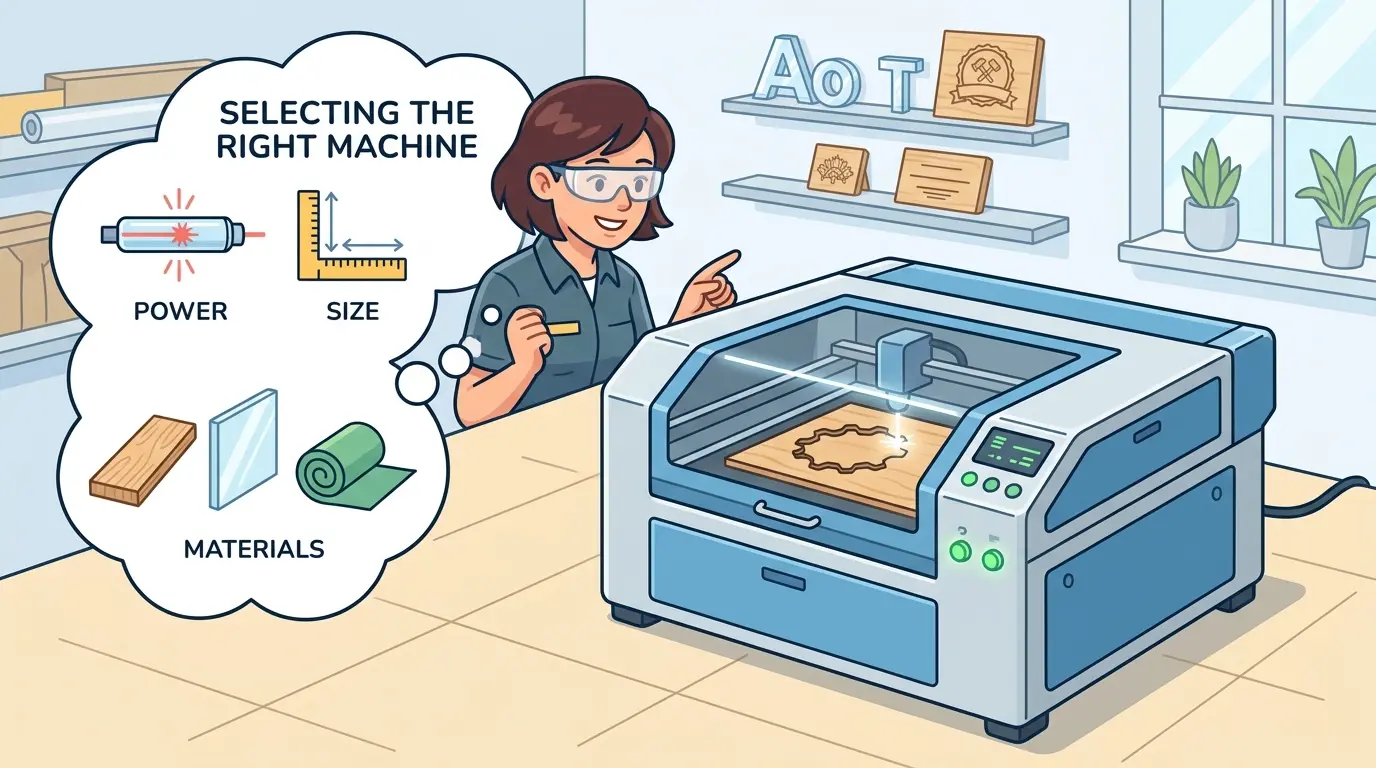
CO2 laser power should be matched to the thickest routine material, the target cycle time, and the expected finish quality. That is different from buying based on an occasional maximum job.
Higher power can help raise throughput on thicker non-metal materials and can widen the workable process window for some cutting applications. But higher power alone does not guarantee cleaner edges, better engraving quality, or easier operation. If motion control, extraction, focus stability, and recipe discipline are weak, more power can simply expose process problems faster.
In practice, buyers should think about power in this order:
- The Materials That Consume the Most Machine Hours
- The Thickness Range Used Repeatedly, Not Rarely
- Whether the Priority Is Cutting Speed, Edge Appearance, Engraving Quality, Or a Balance of All Three
- How Much Changeover the Machine Must Handle Between Different Jobs
This approach reduces two common mistakes: underbuying for everyday production demands and overbuying for rare jobs that do not define the machine’s real return on investment.
Bed Size, Material Handling, and Changeovers Deserve More Attention Than Many Buyers Give Them
If a shop routinely works from full sheets or nests many smaller parts together, bed size becomes a productivity issue, not just a dimensional specification. A machine that forces extra pre-cutting, awkward material staging, or frequent repositioning adds labor even when the beam itself performs well.
The same logic applies to part removal and job changes. In non-metal production, many hours are lost between jobs rather than during cutting. Shops that frequently switch between acrylic display parts, engraved wood panels, and functional wood-based components should pay close attention to how quickly operators can return the machine to a stable condition.
Signs that changeover discipline will matter a lot include:
- Frequent Material Switching
- Different Appearance Standards Between Jobs
- Multiple Operators Sharing the Same Machine
- Short-Run Or Custom Orders Mixed With Repeated Production Parts
When these conditions apply, repeatable setup workflow is often as valuable as raw beam capability.
When CO2 Laser Is the Right Fit and When Another Process May Fit Better
CO2 laser is commonly well suited to non-metal work that benefits from clean contours, fine detail, non-contact processing, and flexible cut-and-engrave workflows. But it is not the best answer to every sheet-processing problem.
| Production Need | CO2 Laser Fit | Better Alternative When Applicable |
|---|---|---|
| Acrylic Display Parts and Signage | Strong Fit | Not usually necessary unless another process already fits the full workflow better |
| Decorative Wood Panels and Detailed Shapes | Strong Fit | Application dependent |
| Engraving Plus Contour Cutting in One Workflow | Strong Fit | Often less efficient with purely mechanical processing |
| Mixed Small-Batch Non-Metal Production | Strong Fit | Application dependent |
| Heavy Panel Breakdown for Furniture Lines | Application Dependent | Mechanical panel processing may fit better |
| Full-Sheet Parts That Also Need Routing and Drilling | Limited | CNC nesting machines often fit better |
| Primarily Metal Production | Weak Fit | A different machine technology should be evaluated |
This matters because some buyers try to stretch CO2 laser into jobs that are really driven by furniture-line throughput, downstream machining, or structural panel processing. In those cases, the better investment may be a different process altogether. CO2 laser earns its place when the workflow benefits from detail, flexibility, and non-contact non-metal processing.
Questions To Resolve Before You Compare Quotes
Before comparing suppliers or final configurations, buyers should clarify the production realities that will actually decide success:
- Which Material Family Will Use the Most Machine Time?
- Are Customers More Sensitive to Edge Appearance Or Delivery Speed?
- Will the Machine Spend More Time Cutting, Engraving, Or Switching Between Both?
- How Often Will Operators Change Material Type, Thickness, Or Part Family?
- Does the Shop Need Full-Sheet Handling Or Mostly Smaller Parts?
- How Much Daily Cleaning and Maintenance Can the Team Sustain Without Disrupting Output?
- Will One Machine Support a Dedicated Workflow Or a Shared Mixed-Job Queue?
These questions usually reveal more than a specification sheet does. They expose whether the machine should be optimized for visual quality, throughput, mixed-job flexibility, or a narrower production niche.
Common Buying Mistakes
Several mistakes show up repeatedly in CO2 laser purchases for non-metal processing:
- Buying for the Best-Case Demo Instead of the Weekly Production Mix
- Choosing Power Based on Rare Maximum Jobs Instead of Routine Work
- Underestimating the Impact of Smoke Extraction and Cleanup on Throughput
- Treating Acrylic, Wood, and Engineered Board as If They Have the Same Quality Priorities
- Ignoring Changeover Stability in Mixed-Job Production
- Expecting CO2 Laser To Replace Every Mechanical Cutting Or Panel-Processing Task in the Plant
Most of these errors do not come from misunderstanding what a CO2 laser can do. They come from misunderstanding where CO2 laser fits best in a real production workflow.
Practical Summary
A good CO2 laser machine for non-metal processing is not simply the machine with the most impressive sample or the most aggressive headline claim. It is the machine that matches the real material mix, supports repeatable daily output, and stays manageable when production conditions are no longer ideal.
If your work depends on acrylic parts, wood engraving, shaped non-metal components, or mixed small-batch production where detail and flexibility matter, CO2 laser can be a practical fit. If your output is driven mainly by heavy panel breakdown, routing, drilling, or primarily metal work, another process may align better with the workflow. The strongest buying decision comes from matching the machine to recurring production reality rather than to the most attractive isolated demonstration.