When a shop compares fiber laser technology with CO2 laser technology, the first mistake is usually treating the beam source as the decision. In production, the real issue is whether the machine matches the material mix that fills the schedule and generates margin. A source that looks advanced on paper can still produce weak ROI if it is cutting the wrong jobs, forcing slow setups, or pushing too much secondary work downstream.
For most metal-first operations, fiber laser technology is commonly the stronger economic fit. For wood, acrylic, engraving, and other non-metal workflows, CO2 often remains the more practical choice. The payback question is not which technology is newer. It is which technology fits what the factory cuts all day.
Start With The Material Mix, Not The Spec Sheet
Before comparing quotations, buyers should map their workload into job families:
- Metal Sheet Parts That Need Fast Turnaround
- Reflective Metal Jobs That Need Stable Processing
- Wood And Acrylic Parts That Value Clean Detail
- Decorative Or Branded Components That Need Engraving
- Mixed Orders That Switch Materials Frequently
- Repetitive Production Runs Versus Short, High-Mix Work
This matters because ROI comes from utilization. If the machine spends most of its time on materials it handles efficiently, payback becomes easier to justify. If it is repeatedly forced outside its strongest use case, operating cost, downtime, and lost throughput quickly eat into the investment case.
Where Fiber Laser Usually Wins
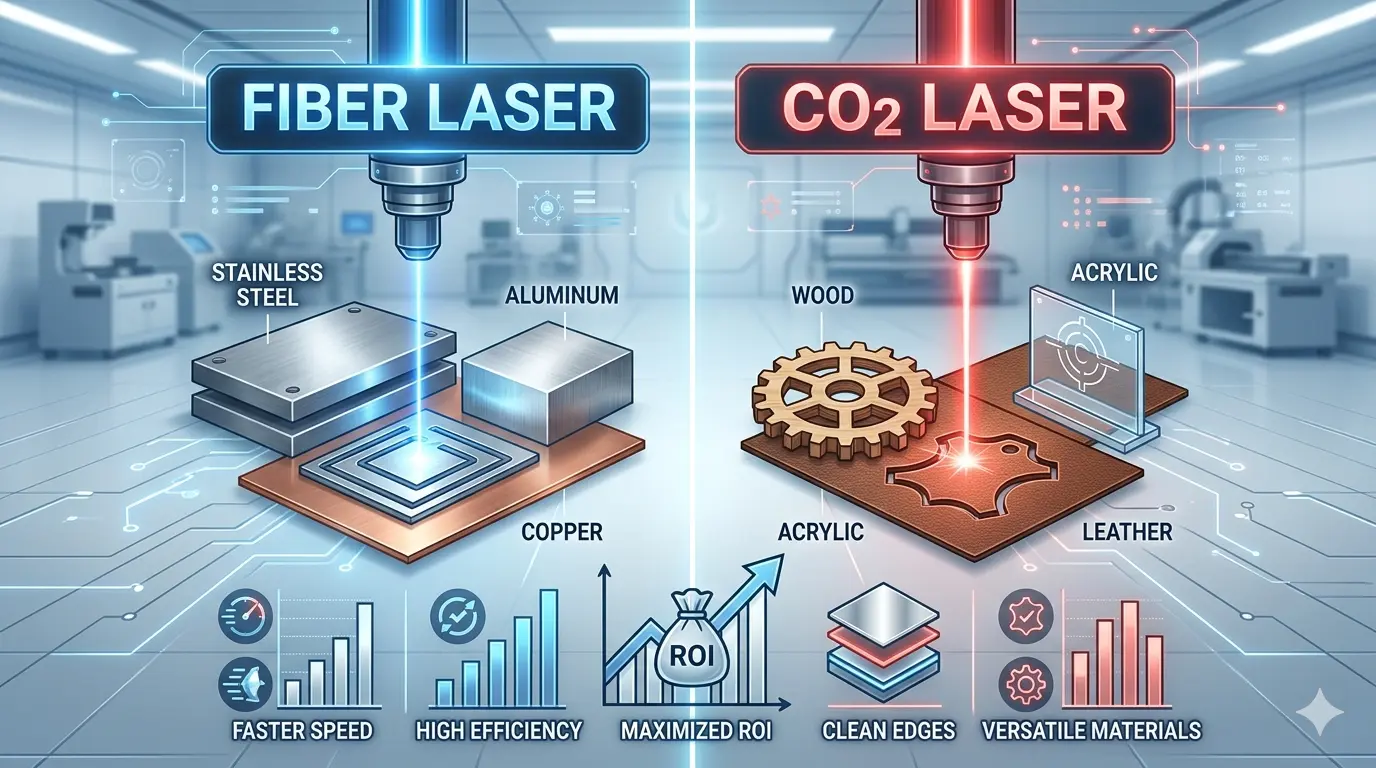
Fiber laser systems are commonly favored when the business is built around sheet metal rather than non-metal processing. That usually includes carbon steel, stainless steel, aluminum, brass, and copper.
In those workflows, fiber laser technology is often selected because it helps deliver:
- Faster Cutting On Routine Metal Jobs
- Stronger Fit For Reflective Metals
- Lower Energy Demand Relative To Older CO2-Based Metal Workflows
- Less Optical Path Maintenance Complexity
- Better Alignment With Automated Loading, Unloading, And Nesting Cells
The practical effect is not just higher cutting speed. Metal-focused shops often see the ROI case improve because faster cycle times, lower operating burden, and more stable metal processing help reduce cost per part. If downstream bending, welding, or assembly depends on predictable part flow, that consistency can matter as much as raw throughput.
Where CO2 Usually Makes More Sense
CO2 laser technology remains highly relevant when the workload is centered on wood, acrylic, and similar non-metallic materials, especially where cutting and engraving need to coexist inside one process.
That is why CO2 systems are still commonly chosen for workflows that prioritize:
- Wood And Acrylic Cutting
- Fine Engraving On Non-Metal Surfaces
- Decorative Panels, Signage, And Display Components
- Mixed Non-Metal Production With Frequent Design Changes
- Detail Quality That Matters More Than Pure Metal Throughput
For buyers focused on wood, acrylic, and related non-metal applications, the current Pandaxis category for laser cutters and engravers reflects that kind of production fit more naturally than a metal-first fiber discussion.
CO2 becomes less attractive when the factory is primarily trying to increase sheet metal output. But for non-metal processing, it can remain the more logical production tool rather than a legacy compromise.
Material Match At A Glance
| Material Or Job Type | Fiber Laser Fit | CO2 Laser Fit | Practical Selection Logic |
|---|---|---|---|
| Carbon Steel Sheet | Commonly Strong | Usually Less Competitive For Metal-First ROI | Fiber is often easier to justify when metal throughput drives revenue |
| Stainless Steel Parts | Commonly Strong | Usually Less Competitive For Daily Metal Production | Fiber is often chosen for cleaner metal-focused workflow economics |
| Aluminum, Brass, And Copper | Commonly Stronger Fit | Historically Less Straightforward | Fiber is often favored when reflective metals matter |
| Wood Panels And Components | Usually Not The Natural First Choice | Commonly Strong | CO2 is often better aligned with non-metal cutting and detailing |
| Acrylic Parts And Signage | Usually Not The Natural First Choice | Commonly Strong | CO2 often fits cleaner non-metal processing and engraving needs |
| Non-Metal Engraving Work | Limited Fit Relative To CO2 Workflows | Commonly Strong | CO2 is often easier to justify when engraving is part of daily output |
| Mixed Metal And Non-Metal Production | Can Be Strong If Metal Dominates | Can Be Strong If Non-Metal Dominates | The dominant revenue material should drive the machine choice |
How ROI Actually Appears On The Shop Floor
Laser ROI is rarely created by purchase price alone. It usually comes from a combination of throughput, operating cost, labor efficiency, and how well the machine supports the most common jobs.
A practical ROI comparison usually comes down to these drivers:
| ROI Driver | Fiber Laser Usually Looks Better When | CO2 Usually Looks Better When |
|---|---|---|
| Revenue Mix | Metal Parts Drive Most Of The Schedule | Non-Metal Parts And Engraving Drive More Of The Schedule |
| Throughput Pressure | The Factory Needs Faster Sheet Metal Output | The Factory Needs Flexible Non-Metal Cutting And Marking |
| Operating Cost Control | Energy Use And Maintenance Burden Need To Drop In Metal Production | Operating Efficiency Matters More In Non-Metal Work Than Maximum Metal Speed |
| Secondary Processing | Faster, Cleaner Metal Flow Reduces Downstream Bottlenecks | Non-Metal Edge Quality And Engraving Value Matter More Than Metal Productivity |
| Equipment Utilization | The Machine Will Spend Most Of Its Hours Cutting Metal | The Machine Will Spend Most Of Its Hours On Wood, Acrylic, Or Similar Materials |
The key is to calculate ROI from actual job mix, not from the most impressive demo sample. A fiber machine can look expensive but still pay back cleanly in a metal shop if it cuts high-frequency jobs faster and with less operating drag. A CO2 machine can look less advanced on paper but deliver better value if the factory mostly processes non-metals and benefits from combined cutting and engraving flexibility.
When One Machine Becomes The Wrong Compromise
Some buyers try to force one platform to cover every opportunity. That is where ROI often deteriorates.
A metal-dominant shop that chooses CO2 mainly for a lower entry price may later absorb the cost through slower output, higher energy demand, or more maintenance attention. A non-metal producer that chooses fiber mainly because it sounds more modern may discover that the core job mix never lets the machine earn its keep.
Mixed-material factories need to be especially honest here. If metal and non-metal volumes are both strategically important, the strongest long-term answer may not be choosing one source over the other. It may be deciding whether two specialized workflows create better capacity planning, more stable quality, and better margin control than one compromised machine.
Questions Buyers Should Answer Before Requesting Quotes
- Which Material Family Accounts For The Largest Share Of Machine Hours?
- Which Jobs Generate Margin Rather Than Just Volume?
- Does The Factory Need Metal Throughput, Non-Metal Versatility, Or Both?
- How Much Of The ROI Case Depends On Lower Energy Use And Simpler Maintenance?
- Is Engraving A Core Revenue Activity Or Only An Occasional Requirement?
- Will The Machine Sit Inside A Larger Automated Cell Or Operate As A Flexible Standalone Process?
- Are You Buying For Today’s Order Mix Or For A Credible Shift In Future Demand?
These questions usually produce a better decision than a spec sheet shootout because they connect the machine to actual production economics.
The Practical Bottom Line
Fiber laser and CO2 laser technology each have a defensible place, but not in the same shop profile. Fiber is commonly the stronger ROI choice when metal cutting dominates the schedule and the business needs speed, efficiency, and stable metal processing. CO2 is commonly the better fit when wood, acrylic, engraving, and related non-metal workflows are what keep the machine busy.
That is why material match should come before headline specs. If the material mix is right, ROI usually follows. If the material mix is wrong, even a technically impressive machine becomes hard to justify.
For teams reviewing laser investment alongside routing, panel processing, or other equipment decisions, the broader Pandaxis product catalog can help place laser technology inside a wider production plan rather than treating it as an isolated purchase.