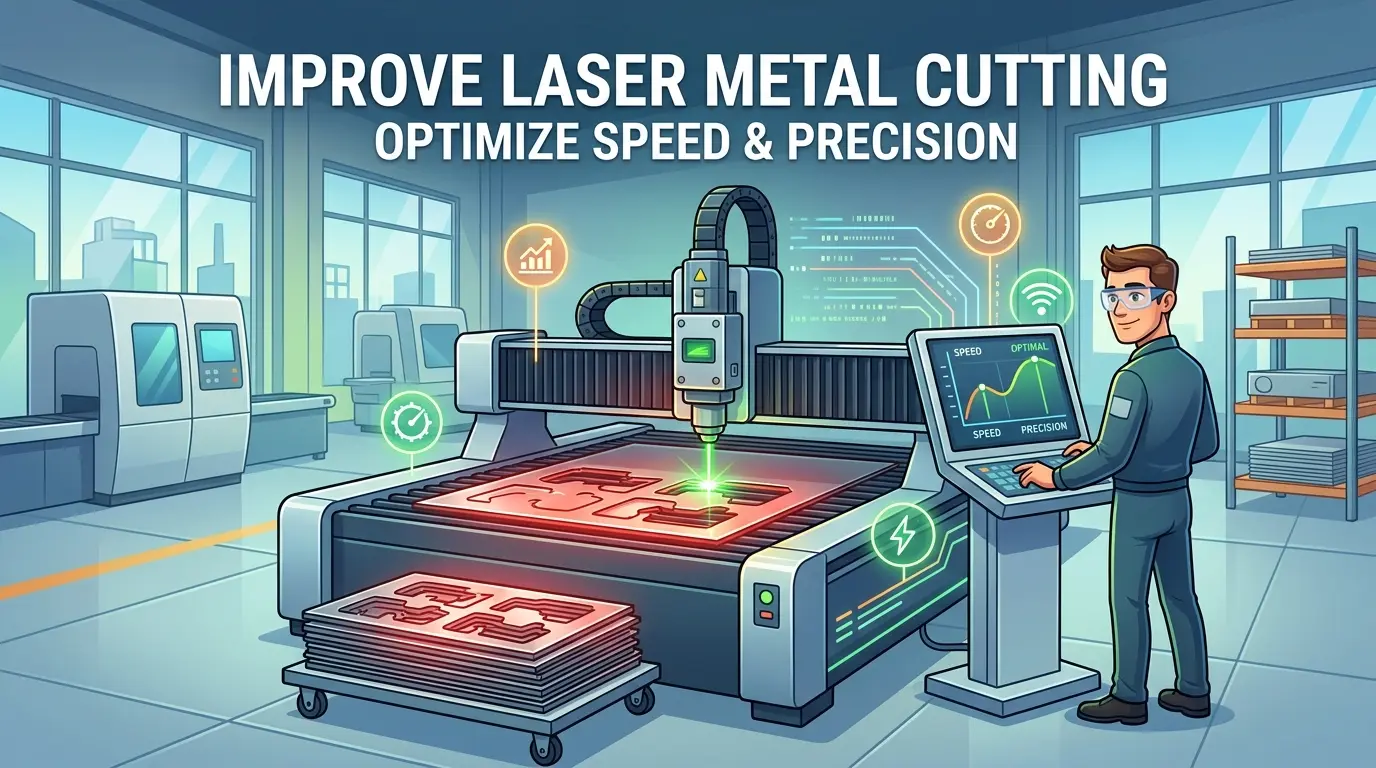
Improving speed and precision on a laser metal cutting machine is usually a process-control problem, not a single-specification problem. Shops get better results when laser source fit, motion tuning, assist gas, nesting strategy, and maintenance are managed as one system, so faster cutting does not create more scrap, rework, or assembly delays downstream.
Fabricators rarely struggle because a machine cannot cut metal at all. The real problem is that higher output targets often expose weak points elsewhere in the process: poor edge quality, unstable small-feature accuracy, more dross, harder fit-up, and more operator intervention after the part leaves the table.
That is why speed and precision should be treated as linked production outcomes, not separate targets. If a faster cut creates more grinding, deburring, sorting, or correction work, the line did not actually become more efficient.
What Is a Laser Metal Cutting Machine
A laser metal cutting machine is a production system that uses a focused laser beam and assist gas to cut metal parts with controlled heat input, repeatable geometry, and consistent edge quality.
In real manufacturing, that definition matters because the machine is not only a cutting device. It is part of a broader flow that includes material handling, nesting, recipe control, part removal, bending, welding, coating, and final assembly. A machine that looks fast in isolation can still slow the factory if its output is inconsistent or difficult to process downstream.
For that reason, improving results is less about chasing the highest headline speed and more about building a stable process window for the metals, thicknesses, part geometries, and tolerance expectations your shop handles every day.
Why Speed and Precision Often Move in Opposite Directions
The faster a shop pushes throughput, the less margin it usually has for unstable focus, poor gas flow, dirty consumables, sheet variation, or aggressive acceleration settings. Precision problems do not always appear as obvious failed cuts. They often show up as small deviations that multiply through the rest of the workflow.
| Production Factor | When Speed Is Pushed Too Hard | When Precision Is Protected Too Cautiously | Balanced Approach |
|---|---|---|---|
| Recipe Selection | Short cycle time but unstable cut quality across materials | Good edges but underused machine capacity | Build material- and thickness-specific recipes |
| Focus and Nozzle Condition | More dross, taper, and inconsistent fine details | Unnecessary slowdowns to compensate for poor setup | Standardize inspection and replacement intervals |
| Assist Gas Strategy | Fast passes with poor edge condition or burrs | Clean cuts with unnecessarily high operating cost or reduced output | Match gas choice to part quality and downstream needs |
| Motion and Acceleration | Lost accuracy on corners, holes, and short features | Good geometry but longer cycle time than necessary | Tune motion to part geometry, not just long straight cuts |
| Nesting and Cut Sequence | Heat buildup, part movement, and sorting inefficiency | Safe but inefficient sheet usage and extra non-cut time | Optimize for both machine motion and part stability |
| Maintenance Discipline | Performance drift hidden until scrap or rework rises | Excessive caution without measurable gain | Track consumables and quality trends against output |
The main lesson is simple: a fast machine becomes a slow production system when instability forces manual correction later. Precision has to be measured where the part is used, not only where it is cut.
The Process Variables That Improve Both Outcomes
The best-performing fabricators usually improve speed and precision by tightening process discipline in a few critical areas.
- Match the Cutting Recipe to the Actual Material Mix
Cutting behavior changes with material type, thickness, surface condition, reflectivity, and part geometry. Shops lose performance when they try to run one broad recipe across too many combinations. A stable recipe library reduces setup hesitation, protects part quality, and shortens trial-and-error time during production.
- Treat Beam Delivery, Focus Position, and Nozzle Condition as Production Variables
Nozzle wear, contamination, and focus drift can quietly reduce both edge quality and effective speed. Operators often respond by slowing the process, even though the real issue is setup consistency. Standardized inspections and change intervals usually create more usable speed than simply raising output targets.
- Tune Motion Control for Real Part Geometry
Long straight cuts and dense nests do not stress the machine in the same way. Acceleration, corner behavior, and short-feature control often matter more than raw top-end speed when a shop produces parts with slots, holes, tabs, and small contours. Better motion tuning protects geometry without forcing the entire job to run slowly.
- Use Assist Gas as a Quality Lever, Not Only a Cutting Cost
Gas stability affects edge finish, dross formation, oxidation behavior, and downstream weld or coating readiness. Shops that treat gas only as an expense often miss the larger cost of extra cleaning or inconsistent part condition. The right gas strategy should support the quality level the next process actually needs.
- Improve Sheet Handling, Flatness Control, and Cut Sequencing
Precision is harder to maintain when the sheet is unstable, poorly supported, or thermally stressed by an inefficient sequence. Nesting should support part quality and machine motion together. Good sequencing reduces repositioning losses, heat concentration, and manual interruptions during unloading and sorting.
Where Fabricators Usually Lose Performance
Many shops assume the bottleneck sits inside the laser source. In practice, speed and precision are often lost in process decisions around the machine.
- Poor Recipe Standardization: Operators rely on memory or habit instead of controlled parameter sets.
- Inconsistent Consumable Control: Nozzle wear, contamination, and neglected checks create gradual quality drift.
- Heat Buildup in Dense Nests: Small parts and tight spacing can reduce edge quality even when the machine appears productive.
- Misleading Throughput Metrics: Managers track cut time but ignore unloading, sorting, deburring, and fit-up correction.
- Overly Broad Machine Expectations: One setup is expected to handle every thickness, tolerance level, and part style equally well.
The most expensive performance loss is usually not a visibly failed part. It is the accumulation of small inefficiencies that increase labor after cutting. If the bending cell, welding station, or assembly team constantly compensates for laser output variation, the cutting department is borrowing time from the rest of the factory.
What Buyers Should Check Before Choosing a Machine
If your goal is to improve both speed and precision, machine selection should start with workflow fit rather than marketing comparisons alone.
- Material Range: A machine should be chosen around the metals and thickness distribution that drive most of your revenue, not only your most demanding sample part.
- Part Geometry Mix: Shops cutting many holes, fine features, and nested parts need strong motion behavior and recipe stability, not only fast straight-line performance.
- Tolerance Expectations: If downstream bending, welding, or assembly is sensitive, cut consistency may matter more than maximum output in a single shift.
- Automation Level: Loading, unloading, sheet change time, and part sorting influence real throughput as much as beam performance does.
- Software and Process Control: Nesting, parameter management, traceability, and operator standardization affect repeatability every day.
- Maintenance Access and Support Model: A machine that is difficult to keep stable will slowly trade away both speed and precision over time.
Buyers should also separate three very different questions:
- How fast can the machine cut under ideal conditions?
- How consistently can it cut the parts we actually run?
- How much downstream labor does its output create or remove?
The right decision usually comes from the third question. A machine that slightly lowers theoretical speed but sharply reduces deburring, rework, and fit-up correction can produce a stronger factory-wide return.
How to Improve Results After Installation
Even a well-chosen machine underperforms without process discipline after commissioning. Shops that improve quickly usually take a structured approach.
- Create Approved Recipes for Core Materials: Build a controlled library for your highest-volume combinations first.
- Track Output Together With Rework: Measure throughput alongside burr rate, fit-up issues, and downstream correction time.
- Standardize Nozzle and Focus Checks: Turn them into routine production control instead of reactive troubleshooting.
- Review Nesting Logic Regularly: Optimize for machine motion, thermal stability, and part removal efficiency.
- Train Operators on Process Cause and Effect: Operators should understand why a change affects both speed and precision, not just which button to press.
This is where many shops unlock their biggest gain. The machine may already be capable of better performance, but the process around it is not yet disciplined enough to support it.
FAQ
What matters more for precision: laser power or motion control?
Both matter, but motion control often determines whether corners, holes, and short features stay consistent. High power without stable motion can still produce poor part accuracy.
Does higher power always improve metal cutting speed?
No. Higher power can improve output in the right application, but poor recipes, unstable consumables, bad nesting, or weak handling can erase the gain.
Can assist gas affect part accuracy?
Yes. Assist gas influences edge condition, dross, oxidation behavior, and cut stability. It directly affects whether a part leaves the machine ready for the next step.
Why do fast cut speeds sometimes increase factory cost?
Fast cutting can raise total cost when it creates more burrs, rework, sorting delays, or assembly correction. True productivity is measured across the whole workflow.
When should a shop prioritize automation over raw cutting speed?
Automation matters most when sheet change time, unloading, and part handling limit output. In many factories, handling efficiency improves usable throughput more than headline cut speed.
Conclusion
Improving speed and precision on a laser metal cutting machine is not about forcing one result at the expense of the other. It is about building a process that matches the machine to the material mix, stabilizes beam and gas behavior, tunes motion for real parts, and measures performance by downstream outcomes instead of cut time alone.
For Pandaxis readers, the larger lesson is to choose equipment by workflow fit rather than by isolated specifications. If your team is evaluating a broader equipment upgrade across adjacent fabrication processes, the Pandaxis product catalog is a practical starting point for reviewing the machinery categories the brand currently emphasizes.