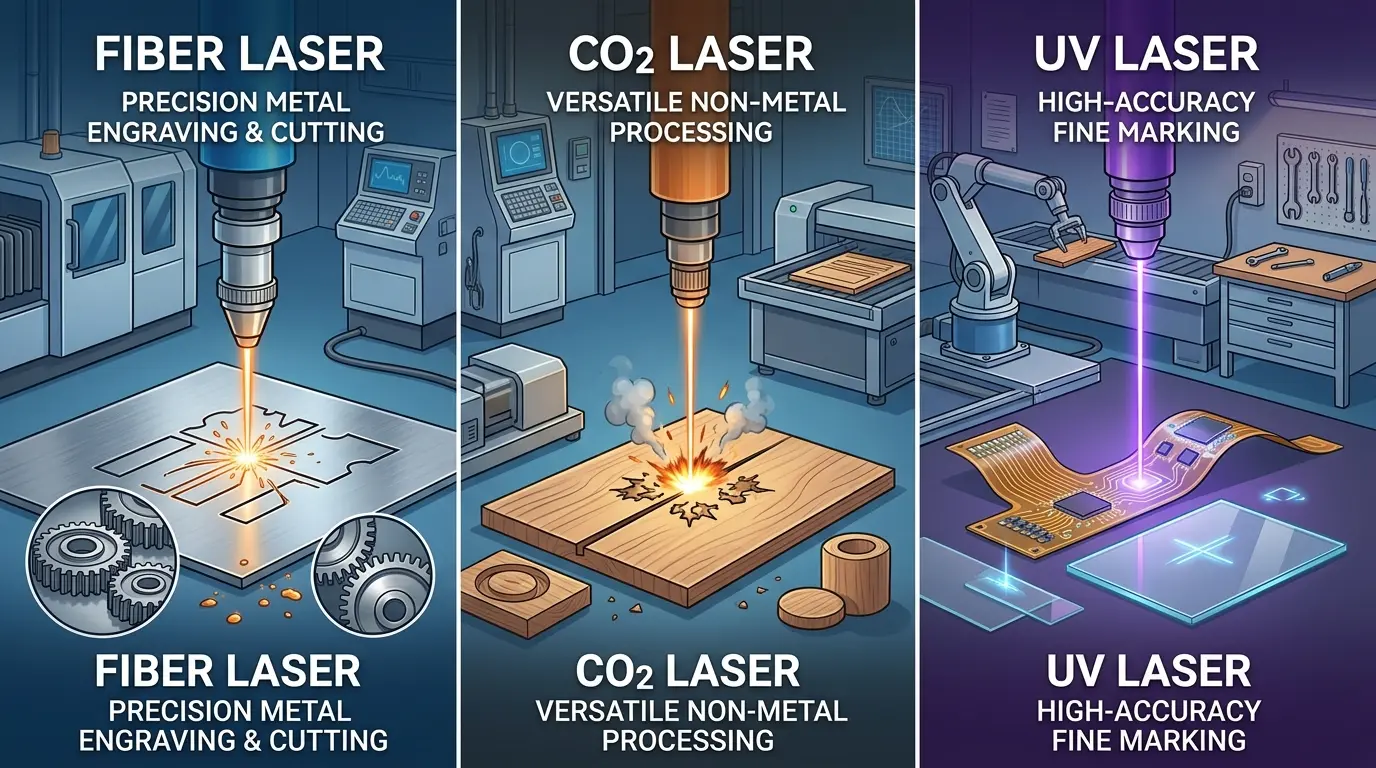
Many buyers put these three laser types into the same shortlist before they have defined the real production task. That is usually where the confusion starts.
In real factories, fiber, CO2, and UV are not simply three versions of the same machine. They are usually chosen to solve different material, finish, and workflow problems. If that distinction is missed, a shop can end up with a laser source that looks impressive in a quote comparison but creates the wrong kind of throughput, the wrong kind of finish, or the wrong kind of rework.
If you are reviewing a broader Pandaxis product catalog while mapping out future equipment needs, the practical question is not which laser sounds most advanced. The practical question is which source fits the parts you run, the defects you are trying to avoid, and the process step where the machine is supposed to create value.
Why These Three Lasers Are Often Compared Incorrectly
The first mistake is assuming all three belong to the same buying discussion.
In broader industrial use:
- Fiber Lasers Are Commonly Evaluated For Metal-Centric Cutting Or Marking Workflows
- CO2 Lasers Are Commonly Evaluated For Wood, Acrylic, And Other Non-Metallic Cutting And Engraving Workflows
- UV Lasers Are Commonly Evaluated For Fine, Low-Heat Marking On Sensitive Materials Or Appearance-Critical Surfaces
That means the comparison is not really about which technology is best in the abstract. It is about whether the production priority is metal throughput, non-metal cutting flexibility, or low-heat marking control.
When buyers compare all three only by headline power, speed claims, or brand reputation, they usually skip the more important question: what exactly needs to happen to the part at this station?
Start With the Production Task, Not With the Laser Source
Before comparing the laser source, define the job in process terms.
Ask these questions first:
- Are You Primarily Cutting Metal Parts, Cutting Non-Metal Parts, Or Marking Finished Components?
- Is The Main Goal Throughput, Fine Detail, Low Heat Impact, Or Material Flexibility?
- Does The Part Need Cutting, Engraving, Surface Marking, Or A Combination Of Those Steps?
- Is Surface Appearance Part Of The Product Value?
- Is The Material Stable And Repetitive, Or Does The Queue Change Constantly?
- Is The Real Bottleneck Laser Processing, Or A Different Upstream Or Downstream Step?
Once those answers are clear, the comparison usually becomes more rational.
Fiber, CO2, And UV at a Glance
| Decision Factor | Fiber Laser | CO2 Laser | UV Laser |
|---|---|---|---|
| Typical Starting Point | Metal-focused cutting or marking workflows | Non-metal cutting and engraving workflows | Fine marking on heat-sensitive or delicate surfaces |
| Common Material Fit | Metals and many metal-part production tasks | Wood, acrylic, and similar non-metallic materials | Sensitive plastics, coated parts, glass, ceramics, and fine-detail marking tasks |
| Main Value Driver | Industrial metal productivity and durable direct marking | Cut-and-engrave flexibility on non-metal materials | Low-heat interaction and cleaner marking on delicate substrates |
| Where It Usually Earns ROI | When the business is centered on metal fabrication or metal traceability | When the queue depends on wood, acrylic, signage, decor, or mixed non-metal work | When reject risk comes from heat damage, haze, discoloration, or poor small-code quality |
| Common Buying Mistake | Choosing it for a non-metal workflow just because it sounds more industrial | Expecting it to solve metal-heavy production priorities | Treating it as a universal premium option even when the job is straightforward metal marking |
| Practical Limitation | Can be the wrong fit when surfaces are highly heat-sensitive or cosmetic | Usually not the first reference point for metal-centric production | Usually not the first choice for broad cutting workflows or aggressive material removal |
The table is useful because it shows that each source usually wins on a different production objective.
Where Fiber Usually Fits Best
Fiber laser systems are commonly the better starting point when the production environment is built around metal processing. In those settings, the machine is often judged by part flow, consistency, and how well it supports broader fabrication or traceability requirements.
Fiber is commonly evaluated for situations such as:
- Metal Part Cutting In Fabrication Workflows
- Direct Marking On Industrial Metal Components
- Serial Number, Code, Or Identification Marking On Metal Parts
- Production Cells Where Metal Throughput Matters More Than Decorative Finish On Non-Metal Materials
The workflow logic is simple. If most machine hours are spent on steel, aluminum, stainless components, or similar metal jobs, fiber often becomes the most relevant source family to evaluate first.
The tradeoff is equally important. Fiber is not automatically the right answer when the production queue is dominated by wood display parts, acrylic signage, decorative engraving, or heat-sensitive substrates. In those cases, the source can solve the wrong bottleneck even if it performs well in a metal-focused context.
Where CO2 Usually Fits Best
CO2 lasers are commonly the stronger fit when the factory needs cutting and engraving flexibility across wood, acrylic, and similar non-metallic materials. In those workflows, buyers are often balancing shape cutting, surface detail, edge appearance, and job-to-job flexibility rather than building around a metal fabrication line.
That is why CO2 is often considered for:
- Wood Cutting And Engraving
- Acrylic Signage And Display Production
- Decorative Panels And Custom Shapes
- Mixed Cut-And-Engrave Workflows On Non-Metal Materials
- Jobs Where Finished-Part Appearance Matters Alongside Basic Throughput
For buyers reviewing laser cutters and engravers for non-metal processing, CO2 often makes sense because one workflow can support both profile cutting and visual detail work on the same general material family.
The honest tradeoff is that CO2 should not be treated as the universal answer just because it is versatile in non-metal work. If the factory’s revenue and machine hours are tied mostly to metal parts, a CO2-first decision can leave the line poorly aligned with the real production target.
Where UV Usually Fits Best
UV lasers are usually brought into the discussion for a different reason. They are commonly evaluated when the biggest problem is not whether a mark can be made, but whether it can be made without damaging a sensitive surface.
That usually includes situations such as:
- Fine Marking On Heat-Sensitive Plastics
- Codes Or Logos On Coated Or Painted Components
- Small Marking Areas On Cosmetic Or Electronic Housings
- Surface Marking On Glass, Ceramics, Or Other Delicate Materials
- Traceability Steps Where Contrast And Edge Definition Matter More Than Aggressive Material Interaction
In these cases, UV is often valued because lower thermal side effects can help reduce whitening, haze, surface distortion, or other cosmetic failures.
The tradeoff is that UV should not be treated as a premium replacement for every laser process. If the job is dominated by straightforward metal marking or broad cutting work, UV may add complexity without solving the main production problem.
The Most Useful Way to Compare Them
The best comparison is not source versus source. It is workflow versus workflow.
| If Your Main Production Need Is… | Usually Start by Evaluating… | Why |
|---|---|---|
| Cutting Metal Parts At Industrial Scale | Fiber Laser | The workflow is usually driven by metal processing priorities |
| Cutting And Engraving Wood, Acrylic, Or Similar Non-Metal Materials | CO2 Laser | Material flexibility and visual finish often matter more than metal-line productivity |
| Fine Marking On Delicate Plastics, Coated Parts, Or Sensitive Surfaces | UV Laser | Lower heat impact is often the key process advantage |
| Permanent Codes On Metal Components | Fiber Laser | The marking goal is usually durability and metal-workflow fit |
| A Mixed Non-Metal Queue With Both Shape Cutting And Surface Detail | CO2 Laser | One system can often support broader non-metal processing logic |
| Appearance-Critical Marking With Minimal Surface Damage | UV Laser | Reject reduction often matters more than raw station speed |
This is also why some comparisons become unproductive. A buyer may ask whether UV is better than CO2, when the real question is whether the job is marking or cutting. Another buyer may ask whether fiber is better than CO2, when the real question is whether the business is actually metal-centric or still driven by non-metal materials.
Common Buying Mistakes When Comparing Fiber, CO2, and UV
Most bad laser decisions come from one of a few patterns.
First, buyers compare technology labels instead of dominant materials. The result is a machine that fits the brochure better than the factory.
Second, they compare speed without defining what counts as a finished part. A fast process is not productive if it creates reject risk, poor surface appearance, or extra downstream work.
Third, they assume one source should cover every material strategy equally well. In practice, the more mixed the material plan becomes, the more carefully workflow fit has to be validated.
Fourth, they judge performance from a clean sample instead of from daily production conditions. Real output depends on material variation, fixturing, presentation stability, and how the part behaves after the laser step.
Fifth, they try to solve a broader production bottleneck with laser alone. If the real constraint sits in panel breakdown, routing, drilling, assembly preparation, or another plant-level process, a laser comparison may be answering the wrong question.
What Buyers Should Validate Before Choosing
Before making a final decision, buyers usually get a better outcome by validating a few operational realities:
- Which Material Family Uses Most Of The Planned Machine Time
- Whether The Job Is Cutting, Engraving, Marking, Or A Combination
- Whether Surface Appearance Is Functional, Cosmetic, Or Both
- How Sensitive The Material Is To Heat, Discoloration, Or Distortion
- Whether The Production Mix Is Stable Or Changes Frequently
- Whether The Target Is Throughput, Fine Detail, Or Reject Reduction
- How The Laser Step Connects To Handling, Inspection, Assembly, Or Finishing
These questions matter more than abstract comparisons because they force the purchase decision back into the actual plant workflow.
Practical Summary
Fiber, CO2, and UV lasers are best understood as tools for different production conditions rather than as three interchangeable levels of the same technology.
Fiber is commonly the strongest starting point for metal-focused cutting and marking workflows. CO2 is commonly the strongest starting point for wood, acrylic, and other non-metal cutting and engraving work. UV is commonly the strongest starting point for fine, low-heat marking on sensitive or appearance-critical materials.
The right choice depends less on which laser sounds more advanced and more on what the part needs, what the material will tolerate, and where the real value is supposed to appear in the workflow. Buyers usually make better decisions when they choose the source that fits the dominant job every day, not the source that looks strongest in a generic comparison.