Factories usually ask this question when the marking step starts creating friction. Parts need permanent IDs, traceability codes, logos, or compliance marks, but the production team has not yet decided whether it is better to move the workpiece to a stable marking station or bring the marking head to the part.
That is why the real comparison is not portability versus technology. It is process flexibility versus process stability. A handheld laser marking machine can be a practical fit when parts are large, installed, awkward to handle, or marked only occasionally. A fixed fiber laser marking machine is commonly the stronger choice when repeatability, code consistency, fixturing, and daily output matter more than mobility.
The Real Decision Is Part Handling vs Process Control
Many buyers compare handheld and fixed systems as if one is simply more advanced than the other. In practice, they solve different production problems.
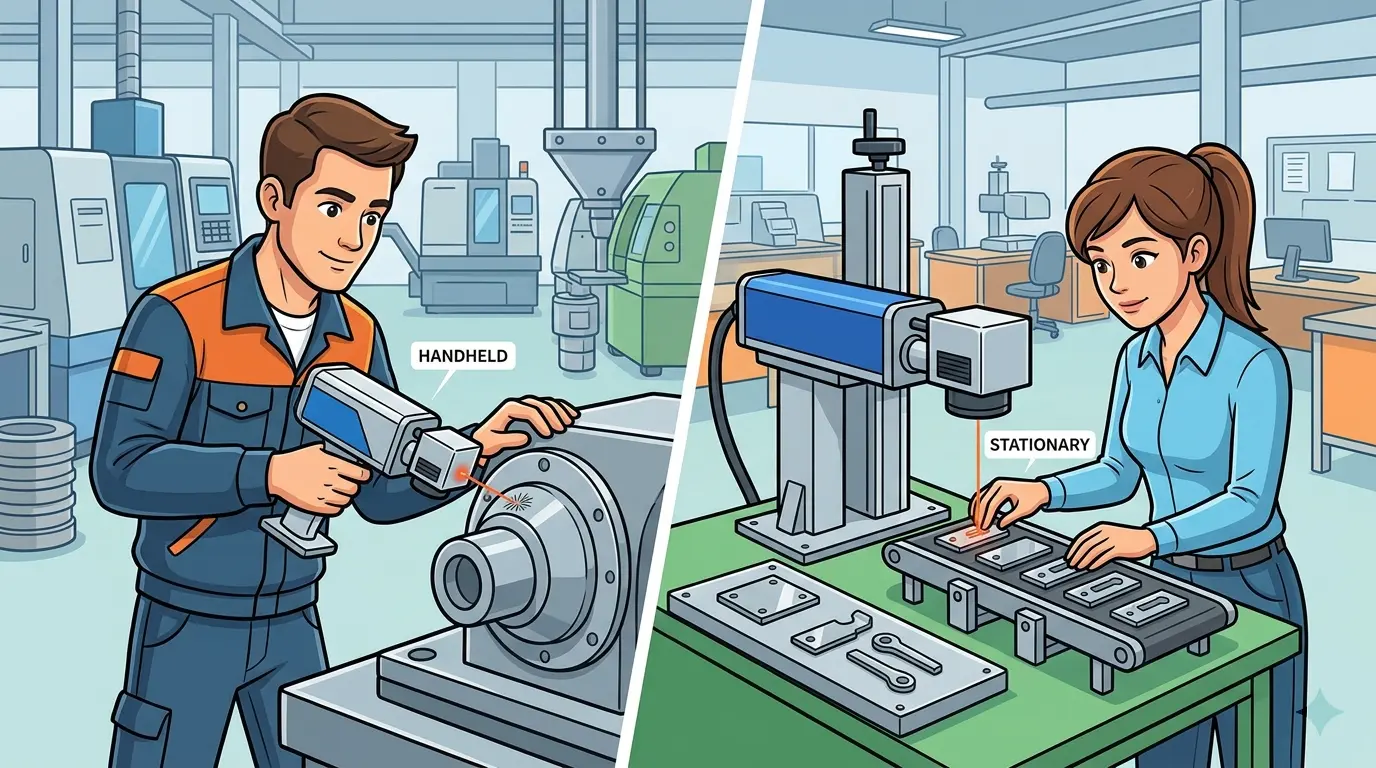
A handheld laser marking machine is usually evaluated when part movement is expensive in time, labor, or risk. Large weldments, installed equipment, oversized housings, maintenance assets, and heavy fabricated parts often fall into this category. The advantage comes from reducing unnecessary lifting, repositioning, and waiting.
A fixed fiber laser marking machine is usually evaluated when the goal is a more controlled marking cell. The marking head stays in a defined position, parts are presented with more predictable alignment, and the workflow is easier to standardize. That becomes important when the plant depends on machine-readable codes, stable mark placement, repeatable cosmetic quality, or serialized daily production.
The better choice depends on which problem is more expensive in your factory: moving the part or controlling the process.
Side-by-Side Comparison
| Decision Factor | Handheld Laser Marking Machine | Fixed Fiber Laser Marking Machine |
|---|---|---|
| Best Fit For Part Size | Large, heavy, installed, or awkward workpieces | Small to medium parts that can be presented consistently |
| Main Workflow Value | Reduces part handling by bringing the mark to the part | Improves repeatability by bringing the part to a controlled marking zone |
| Position Repeatability | More dependent on operator control and referencing discipline | Usually stronger because fixturing and alignment are easier to standardize |
| High-Volume Throughput | Can be limited by positioning time and operator movement | Usually better for repeated daily jobs and serialized batches |
| Small Codes And Tight Placement | More difficult to hold consistently on demanding jobs | Better suited to precise placement and stable code geometry |
| Flexibility Across Large Assemblies | Strong advantage | Often weaker if the part is difficult to move or fixture |
| Integration With Verification | Possible, but more variable in open or changing setups | Easier to build into a dedicated marking and scanning workflow |
| Safety And Extraction Control | Harder to keep uniform across changing work areas | Easier to manage in one defined cell |
| Operator Skill Sensitivity | Higher | Lower once the process is standardized |
| Floor Space Efficiency | Useful when a permanent cell is hard to justify | Better when the marking task is frequent enough to justify a dedicated area |
This table shows the main tradeoff clearly. Handheld systems usually win when mobility removes real handling waste. Fixed systems usually win when consistency matters every shift.
When a Handheld Laser Marking Machine Makes More Sense
Handheld laser marking is commonly well suited to situations where the workpiece does not fit naturally into a dedicated cell.
Typical examples include:
- Large Fabricated Frames Or Weldments
- Installed Equipment That Cannot Be Removed Easily
- Heavy Castings Or Machined Components That Are Inconvenient To Reposition
- Maintenance Assets, Tooling, And Factory Fixtures Marked Intermittently
- High-Mix, Low-Volume Jobs Where Marking Needs Change Frequently By Department
In these environments, portability helps because the marking step no longer forces unnecessary transport or re-fixturing. That can reduce handling time and lower the chance of scratching, dropping, or misaligning large parts just to add an identification mark.
But buyers should not mistake mobility for automatic productivity. A handheld setup usually depends more heavily on operator stability, line-of-sight positioning, temporary referencing, and local work conditions. If the mark must land in exactly the same position every time, or if small codes need reliable scanning, the portable advantage can shrink quickly.
When a Fixed Fiber Laser Marking Machine Is Usually the Better Choice
Fixed fiber laser marking machines are commonly the stronger fit when the plant needs a repeatable process rather than a movable tool.
They are often preferred for:
- Serialized Production Parts Running Every Shift
- Data Matrix, QR, Or Compact Code Marking
- Stable Part Families With Dedicated Fixtures Or Nests
- Cosmetic Product Marks That Need Better Consistency
- Production Cells Where Marking, Verification, And Data Capture Must Stay Aligned
The main advantage is process discipline. When the head position is fixed and the part is presented predictably, it becomes easier to control focus, code placement, mark orientation, and downstream verification. That is especially useful when the mark supports traceability systems instead of only human-readable identification.
This does not mean a fixed setup is always faster in absolute terms. If oversized parts must be lifted, staged, and reoriented just to reach the machine, a fixed cell can become its own bottleneck. But when parts are already moving through a structured production flow, a fixed station usually offers stronger repeatability and less operator-to-operator variation.
Where Buyers Often Misjudge the Tradeoff
One common mistake is assuming a handheld laser marking machine is the more flexible long-term investment because it can be used in more places. Physical mobility is useful, but workflow flexibility also depends on how easily the factory can create consistent results. A machine that can reach many parts may still create variation if each job requires manual positioning and ad hoc setup.
Another common mistake is assuming a fixed fiber laser marking machine is automatically the better production option because it looks more stable in a demo. Demos usually use clean, well-positioned samples. Real production may involve large parts, mixed surfaces, awkward geometries, or departments that only need marking occasionally. In those cases, the cost of moving the part can outweigh the benefit of a fixed station.
The practical lesson is simple: sample quality alone is not enough. Buyers should compare usable marks per hour, placement consistency, operator dependency, and how the marking step fits upstream and downstream work.
Questions That Should Drive the Buying Decision
Before choosing between handheld and fixed fiber laser marking, production teams should answer a few process questions clearly.
| Question | Why It Matters |
|---|---|
| Are The Parts Difficult To Move, Or Is Movement Simply Inconvenient? | True handheld value comes from removing major handling waste, not minor preference |
| How Important Is Repeatable Placement? | Tight placement tolerances usually favor a fixed setup |
| Will The Marks Support Scanner-Based Traceability? | Reliable code reading often benefits from a more controlled station |
| Is The Job High-Volume Or Intermittent? | Frequent repeated work often justifies a fixed cell, while occasional work may not |
| How Many Operators Or Departments Will Use The System? | Shared use can favor portability, but only if setup discipline remains strong |
| What Happens After Marking? | Inspection, scanning, assembly, and shipping requirements often expose weak process choices |
| How Will Safety And Extraction Be Controlled? | Changing locations increases the need for clear operating discipline |
These questions usually reveal whether the plant needs a flexible marking tool, a stable marking station, or a split strategy using both.
When a Mixed Strategy Is the Smarter Answer
Some factories frame the decision too narrowly. The best answer is not always handheld or fixed. It can be handheld for oversized or installed work and fixed for repeated production parts.
That division often makes sense when the business has two separate marking demands:
- Daily Serialized Parts That Need Stable, Repeatable Marking
- Occasional Large Or Installed Workpieces That Are Expensive To Move
In that kind of environment, asking one setup to cover both jobs can create unnecessary compromise. A fixed cell may be excellent for structured production but impractical for large assemblies. A handheld unit may be useful for oversized work but too dependent on operator control for daily batch traceability.
Thinking in terms of workflow split instead of one-machine universality usually leads to a more defensible equipment decision.
Practical Summary
A handheld laser marking machine usually makes more sense when the workpiece is large, installed, awkward to reposition, or marked only occasionally. Its main value is reduced handling. A fixed fiber laser marking machine usually makes more sense when the factory needs repeatable placement, code consistency, predictable fixturing, and smoother integration into a structured production flow.
Neither setup is universally better. The stronger choice depends on whether your marking problem is mainly about access to the part or control of the process. If moving the part is the bigger cost, handheld can be the right fit. If variation, verification, and daily output are the bigger risks, fixed fiber laser marking usually deserves the stronger look.
For manufacturers reviewing marking equipment alongside broader machinery planning, the Pandaxis product catalog offers a wider view of industrial equipment categories and production-focused buying paths.