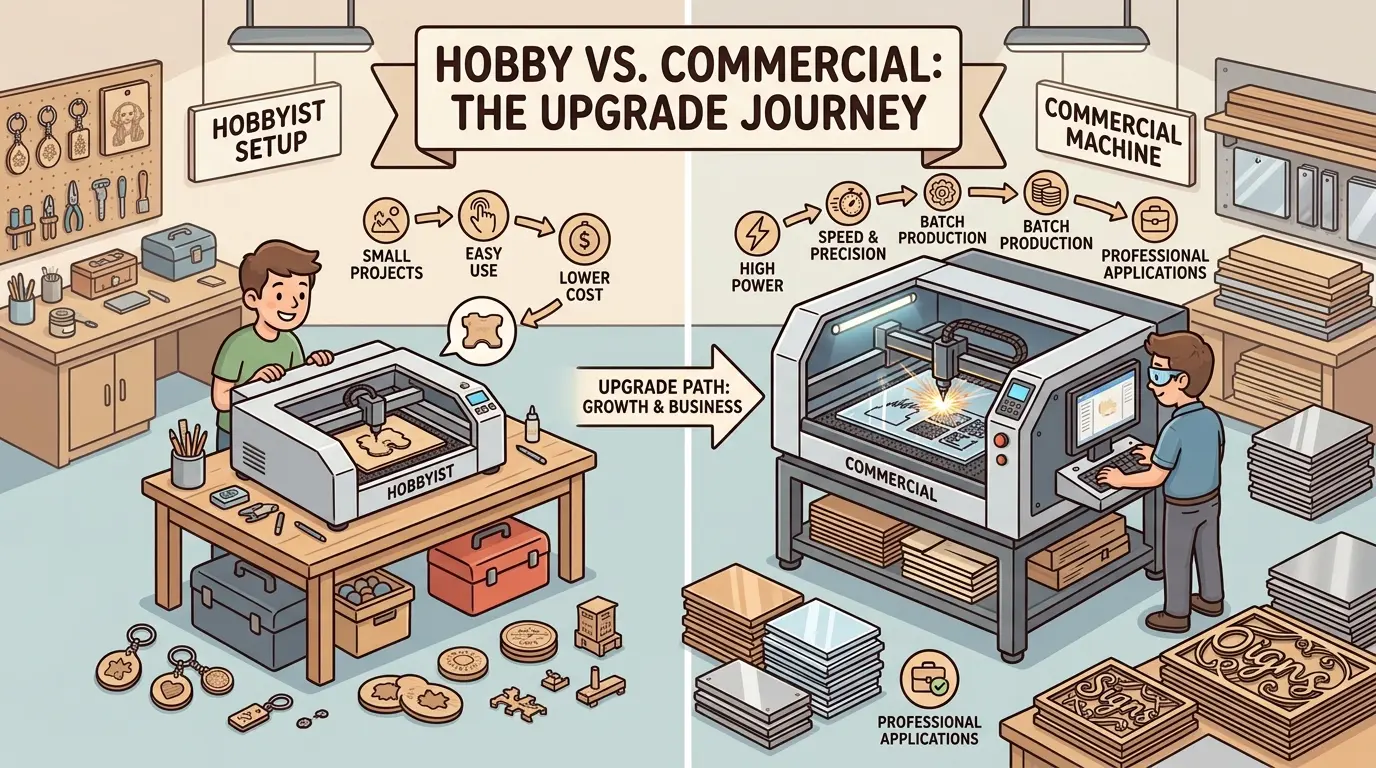
A hobby laser cutter can be a smart starting point for samples, short custom runs, and early product development. The upgrade question usually appears when the same machine is asked to support delivery dates, repeat orders, larger workpieces, and more predictable finish quality.
That is the real dividing line. Moving from a hobby laser to a commercial machine is not only about more power or a larger footprint. It is usually about whether the laser has become part of a production workflow where throughput, repeatability, cleaner cuts, lower rework, and scheduling confidence matter every day.
Why This Decision Usually Starts With Workflow Pressure
Most small shops do not begin with a production-grade laser. They begin with a machine that is affordable, compact, and useful for learning materials, testing designs, and proving market demand. That makes sense.
The problem starts when order volume grows faster than process discipline. A machine that works well for occasional engraving can become a bottleneck when jobs must move through quoting, setup, cutting, engraving, cleanup, packing, and dispatch on a reliable schedule. At that point, the question is no longer whether the machine can produce a part. The question is whether it can support the business around the part.
Typical pressure points include:
- Longer job queues than the sales schedule can tolerate
- Repeated manual repositioning because the work area is too limited
- Inconsistent cut quality between short runs and longer production sessions
- Too much operator attention tied up in setup, supervision, and cleanup
- More scrap or rework than the job margin can comfortably absorb
When these issues become routine rather than occasional, the upgrade discussion becomes practical instead of aspirational.
What Separates A Hobby Laser Cutter From A Commercial Machine
The difference is usually not one headline feature. It is the combined effect of machine stability, material handling, daily runtime expectations, process control, and how well the equipment fits repeat production.
| Decision Factor | Hobby Laser Cutter | Commercial Laser Machine | Workflow Impact |
|---|---|---|---|
| Runtime Expectation | Better suited to intermittent use and shorter sessions | Better suited to sustained daily operation | More reliable production scheduling |
| Material Handling | Often limited to smaller sheets and more manual positioning | Usually easier to stage, align, and process larger or more regular batches | Fewer setup interruptions and alignment errors |
| Batch Consistency | Acceptable for prototypes and one-off work | Better aligned with repeat jobs and stable output | Lower rework and more predictable finish quality |
| Extraction And Process Cleanliness | Often more basic | Usually more production-oriented | Cleaner cuts, less residue, and easier shop control |
| Setup Efficiency | More operator-dependent | More structured for recurring jobs | Faster changeovers and simpler quoting logic |
| Downtime Tolerance | Can be manageable if deadlines are flexible | Downtime carries higher cost but the machine is chosen for business-critical use | Better fit when customer commitments depend on machine availability |
| Growth Headroom | Good for learning and early-stage sales | Better fit for scaling production | Supports business growth without constant workarounds |
This is why many buyers underestimate the upgrade decision at first. They compare machines as objects rather than as parts of a workflow. In practice, the commercial machine wins when the shop needs a more dependable process, not just a more impressive specification sheet.
The Signs Your Current Laser Is Already Costing You Too Much
An upgrade usually makes sense before the old machine completely fails. The stronger signal is that the current machine is quietly raising your production cost.
Common warning signs include:
- Orders are waiting for laser capacity instead of design approval or raw material arrival.
- Jobs have to be split into extra setups because the work area does not fit the part or sheet efficiently.
- Operators spend too much time adjusting placement, monitoring cuts, or cleaning up inconsistent results.
- Scrap, scorching, incomplete cuts, or edge-cleaning work are becoming part of normal production.
- You are turning down repeat business because you cannot promise lead times with confidence.
- Quoting has become difficult because actual machine time varies too much from job to job.
- The machine is still useful, but only if someone constantly works around its limits.
That last point matters. A hobby laser can still be functional while being economically wrong for the next stage of the business.
When A Hobby Laser Cutter Is Still The Right Choice
Not every shop should upgrade immediately. In some cases, keeping a hobby laser is the more disciplined choice.
A smaller machine can still be the right fit when:
- The laser is mainly used for prototyping, sampling, or internal development.
- Order volume is irregular and does not justify a dedicated production asset.
- Most work is personalized, experimental, or artist-led rather than batch-oriented.
- Lead times are flexible enough that occasional slowdowns do not harm the business.
- The laser supports another core process instead of carrying the main revenue load.
In those situations, the hobby machine is not a mistake. It is simply being used within its natural operating role. The problem begins when a prototype-oriented tool is expected to behave like production infrastructure.
What A Commercial Upgrade Usually Changes In Daily Production
For shops working with wood, acrylic, and similar non-metal materials, moving into dedicated laser cutters and engravers is usually less about chasing a larger headline claim and more about stabilizing the production process.
In practical terms, a commercial upgrade often improves the workflow in four ways.
First, it supports better throughput planning. Jobs can be grouped more logically, scheduled more confidently, and moved through the shop with fewer special handling steps.
Second, it improves repeatability. Settings, positioning, and output become easier to standardize, which matters when the same file must produce the same visual result across multiple runs.
Third, it reduces labor waste around the machine. Less babysitting, less manual repositioning, and less cleanup effort mean the operator can focus on production rather than constant correction.
Fourth, it raises downstream quality. Cleaner edges, more stable engraving results, and fewer incomplete cuts can improve assembly, finishing, packaging, and customer acceptance.
That is why the best commercial upgrade is not always the one that looks most advanced. It is the one that removes the current constraint in your workflow.
How To Decide Without Overbuying
The safest buying decision is grounded in the jobs you already run, not the machine category you hope to grow into someday.
Use this selection logic before upgrading:
- Measure Where Time Is Actually Being Lost. Separate design time, setup time, machine runtime, cleanup, and rework.
- Review Your Real Job Mix. Look at part size, material type, batch frequency, and the balance between cutting and engraving.
- Identify The Most Expensive Bottleneck. It may be work area limits, inconsistent finish quality, manual setup, or unreliable daily output rather than raw speed alone.
- Define The Required Finish Standard. Decorative work, branded products, architectural pieces, and repeat retail orders do not tolerate the same level of variation.
- Buy For The Next Stable Workflow Stage. Choose a machine that fits the production level you can sustain, not the one justified only by an optimistic future scenario.
If the upgrade is part of a broader move from bench-scale production toward a more organized equipment roadmap, reviewing the wider Pandaxis product catalog can also help clarify how laser processing should fit alongside other fabrication steps.
Upgrade Timing Matters More Than Machine Labels
Many buyers ask whether they should upgrade as soon as sales increase. A better question is this: has the laser become a recurring source of delay, inconsistency, or unnecessary labor?
If the answer is yes, the upgrade may already be justified. If the answer is no, a hobby laser may still be doing exactly what it should.
That distinction protects buyers from two expensive mistakes. One is upgrading too early and carrying industrial equipment costs before production demand is stable. The other is upgrading too late and losing margin, delivery reliability, and repeat business because the machine has fallen behind the workflow.
Practical Summary
The right time to move from a hobby laser cutter to a commercial machine is when production discipline matters more than basic capability. If the laser is now expected to support repeat orders, predictable lead times, cleaner cuts, easier material handling, and lower rework, a commercial upgrade is usually a workflow decision rather than a luxury purchase.
If the work is still experimental, irregular, or prototype-driven, a hobby laser may remain the right tool. But once machine limits begin to shape pricing, scheduling, and quality outcomes, the business has usually outgrown hobby equipment even if the machine itself still runs.
That is the clearest upgrade signal: not whether the laser can still cut, but whether it can still support the way your shop needs to produce.