Most shops do not ask this question at the start of a project. They ask it when marking becomes a friction point. Large assemblies are awkward to move, serialized parts need more consistent codes, or operators are spending too much time repositioning work just to add an ID mark.
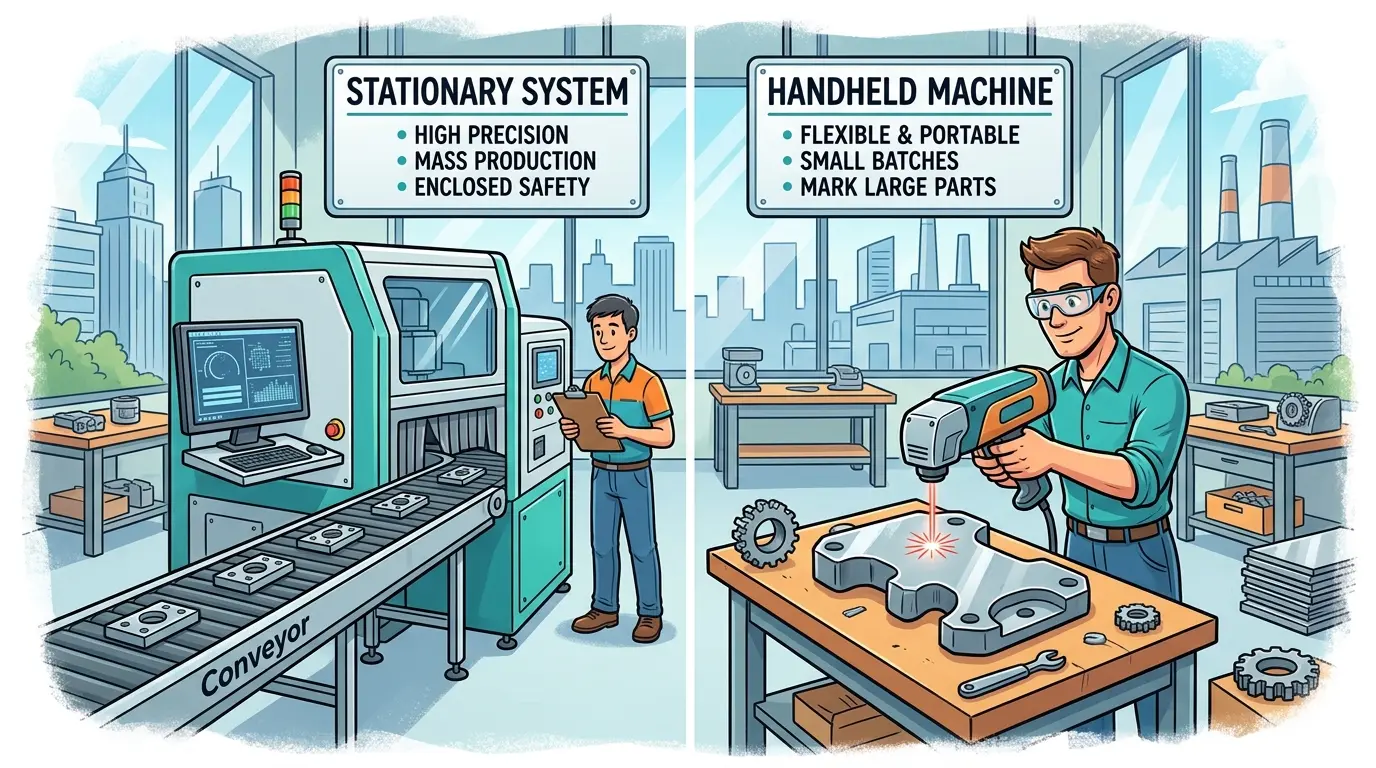
That is why the real decision is not which setup looks more advanced. It is whether your shop gains more from bringing the marking head to the part or bringing the part into a controlled marking station. A handheld laser marking machine can remove handling waste when parts are oversized, installed, or marked only occasionally. A fixed laser marking system usually becomes the stronger choice when repeatability, throughput, and verification discipline matter every day.
Start With the Constraint on Your Floor
Shops often compare handheld and fixed marking systems as if they are simply two versions of the same machine. In practice, they solve different operational problems.
If the biggest cost in your workflow is moving heavy, awkward, or already assembled parts, handheld marking can make sense because it reduces lifting, staging, and re-fixturing. If the bigger cost is variation in mark position, unreadable codes, inconsistent cosmetic quality, or slow batch handling, a fixed system usually deserves the first look.
The most useful question is simple: where is the real production penalty today?
- Part Handling And Repositioning
- Mark Placement Variation
- Queue Time At A Shared Station
- Scanner Readability Problems
- Rework Caused By Inconsistent Setup
- Safety And Extraction Control Across Multiple Work Areas
The answer usually points toward the right workstation style before you even compare brands or configurations.
Quick Comparison
| Decision Factor | Handheld Laser Marking Machine | Fixed Laser Marking System |
|---|---|---|
| Best Fit For Part Size | Large, heavy, awkward, or installed workpieces | Small to medium parts that can be presented consistently |
| Main Workflow Benefit | Reduces handling by bringing the mark to the part | Improves repeatability by bringing the part to a controlled station |
| Placement Consistency | More dependent on operator stability and reference methods | Usually stronger with fixtures, nests, or stops |
| Batch Throughput | Often slower on repeated jobs because positioning changes from part to part | Usually better for repeated production and serialized batches |
| Small Code Readability | Harder to control when placement tolerance is tight | Easier to keep stable for scanner-based traceability |
| Safety And Fume Control | Harder to standardize across changing work areas | Easier to manage in one defined cell |
| Flexibility For Large Assemblies | Strong advantage | Often weaker if parts are difficult to move |
| Training Sensitivity | Higher | Lower once the process is standardized |
This comparison shows why neither option is universally better. One removes transport waste. The other reduces process variation.
Do Not Confuse Workstation Style With Laser Source
Many buyers mix two separate decisions together.
The first decision is workstation style: handheld or fixed. That choice is mainly about part access, fixturing, workflow control, and operator dependency.
The second decision is process and material fit: what kind of mark is required, what material family is being processed, and how much contrast, permanence, or detail the application needs.
Those decisions overlap, but they are not the same. A shop may need a fixed system because it runs repeated serialized parts, regardless of which marking source it ultimately selects. Another shop may need handheld access because it marks large fabricated assemblies in place, even if the actual mark requirements are modest.
This is also where some buyers realize they are not really looking for a dedicated marking station at all. If the job is closer to engraving on wood, acrylic, or similar non-metallic parts than to industrial identification workflow, broader laser cutters and engravers may be the more relevant equipment category.
When Handheld Marking Earns Its Keep
Handheld marking usually creates the most value when the part is expensive to move.
Common examples include:
- Large Weldments And Fabricated Frames
- Installed Equipment Or In-Place Components
- Heavy Castings Or Machined Parts That Are Difficult To Reposition
- Maintenance Assets, Tooling, And Plant Fixtures
- High-Mix, Low-Volume Jobs Spread Across Multiple Work Areas
In these environments, the gain is not just portability. The real gain is reduced disruption. Operators spend less time lifting, staging, and waiting for a separate marking cell. Late-stage marking becomes easier because the part does not have to leave its work area simply to receive an ID, logo, or reference code.
That said, handheld marking is not free flexibility. It usually demands better operator discipline. Reference points matter more. Surface approach angle matters more. Consistent distance and alignment matter more. If the job requires small machine-readable codes in the exact same location every time, mobility can quickly become a source of variation instead of an advantage.
When a Fixed System Usually Delivers Better Results
Fixed laser marking systems are generally the stronger fit when the shop wants a repeatable process rather than a movable tool.
They tend to pay back faster in situations such as:
- Repeated Production Of Similar Part Families
- Tight Placement Tolerance For Codes Or Cosmetic Marks
- Scanner-Based Traceability Workflows
- Stable Part Presentation Using Fixtures, Nests, Or Stops
- Production Cells Where Marking, Verification, And Data Capture Need To Stay Aligned
The workflow benefit is control. Once part positioning is standardized, it becomes easier to maintain mark placement, orientation, readability, and operator-to-operator consistency. Fixed systems also make it easier to support downstream inspection because the mark is created in a predictable zone under repeatable conditions.
This matters most when the plant cares about usable marks per hour, not just whether a sample mark looks acceptable in a demo. If the same job runs every shift, a controlled station usually reduces variability, shortens operator decision time, and improves traceability confidence.
The Hidden Cost Areas Buyers Often Miss
The wrong decision usually happens when teams compare sample marks instead of comparing operating conditions.
| Overlooked Issue | Why It Changes the Decision |
|---|---|
| Part Referencing | Handheld setups often rely more on visual alignment, while fixed stations can standardize position more easily |
| Operator Variation | Free-positioning work usually depends more on individual skill and consistency |
| Verification Workflow | Fixed stations are easier to pair with scanning, inspection, and data capture steps |
| Queue Management | A fixed station can become efficient or congested depending on part flow; handheld avoids queues but may slow each cycle |
| Safety Discipline | Portable work areas require stronger procedural control if the machine is used in multiple locations |
| Rework Exposure | Misplaced or weak marks can erase the time saved by portable access |
A good buying discussion should always include these questions:
- How many usable marks per shift are actually needed?
- How small or position-sensitive are the codes?
- Will multiple operators use the equipment?
- How often does the job change?
- What happens immediately after marking?
If the mark feeds inspection, assembly, shipping, or traceability records, process stability matters more than convenience.
A Simple Shop-Fit Decision Table
| Shop Profile | Better Starting Point | Why |
|---|---|---|
| Fabrication Shop Marking Large Welded Assemblies | Handheld | Moving the part may cost more than moving the marking head |
| Machine Shop Running Repeated Serialized Components | Fixed | Repeatable placement and code readability usually matter more than mobility |
| Maintenance Team Marking Tools, Fixtures, And Plant Assets | Handheld | The work is scattered and intermittent rather than cell-based |
| Production Line With Scanner Verification | Fixed | Controlled presentation and downstream verification are easier to standardize |
| Mixed Job Shop With Both Oversized Parts And Repeated Batches | Hybrid | One setup often cannot solve both access and repeatability equally well |
This table is a starting point, not a rulebook. Shops with mixed workloads often discover that one setup handles their exception work while the other supports their daily volume.
When a Hybrid Approach Is the Smarter Answer
Some buyers force an either-or decision because they want one system to cover every job. That often creates unnecessary compromise.
A mixed environment may benefit from:
- A Fixed Station For Repeated Serialized Parts
- A Handheld Unit For Oversized Or Installed Workpieces
- Separate Job Rules For High-Precision Codes Versus General Identification Marks
This split is often more honest operationally. A fixed system can protect daily output where repeatability matters, while handheld capability can serve low-frequency jobs that would otherwise create handling waste. Instead of asking one setup to do everything adequately, the shop gives each type of work the process it actually needs.
Practical Summary
A handheld laser marking machine usually makes more sense when the part is difficult to move, the job is intermittent, or the mark must be applied late in the workflow without sending the workpiece back through a dedicated station. A fixed laser marking system usually makes more sense when the plant depends on repeatable placement, stable code quality, predictable throughput, and easier integration with verification.
The better choice depends on what your shop is trying to remove: handling waste or process variation. If moving the part is the expensive step, handheld marking deserves the stronger look. If inconsistency, unreadable codes, and operator dependence are the bigger risks, a fixed system is usually the safer production decision.
For teams reviewing marking requirements alongside broader machinery planning, the Pandaxis product catalog gives a wider view of production-oriented equipment categories and process-fit decisions.