Many buyers start this comparison as if they are choosing between two completely different machine families. In real production, the difference is usually less dramatic. Most of the time, the real question is whether the job needs a shallow surface change, a deeper recessed result, or simply a clear visual mark that can survive handling and inspection.
For factories reviewing laser cutters and engravers for wood, acrylic, and similar non-metallic work, that distinction matters because the workflow changes long before the machine label does. Once a job moves from light surface contrast to visible depth, cycle time, residue management, finish control, and downstream labor all become more important.
Why The Terms Overlap So Often
“Laser etching” and “laser engraving” are often used loosely in machine listings, sales conversations, and even internal production notes. One buyer may use etching to mean a light surface effect. Another may use the same word for any permanent laser-made mark. A third may call a shallow engraved logo an etched mark simply because the finished part does not feel deeply recessed.
That is why terminology alone is not a reliable buying guide. In many cases, the same laser platform can handle both outcomes within a certain process window. What changes is not always the machine category. What changes is the amount of material interaction the job requires and how much process stability the factory needs when that interaction becomes more demanding.
What Laser Etching Usually Means In Practice
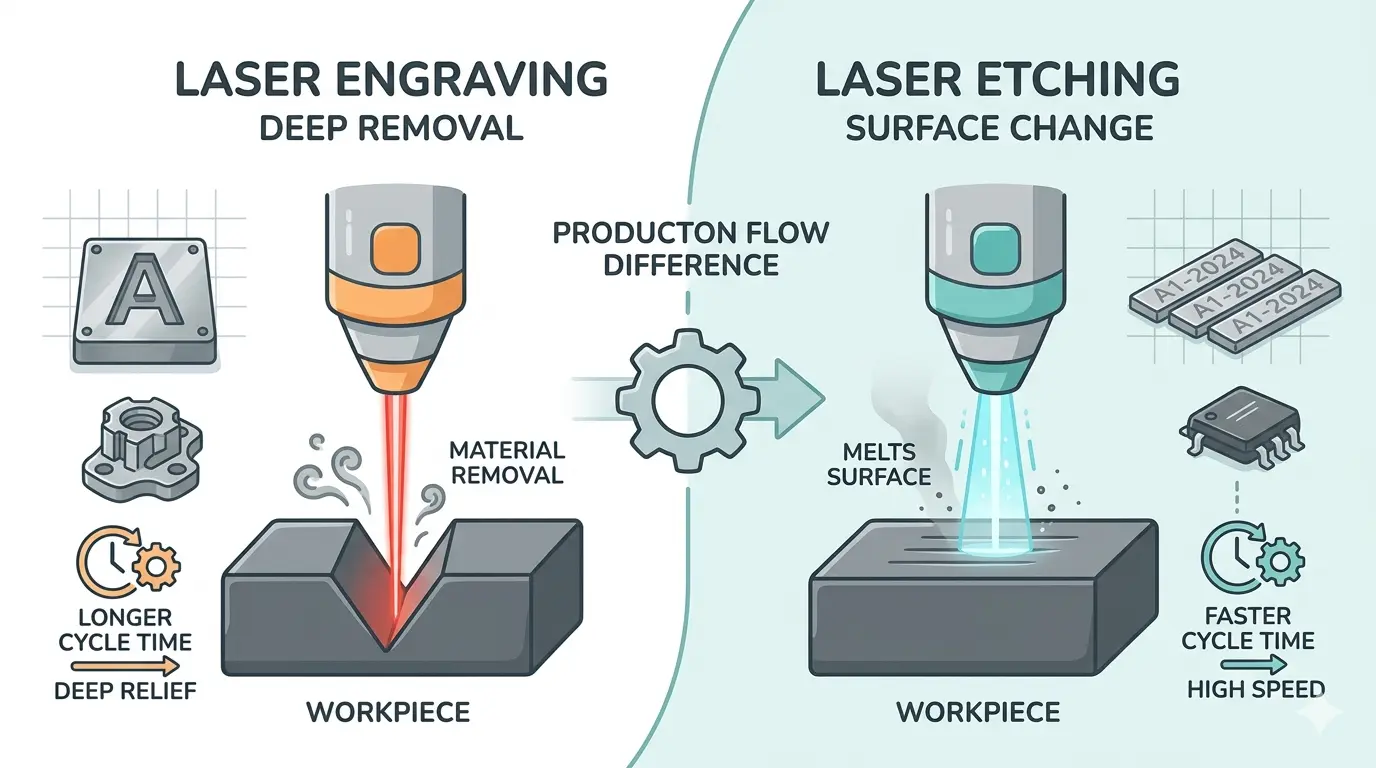
In practical production language, laser etching usually refers to a shallow surface-level result. The process changes the appearance of the top layer more than it removes substantial material. Depending on the substrate, that may show up as a color change, a lightly textured surface, a thin top-layer removal, or a visible but relatively shallow mark.
From a workflow perspective, etching-led jobs are often chosen when the factory wants:
- Clear Surface Contrast
- Fast Cycle Times
- Limited Material Removal
- Low Post-Process Cleanup
- Readable Branding, Graphics, Or Identification
That is why etching is commonly associated with traceability, decorative surface graphics, product branding, and parts where appearance matters more than depth.
What Laser Engraving Usually Means In Practice
Laser engraving usually implies more material removal than etching. The finished result is often easier to feel with a fingertip, easier to see from different viewing angles, and more dependent on stable depth control across repeated orders.
Once the job becomes engraving-led, the machine is being judged on more than contrast. It is also being judged on how efficiently it can remove material while keeping the surrounding surface acceptable.
That shifts attention toward:
- Deeper Recessed Detail
- More Noticeable Tactile Results
- Greater Heat Exposure Per Part
- Higher Residue And Smoke Load
- Longer Processing Time On Filled Areas Or Repeated Passes
This is where many buyers discover that the label engraving is not just a naming preference. It usually signals a more demanding workload.
Side-By-Side Production Comparison
| Real-Use Factor | Laser Etching Workflow | Laser Engraving Workflow | Why It Matters |
|---|---|---|---|
| Main Result | Surface contrast or light top-layer change | Visible recessed detail with more material removal | The inspection standard changes |
| Depth Expectation | Usually shallow | Usually deeper and easier to feel | More depth usually means more machine time |
| Cycle Time Pressure | Better fit for faster marking-style throughput | More likely to slow output on dense or filled artwork | Queue planning becomes more important |
| Cleanup Burden | Often lighter | Often higher because of residue and heat effect | Labor after the machine may rise |
| Artwork Fit | Text, logos, serial information, light graphics | Recessed logos, decorative depth, stronger visual texture | File design starts affecting production economics |
| Risk Focus | Contrast consistency and readable appearance | Depth consistency, surface finish, and edge cleanliness | Rework shifts from visibility issues to finish issues |
The table makes the key point: buyers are not only choosing a label. They are choosing how the job will behave across the shift.
Is There Usually A Strict Machine Difference?
Often, no strict hardware boundary exists. A machine sold as a laser etching machine may still be capable of engraving within a reasonable process range. A machine sold as a laser engraving machine may also handle shallow etched-style work without difficulty.
What buyers are really evaluating is whether the system has enough control range and process stability to cover the needed result without becoming inefficient.
That usually comes down to fundamentals such as:
- Motion Stability
- Focus Consistency
- Reliable Exhaust And Smoke Removal
- Repeatable Material Positioning
- Stable Cooling And Daily Operating Consistency
- Process Control Across Different Artwork Types
So the real buying question is rarely “Which machine etches and which machine engraves?” The more useful question is “How far can this machine move from light surface work into deeper removal before quality, speed, or cleanup become a problem?”
When An Etching-Led Workflow Usually Makes More Sense
An etching-led workflow is commonly the better fit when the part only needs a clear, permanent, and visually consistent mark rather than noticeable depth. That often applies when factories are producing:
- Product Branding And Logos
- Surface Decoration On Finished Parts
- Identification Marks And Traceability Features
- Light Graphic Panels
- High-Mix Jobs With Frequent Artwork Changes
In these cases, the business value usually comes from speed, readability, visual consistency, and lower post-process handling. The factory is not trying to create a carved look. It is trying to create an acceptable mark with minimal disruption to the rest of the line.
When An Engraving-Led Workflow Usually Makes More Sense
Engraving becomes the better fit when depth itself contributes to the product value. That may be because the customer wants a more premium tactile effect, a more durable recessed feature, or a stronger visual result that stands out after finishing, handling, or long-term use.
That often applies when production parts need:
- Recessed Decorative Features
- More Noticeable Visual Depth
- A Tactile Surface Result
- Stronger Mark Persistence After Wear Or Finishing Steps
- More Premium-Looking Branded Details
The tradeoff is that deeper work often consumes more time and creates more process burden. A laser that looks productive on a shallow logo sample can become much slower when the actual workload is full-area removal or repeated deeper passes.
What Buyers Should Check Before Choosing
The safest way to compare etching and engraving is to start with the finished part and work backward through the workflow.
Buyers usually get a clearer answer when they ask:
- Does The Product Need Contrast, Depth, Or Both?
- How Much Tactile Recession Is Actually Required?
- How Much Machine Time Per Part Is Acceptable?
- Will Residue, Darkening, Or Surface Cleanup Create Extra Labor?
- Is The Queue Mostly Text And Graphics, Or Depth-Heavy Decorative Work?
- Does The Material React Well To Light Surface Processing, Or Will It Demand More Care To Keep The Finish Acceptable?
These questions expose the real production logic. A factory running shallow branding across many part variations is solving a different problem from a factory trying to create repeated recessed features on higher-value decorative pieces.
What This Means For Wood, Acrylic, And Similar Non-Metallic Work
In wood, acrylic, and related non-metallic workflows, the difference is often easiest to see in cleanup and finish expectations. Light etched-style work is usually chosen for readable branding, simple graphics, and quicker decorative processing. Engraving becomes more attractive when the part needs a visibly recessed result, stronger texture, or a more premium-looking decorative finish.
That is also why sample evaluation matters so much. A machine may look flexible enough to do both, but the practical decision depends on whether the shop can hold acceptable appearance, throughput, and cleanup effort once the job mix becomes real. A shallow mark that looks excellent at demonstration scale does not automatically prove that deeper engraving will make sense across daily production.
Practical Summary
The difference between a laser etching machine and a laser engraving machine is real in production, but it is usually a difference in job demand more than a clean split between two unrelated machine classes. Etching typically points toward shallow surface change, faster marking-style workflows, and lower cleanup burden. Engraving usually points toward greater material removal, more visible depth, and a heavier process load.
For buyers, the practical lesson is simple: compare the required result, the acceptable cycle time, and the cleanup burden before you compare the label. If the workload depends on fast, readable, surface-level results, etching-led evaluation is usually enough. If the workload depends on visible recessed detail and stronger tactile effect, the machine needs to be assessed as an engraving platform with all the extra workflow demands that come with it.