The first laser cutting machine price a buyer sees is rarely the number that matters. One supplier may quote a base machine only. Another may include cooling, extraction, software, installation, and operator training. A third may look more expensive at first glance simply because the quote is more complete.
For buyers evaluating laser cutters and engravers for wood, acrylic, and similar non-metal materials, the real question is not just “How much does the machine cost?” The more useful question is “What exactly is included in the final quote, and which parts of that scope actually affect production?”
Why Headline Prices Usually Mislead Buyers
Laser cutting machine pricing often looks inconsistent because buyers are not always comparing the same purchase scope.
Two quotes can both be described as laser cutting systems and still represent very different production expectations. One may be suitable for occasional shape cutting on acrylic sheets. Another may be configured for repeated daily production, larger workpieces, stricter finish requirements, or a mixed cut-and-engrave workflow. On paper, both are laser machines. In practice, they solve different factory problems.
That is why the lowest number on a quotation sheet does not automatically represent the lowest real investment. In many cases, it only reflects how much of the required production system has been left out.
Start With the Job Scope Before You Compare the Price
The final quote is usually driven first by what the machine is expected to do every day.
Buyers should define a few operating realities before comparing suppliers:
- Which Materials Consume Most of the Weekly Runtime
- Whether Jobs Are Cutting Only Or Cutting Plus Engraving
- Whether Parts Are Small, Detailed, And Finish-Sensitive Or Large And Throughput-Driven
- Whether Production Is Mostly Repeated Batch Work Or Frequent Job Changes
- Whether Operators Need Fast Recipe Recall Across Multiple Materials
- Whether Appearance Defects, Burn Marks, Or Edge Cleanup Create Customer Risk
These questions matter because a machine bought for occasional sign blanks is not priced the same way as a machine expected to hold stable quality across daily acrylic parts, decorative wood panels, and short-run custom orders.
If the actual workload extends into metal sheet cutting, tube processing, or industrial marking, that should be treated as a separate equipment-selection path rather than folded into the same quote comparison. Those systems follow different cost logic and should not be benchmarked as if they belong to one machine class.
The Main Factors That Push the Final Quote Up Or Down
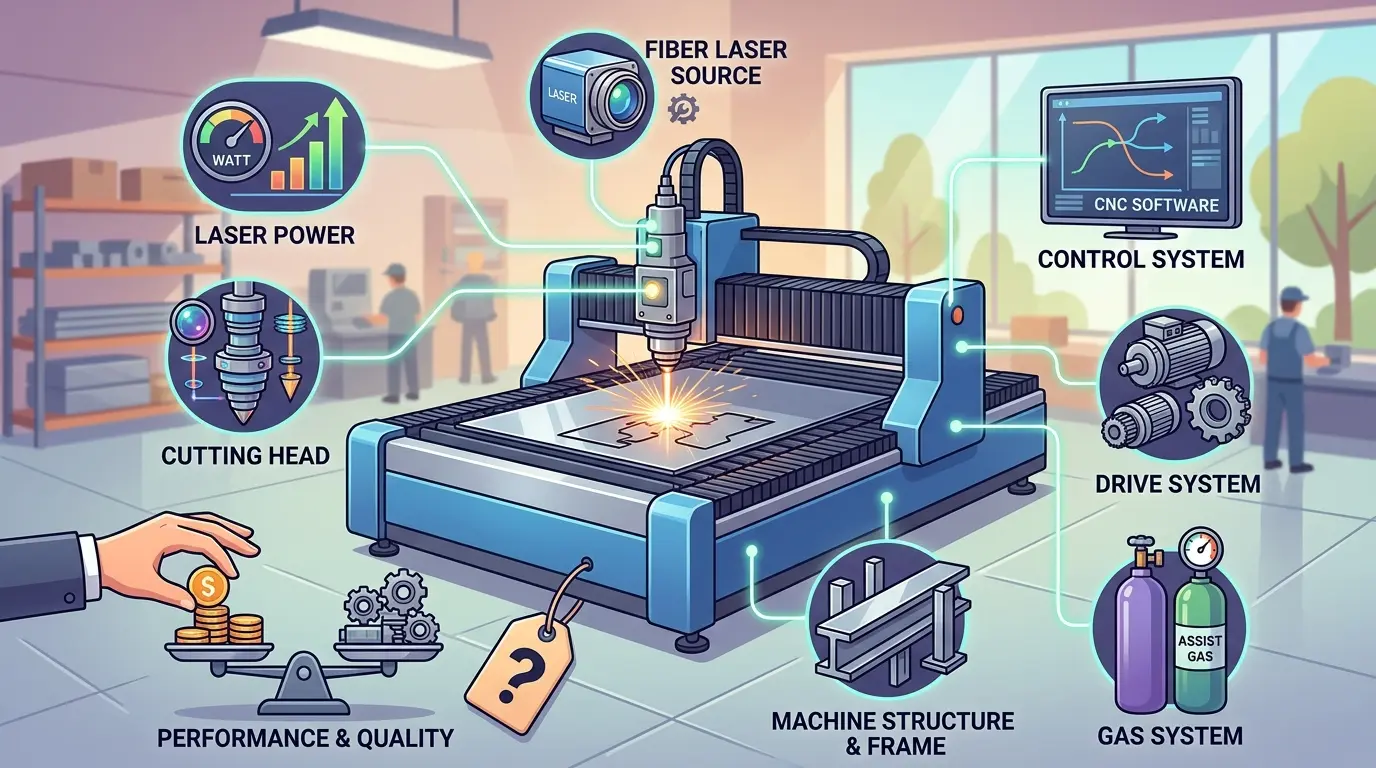
The biggest price drivers are usually the parts of the system that change workflow fit, usable output, and operating stability.
| Quote Driver | Why It Changes the Price | When It Matters Most |
|---|---|---|
| Material Fit and Process Scope | A machine configured for simple cutting is priced differently from one expected to support broader cutting and engraving needs across several non-metal materials | Mixed-material production, custom fabrication, and decorative work |
| Work Area and Table Size | Larger working zones usually increase machine footprint, structural scope, and handling expectations | Larger panels, bigger acrylic sheets, or nested multi-part layouts |
| Power Matched to Routine Work | The quote changes when buyers need more comfortable processing across thicker or more demanding routine materials | Shops where cycle time and stable cut-through both matter |
| Motion Stability and Positioning Control | Better control helps reduce variation, protects detail quality, and lowers placement errors | Customer-visible parts, repeat orders, and tighter tolerance expectations |
| Extraction, Cooling, and Process Environment | Supporting equipment affects residue control, thermal stability, and overall production cleanliness | Acrylic appearance, wood edge quality, and longer daily runtime |
| Software and Job Management | Better workflow tools reduce setup variation and help standardize repeat work | High-mix shops, frequent file changes, and multiple operators |
| Material Handling and Fixtures | Better part support and positioning can improve throughput and reduce operator correction | Small-part batching, repeated layouts, and short-run production |
| Commissioning, Training, and Service Scope | Installation support changes how quickly the machine becomes productive after delivery | First-time laser buyers and factories adding a new process |
Commercial buyers should read the quote through that lens. If one proposal is lower because it strips out the items that protect output consistency, then it may only be cheaper in the narrowest purchasing sense.
Why the Same Machine Category Can Produce Very Different Quotes
Even within the same broad machine category, final quotations move based on how the supplier defines the project.
One buyer may request a machine only. Another may require a more complete installed solution with process-support equipment, operator onboarding, and a clearer startup path. The second quote often looks higher because it reflects the real factory handoff, not just the crate price.
This is especially common when buyers are moving from prototype use to commercial production. At that point, the purchase is no longer just about whether the beam can cut the material. It becomes a question of whether the workflow can stay stable over time without creating extra cleanup, rework, operator dependency, or lost hours during changeovers.
That shift is what turns a simple machine price into a final quote.
The Costs Buyers Often Miss Outside the Base Machine
One of the most common pricing mistakes is treating the base machine number as the full investment.
In practice, buyers should normalize every quote to include the same commercial buckets before comparing suppliers.
| Cost Area | Why It Should Be Separated Clearly |
|---|---|
| Extraction and Cooling | These are often essential to stable daily operation, not optional extras |
| Software or Job Preparation Tools | Workflow control can materially affect repeatability and setup time |
| Fixtures or Positioning Aids | These can influence part placement accuracy and operator efficiency |
| Installation and Commissioning | Startup speed and early production stability often depend on this support |
| Operator Training | Training changes how quickly the machine reaches consistent output |
| Spare and Maintenance Items | Early downtime risk is easier to manage when essential support items are planned upfront |
| Freight, Import Terms, and Site Preparation | Commercial terms can shift the real purchase cost significantly even when the machine itself is unchanged |
Without this normalization, buyers are often comparing different purchasing scopes rather than different machines.
A Lower Quote Can Still Mean a Higher Cost Per Good Part
The final quote should be judged against production outcome, not just against budget approval.
A cheaper machine can become more expensive when it introduces problems such as:
- More Setup Drift Between Jobs
- More Edge Cleanup Or Surface Residue
- More Operator Intervention During Production
- More Variation Across Repeated Parts
- More Rework On Customer-Facing Components
- More Time Lost Solving Startup Or Maintenance Issues
For industrial buyers, this is the real pricing issue. The better question is not whether the machine costs less on day one. The better question is whether it produces acceptable parts with manageable labor, stable repeatability, and less friction across normal production conditions.
That is usually what separates a low quote from a strong quote.
When Paying More Usually Makes Sense
Higher pricing is not automatically justified. But paying more often makes sense when the business depends on lower process risk.
That usually includes situations such as:
- Repeated Daily Production Across Several Operators Or Shifts
- Customer-Facing Parts With Strict Appearance Standards
- Frequent Material Changes That Need Reliable Recipe Control
- Combined Cutting-And-Engraving Workflows In One System
- Faster Ramp-Up After Delivery With Less Trial-And-Error On the Shop Floor
In those cases, the additional spend is not about prestige. It is about reducing waste, shortening the learning curve, and protecting usable throughput.
By contrast, if the workload is simple, infrequent, and operationally forgiving, a more basic purchase scope may be fully reasonable. The right quote level depends on workflow risk, not on the assumption that every buyer needs the same configuration.
Do Not Compare Different Laser Process Families With One Price Logic
Buyers sometimes search for a general laser cutting machine price and then try to compare every laser system they find under one budget framework. That usually creates confusion.
A non-metal laser system for acrylic, wood, and similar materials should not be priced the same way as a sheet-metal cutting system, a tube-cutting platform, or a dedicated marking system. Material class, process demands, safety requirements, and downstream workflow all change the quote structure.
So if the buying team is still deciding between non-metal cutting, metal fabrication, tube processing, or marking applications, the first step is not price negotiation. The first step is clarifying which production problem the machine is actually meant to solve.
Only then does quote comparison become meaningful.
Questions Buyers Should Ask Before Approving a Quote
Before moving forward, industrial buyers should be able to answer the following clearly:
- What Materials Will Use Most of the Machine Hours?
- Is the Workflow Mainly Cutting, Or Cutting Plus Engraving?
- What Part Sizes And Finish Standards Define Acceptable Output?
- Which Costs Are Included in the Quote, and Which Are Left Outside It?
- How Much Changeover Time Is Acceptable Between Jobs?
- What Support Is Available During Installation, Startup, and Early Production?
- What Process Problems Would Be Most Expensive for the Plant: Scrap, Cleanup, Slow Changeovers, Or Downtime?
These questions usually produce a better buying decision than asking for a generic market average. They force the quote discussion back toward real production needs.
Practical Summary
Laser cutting machine price is rarely one clean number. The final quote is usually driven by application scope, material fit, work area, supporting equipment, software workflow, installation support, and the level of repeatability the buyer expects in daily production.
The strongest way to compare quotes is to define the job first, normalize the commercial scope second, and judge the system by the cost of producing good parts rather than by the smallest headline figure. That approach gives industrial buyers a much more useful answer than any isolated price tag ever will.