In cabinet production, drilling errors rarely announce themselves at the machine. They usually appear later, when shelf pins do not align cleanly, hinges need adjustment, connector holes slow assembly, or drawer components need extra checking before hardware installation. By the time those issues show up, the cost is already moving through the line as rework, slower assembly, and less predictable throughput.
That is why CNC drilling matters in cabinetry. It changes drilling from a largely operator-dependent task into a programmed, repeatable process. For factories producing repeated carcass parts, shelves, drawer panels, and hardware-ready components, that usually leads to better hole-position consistency and a faster daily production rhythm.
Why Hole Accuracy Has Such A Large Downstream Effect
Cabinet production depends on alignment. A panel can look acceptable after cutting and edge finishing, yet still create delays if the holes that guide assembly are slightly off from where they should be.
Common drilling-related problems include:
- Shelf-pin rows that do not stay consistent from panel to panel
- Connector and dowel holes that slow carcass assembly
- Hinge-related drilling that leads to extra door adjustment later
- Drawer component drilling that creates fit variation in box assembly
- Too much measuring, marking, or manual correction before hardware installation
In other words, drilling accuracy is not just about making holes in the right place once. It affects whether the cabinet goes together smoothly every time. When hole placement drifts, the assembly team becomes the last quality-control stage for a drilling problem that should have been prevented earlier.
What CNC Drilling Changes In The Workflow
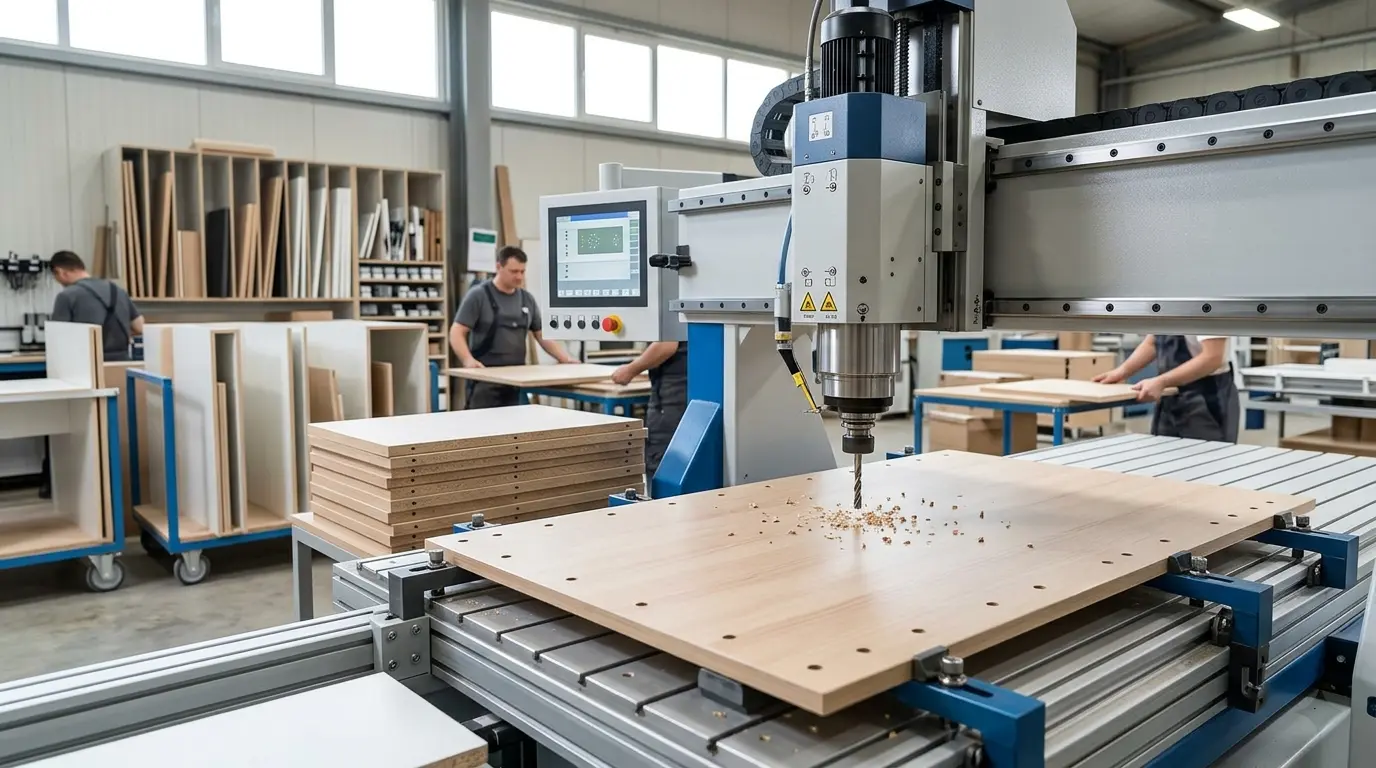
In many cabinet factories, drilling follows repeated logic. Side panels need matched hole patterns. Shelves require consistent rows. Drawer parts rely on stable referencing. Hardware mounting depends on predictable distances and repeated positioning. CNC drilling improves these tasks because the pattern is driven by the program and machine referencing rather than repeated manual layout.
For buyers evaluating dedicated boring and drilling machines, the core benefit is not simply automatic hole making. The more important advantage is repeatability. Once the part is referenced correctly and the drilling sequence is set, the machine can process repeated cabinet components with far less variation than a manual or jig-heavy workflow.
That usually changes the daily process in four practical ways:
- Less manual measuring and marking before drilling
- More consistent hole placement across repeated batches
- Lower dependence on individual operator technique
- Cleaner handoff into hardware fitting and assembly
In cabinet production, that kind of control often matters more than any isolated discussion about drilling speed.
Where The Accuracy Gains Actually Show Up
The value of CNC drilling becomes easier to see when you look at the downstream effects instead of the drilling station alone.
| Drilling Task | What Becomes More Stable | Why It Matters Downstream |
|---|---|---|
| Shelf-pin and line-boring patterns | Hole spacing and repeat positioning | Shelves sit level and panels match across the batch |
| Connector and dowel holes | Panel-to-panel alignment | Carcass assembly goes together with less forcing and checking |
| Hinge-related drilling | Mounting consistency across repeated doors and carcass parts | Door fitting requires less correction |
| Drawer component drilling | Repeated hole logic on similar parts | Drawer assembly and hardware mounting move faster |
| Left-right panel matching | Symmetry and sequence consistency | Sorting effort drops and assembly surprises become less common |
The practical effect is that accuracy becomes systematic rather than accidental. Instead of correcting slightly different panels one by one, production can move forward assuming the hole pattern will repeat as expected. That is especially important in cabinet workflows built around standardized hole layouts, where even small positional drift can create disproportionate assembly friction.
Throughput Improves When Rechecking Stops Slowing The Line
Factories do not improve throughput simply because a drilling head moves faster. They improve throughput when repeated parts spend less time being measured, less time waiting for clarification, and less time being corrected after drilling.
That is why the throughput gain from CNC drilling usually comes from process stability as much as machine motion. In batch cabinet production, the workflow often improves because:
- Repeated panels can move through drilling with fewer setup doubts
- Operators spend less time verifying hole locations on routine jobs
- Assemblers receive parts that are more ready for hardware fitting
- Fewer mismatched panels need to be separated for checking or rework
- Standard cabinet parts are easier to batch and sequence through production
In higher-volume environments, multi-spindle or multi-row drilling approaches are commonly used because they help process repeated hole groups more efficiently than step-by-step manual drilling. But even then, the real productivity gain is not only the drilling cycle itself. It is the reduction in hesitation, correction, and downstream interruption.
Dedicated CNC Drilling And CNC Nesting Solve Different Problems
CNC drilling is not automatically the best first answer for every shop. The right fit depends on whether the factory mainly needs faster, more repeatable hole processing or a broader cell that combines cutting, routing, and drilling.
| Workflow Option | Best Fit | Main Advantage | Main Tradeoff |
|---|---|---|---|
| Manual or jig-based drilling | Low-volume work, one-off jobs, or highly flexible operations | Simple to adapt for varied parts | More operator-dependent and harder to scale accurately |
| Dedicated drilling or boring workflow | Repeated cabinet sides, shelves, drawer panels, and hardware-hole preparation | Strong repeatability for drilling-heavy batch flow | Separate process cell rather than an all-in-one solution |
| CNC nesting machines | Custom furniture, shaped parts, and workflows combining cutting, routing, and drilling | Integrates several processes in one cell | May be a less direct answer if the main bottleneck is repeated hole processing on standard cabinet parts |
This tradeoff matters. A factory dominated by repeated rectangular cabinet components often benefits from a dedicated drilling workflow because it keeps hole-making highly consistent and organized. A factory built around custom shapes and combined processing may be better served by an integrated nesting workflow instead.
What To Evaluate Before Upgrading Your Drilling Process
Before investing in CNC drilling, buyers should pressure-test the decision against the real workflow rather than the most attractive machine description.
| Buying Question | Why It Matters |
|---|---|
| Are most daily parts repeated cabinet components? | CNC drilling creates the most value when hole patterns repeat across batches |
| Is assembly losing time because of hole mismatch or hardware-fit variation? | Confirms that drilling accuracy is affecting the wider line |
| Does the factory mainly process rectangular panels or more shaped custom parts? | Helps clarify whether dedicated drilling or integrated nesting is the better fit |
| How much output depends on one experienced operator getting the setup right? | High operator dependency usually signals room for a more repeatable process |
| Are downstream teams correcting drilling variation that is not being measured formally? | Hidden rework often justifies the investment more clearly than nominal speed claims |
| Is the business trying to scale batch production, reduce rework, or both? | Keeps the purchase tied to production goals rather than machine features alone |
These questions usually produce a clearer decision than a feature-by-feature comparison. The best drilling investment is the one that removes a real production constraint.
Practical Summary
In cabinet production, CNC drilling improves accuracy by making hole placement more repeatable and less dependent on manual layout or operator correction. It improves throughput because repeated parts move through drilling, hardware fitting, and assembly with fewer interruptions and fewer fit-related surprises.
That does not mean every factory needs the same drilling solution. Manual drilling can still make sense for low-volume flexible work. Integrated nesting can be the better fit for shape-driven or multi-process production. But when repeated cabinet parts need stable hole positioning and cleaner assembly flow, CNC drilling is often one of the most practical ways to improve both accuracy and daily output.