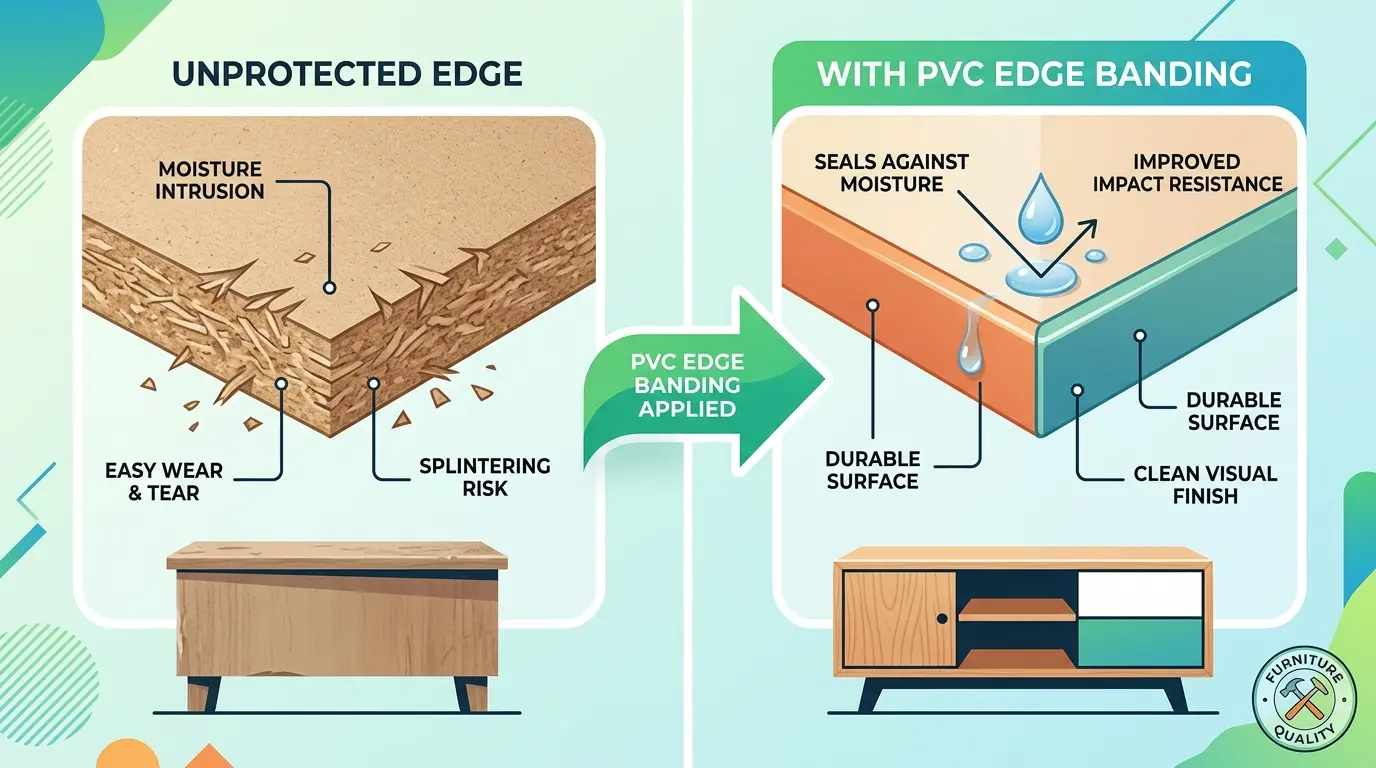
A cabinet can be cut accurately, drilled correctly, and assembled square, yet still look low grade or wear out early if the exposed edges are weak. In panel-based furniture, the edge is where daily contact, cleaning, impact, and visual inspection all concentrate.
That is why PVC edge banding is not just a decorative strip. It is a functional layer that helps protect the panel core while also shaping how finished furniture looks to the customer. For kitchen cabinets, wardrobes, office furniture, retail fixtures, and other board-based products, edge quality often has a direct effect on both service life and perceived value.
Why The Edge Matters More Than Many Buyers Expect
The face of a panel usually gets most of the design attention, but the edge often takes more abuse in real use. Shelves are loaded and unloaded from the front edge. Cabinet doors are touched at the perimeter. Drawer fronts are exposed to repeated contact, cleaning, and occasional knocks. Table and desk edges are where chips, swelling, or peeling become most visible.
If the panel core stays exposed or poorly protected, several problems can appear faster:
- Edge Chipping From Repeated Contact
- Moisture Reaching Sensitive Board Cores
- Surface Swelling Along The Panel Edge
- Early Corner Damage On High-Touch Parts
- A Finished Product That Looks Cheaper Than Its Face Material Suggests
PVC edge banding is commonly used because it helps solve those problems in a way that is compatible with large-scale furniture production, consistent finishing, and a wide range of panel colors and surface styles.
What PVC Edge Banding Changes In Practice
| Edge-Banding Factor | Effect On Durability | Effect On Appearance | What Production Teams Usually Watch |
|---|---|---|---|
| Banding Thickness | More edge protection against bumps, chips, and abrasion when the application fits the use case | Changes how substantial or refined the edge looks | Whether the banding matches the stress level of the part |
| Substrate Edge Preparation | Better bonding and fewer weak points when the board edge is clean and uniform | Reduces waviness, gaps, and visible seam irregularity | Edge quality before banding, including chips and roughness |
| Adhesive And Bond Quality | Helps prevent lifting, peeling, and premature edge failure | A cleaner glue line improves visual finish | Consistent adhesive application and pressure |
| Trimming And Corner Finishing | Protects corners from early breakdown when finishing is controlled well | Creates a smoother, more premium edge feel | Flush trimming, end trimming, and corner quality |
| Color, Texture, And Gloss Match | Does not directly increase strength, but helps keep repairs or replacements less obvious | Strongly affects whether the furniture looks integrated or patched together | Match between edge material and panel face |
This is the practical reality: furniture durability and furniture appearance are both affected by PVC edge banding, but they are not affected by the PVC strip alone. They depend on the full combination of banding choice, substrate condition, bonding quality, and finishing control.
How PVC Edge Banding Improves Furniture Durability
The most direct durability benefit is edge protection. Board materials such as MDF, particleboard, and melamine-faced panels can perform well in furniture production, but their edges are usually more vulnerable than their faces. A properly applied PVC edge helps create a protective barrier at that weak point.
In daily use, that can help in several ways.
First, it helps reduce edge chipping. Repeated contact with boxes, tools, cookware, office equipment, or normal hand use can damage exposed board edges quickly. PVC edge banding provides a sacrificial protective layer, which helps the underlying panel stay intact longer.
Second, it helps limit moisture exposure at the edge. This matters especially in kitchens, bathrooms, laundry areas, and commercial interiors where cleaning or humidity is part of normal operation. PVC edge banding does not make a furniture part waterproof by itself, but it commonly helps reduce direct moisture contact with absorbent board cores.
Third, it improves corner resistance when the edge-banding choice matches the job. Thicker PVC banding is commonly selected for high-contact parts such as work surfaces, cabinet doors, exposed shelving, and commercial fixtures because it gives the edge more protection against impact and day-to-day wear.
This is also why durability should be judged by use case, not by material name alone. A low-contact cabinet interior panel and a reception counter edge do not place the same demands on the banding. The right PVC edge-banding approach depends on where the part sits in the workflow and how the finished furniture will be used.
How PVC Edge Banding Shapes The Visual Finish
Appearance is not only about color matching. PVC edge banding influences how clean, consistent, and complete the furniture looks when viewed up close.
One of the first visual effects is seam quality. If the edge banding sits flush, the glue line stays controlled, and the transition into the panel face is clean, the product usually looks more precise and better finished. If the seam is uneven, discolored, or too obvious, even a well-made cabinet or wardrobe can appear lower in quality.
Another major factor is the relationship between the edge and the panel face. Color, gloss level, texture, and overall visual harmony all matter. A close match tends to make the furniture look more integrated. A poor match can make the edge stand out in a way that feels accidental rather than intentional.
Banding thickness also changes the visual impression. A thinner edge can support a tighter, lighter look on some furniture parts. A more substantial edge can make the product feel more robust, especially on exposed worktops, desks, shelving, and heavy-use commercial pieces. Neither approach is universally better. The right choice depends on the design language and the stress level of the component.
The tactile effect matters too. Customers and end users often touch the edge before they consciously judge the rest of the part. A smooth radius, controlled corner finish, and clean trim line make the furniture feel more finished. Rough trimming, corner defects, or visible glue buildup make the product feel less refined immediately.
Why Process Control Matters As Much As The PVC Material
High-quality PVC banding cannot fully compensate for poor panel preparation or unstable application. If the board edge is chipped, dusty, out of square, or inconsistent, the finished edge is more likely to show a weak bond, visible seam variation, or an uneven surface.
That is one reason automated edgebanders are commonly used in furniture production when factories need more consistent edge quality. The real advantage is not just speed. It is the ability to keep edge preparation, adhesive application, trimming, and finishing more stable from part to part.
In practical terms, production teams usually need to control:
- Edge Preparation Before Banding
- Adhesive Stability And Bond Consistency
- Flush Trimming Without Damaging The Face Material
- End Trimming And Corner Quality On Exposed Parts
- Match Between The Banding Choice And The Product’s Real Use Conditions
When those factors stay under control, PVC edge banding is much more likely to deliver both the durability and appearance benefits buyers expect. When they do not, the product may show problems such as corner lift, visible glue lines, edge telegraphing, or premature peeling even if the base materials are otherwise acceptable.
What Buyers And Production Managers Should Check First
When evaluating finished furniture or reviewing sample parts, the most useful questions are usually simple:
- Does The Edge Sit Flush Without A Visible Step Or Gap?
- Is The Glue Line Tight And Consistent Rather Than Obvious And Irregular?
- Do The Corners Look Durable Enough For The Intended Use?
- Does The Color, Texture, And Gloss Match The Face Material Well Enough?
- Is The Banding Choice Appropriate For A Low-Contact Part Or A High-Wear Part?
Those checks help keep the conversation focused on performance and finish quality rather than on vague claims about materials. In many factories, edge quality is one of the clearest signals of whether the furniture will hold up well in use and whether it will look credible in front of the customer.
Practical Summary
PVC edge banding affects furniture durability by helping protect vulnerable panel edges from chipping, moisture exposure, abrasion, and daily impact. It affects appearance by shaping seam visibility, edge smoothness, corner finish, and how well the edge visually integrates with the face material.
The important tradeoff is that good results do not come from PVC alone. They come from matching the banding choice to the furniture application and applying it with stable process control. In other words, PVC edge banding is most valuable when it is treated as both a protective system and a visual finishing step. For furniture makers, that is what turns a panel part from merely usable into a part that looks finished and stays finished longer.