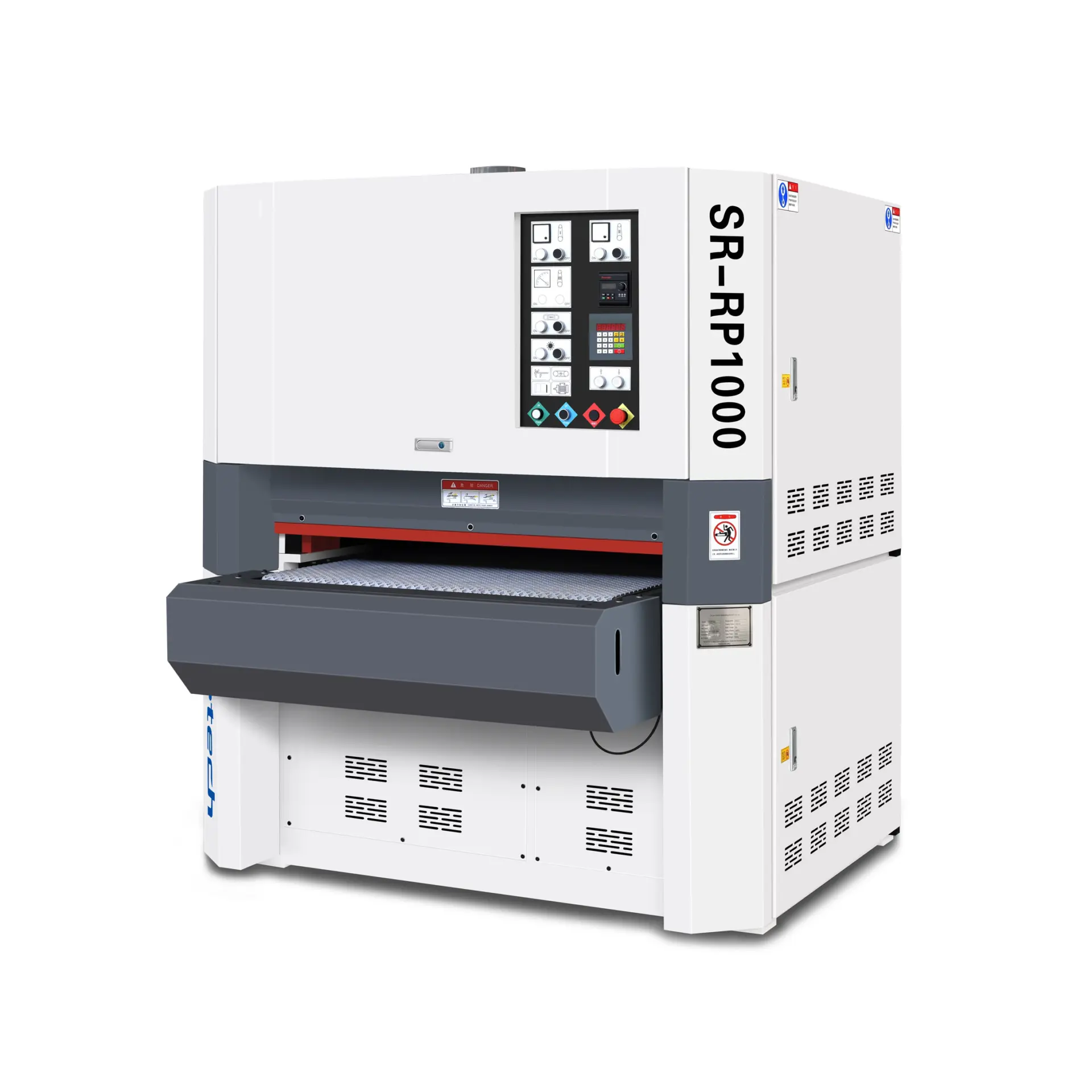
In furniture production, sanding problems usually show up late. A panel looks acceptable coming off the machine, then coating reveals scratch inconsistency, veneer sand-through, thickness variation, rounded edges, or a surface that still needs too much hand correction. By that point, the wide belt sander is no longer just a finishing step. It has become a bottleneck, a quality-control point, and a source of avoidable rework.
That is why wide belt sander configuration should be treated as a workflow decision rather than a machine-label decision. The right setup helps stabilize thickness, flatten glued or machined parts, and prepare surfaces for coating or assembly. The wrong setup either removes material too aggressively, leaves the scratch pattern too coarse for the next process, or adds machine complexity without solving the real production problem.
What Problem Should The Configuration Solve?
A wide belt sander is commonly used in furniture production for calibration and finish preparation on solid wood parts, veneered panels, and paint-grade substrates. But configuration should start with the plant’s actual bottleneck.
For most furniture factories, that usually means clarifying whether the sanding station is expected to do one or more of the following jobs:
- Level Thickness Variation After Gluing, Planing, Or Machining
- Improve Surface Consistency Before Staining, Priming, Or Topcoat
- Reduce Hand Sanding And Touch-Up Before Final Finishing
- Stabilize Quality Across Shifts, Batches, And Operators
- Keep Panels And Components Moving Cleanly Into Coating Or Assembly
If the main problem is flatness and stock removal, the configuration should lean toward calibration control. If the problem is finish quality before coating, the final head sequence and pressure behavior matter more. If both problems exist, the machine has to balance removal and refinement instead of maximizing one at the expense of the other.
Start With The Surface Requirement, Not The Machine Label
Two furniture factories can buy the same machine category and still need very different sanding setups. The reason is simple: they are not sanding the same surface to the same endpoint.
A producer of solid wood tabletops or frame components may need more aggressive leveling at the start of the process. A plant running veneered panels usually needs tighter control over pressure and stock removal because the surface layer offers less margin for correction. A shop preparing MDF for painted furniture may care less about heavy removal and more about keeping the scratch pattern consistent before primer.
The first questions should be operational:
- Are You Removing Variation Or Refining An Already Stable Surface?
- Is The Main Output Solid Wood Parts, Veneered Panels, Or Paint-Grade MDF?
- How Much Hand Sanding Happens After The Machine Today?
- Does Coating Reveal Scratch Problems, Waviness, Or Thickness Variation?
- Is The Line Mostly Repetitive, Or Does Material And Part Style Change Frequently?
Those questions usually point to a better configuration faster than comparing machine descriptions in isolation.
The Main Wide Belt Configurations And Where They Fit
When evaluating wide belt sanders, the most useful comparison is not machine size alone. It is the head sequence and the kind of surface control each configuration supports.
| Configuration | Best Fit | What It Adds To The Workflow | Tradeoff |
|---|---|---|---|
| Single-Head Calibration Setup | Shops that mainly need basic leveling on relatively stable incoming material | Simplifies thickness control and removes light variation before downstream finishing | Limited ability to refine the final scratch pattern inside the same pass |
| Two-Head Roller Plus Platen Setup | General furniture production balancing stock removal and surface preparation | Gives one stage for calibration and another for finish refinement, which often reduces hand sanding | If the first head is set too aggressively, the second head spends more time correcting than refining |
| Two-Head Heavy-Removal Setup | Solid wood lines where incoming parts vary more and need stronger leveling | Improves removal capacity and can stabilize rougher incoming stock before later finishing | May leave more finish work for downstream sanding if the line also needs coating-ready surfaces |
| Three-Stage Calibration, Intermediate, And Finish Setup | Higher-volume furniture plants where surface consistency directly affects coating quality | Separates removal, surface correction, and finish preparation more clearly, helping repeatability across batches | More heads do not help if upstream material quality is unstable or if the product mix changes constantly |
| Finish-Oriented Configuration With More Surface Control | Veneered panels, paint-grade parts, or workflows where visible scratch consistency matters more than heavy stock removal | Helps manage surface quality with less risk of over-sanding sensitive faces | Usually adds less value if the real plant problem is raw thickness variation rather than finish quality |
The practical lesson is that more stages are useful only when each stage has a clear job. A machine becomes less effective when every head is expected to do everything at once.
How Head Type Changes The Result
Configuration is not only about how many heads the machine has. It is also about how each contact style interacts with the workpiece.
| Sanding Element | What It Usually Does | Where It Often Fits Best | Main Risk If Misapplied |
|---|---|---|---|
| Contact Roller | Removes stock, levels variation, and helps control thickness | Solid wood parts, glued panels, and any workflow that needs real calibration work | Can be too aggressive for sensitive surfaces if finish control matters more than removal |
| Platen | Refines the surface and helps create a more uniform finish pattern | Veneered panels, paint-prep surfaces, and finish-oriented furniture workflows | Adds less value if the incoming part is still too uneven for refinement to be effective |
| Combination Or Segmented Finish Section | Balances some correction with gentler surface preparation | Mixed-product environments that need reasonable flexibility between leveling and finishing | Can become a compromise if the factory actually needs a clear calibration-first or finish-first setup |
In simple terms, the roller is usually about flattening and removal. The platen is usually about finishing. Good configuration comes from deciding which job has priority at each step.
Match The Configuration To Your Product Mix
A wide belt sander configuration should make sense for the material and furniture category moving through it every day.
For solid wood components, the bigger issue is often incoming variation. Parts may come from gluing, planing, or machining with enough difference that the first sanding stage needs to stabilize thickness before anyone worries about finish quality. In that case, a stronger calibration-first setup usually makes more sense than a finish-heavy configuration.
For veneered panels, the logic changes. The workflow usually tolerates less aggressive removal, and pressure control matters more because surface mistakes are harder to recover from. A finish-oriented second stage is often more important here than adding raw removal capacity.
For paint-grade MDF, the sanding station often matters because the coating department will reveal every inconsistent scratch pattern. The goal is not just to remove material. It is to create a flat, repeatable surface that behaves predictably under primer and paint.
For mixed furniture lines, the challenge is flexibility. A highly specialized configuration can perform very well on one product family and become less efficient when the material mix changes throughout the week. In those cases, the better question is not which configuration is strongest in theory. It is which one stays stable across real changeovers.
There is also an important negative case. If the factory mainly runs already finished melamine-faced panels or other surfaces that are not intended for broad-face sanding, then the sanding station may not be the core investment decision at all. That is a sign to rethink the process problem before adding machine complexity.
The Sander Works Best As Part Of The Full Line
Many factories under-evaluate how much wide belt sanding depends on upstream consistency and downstream finishing standards. A sander can improve a process, but it does not erase weak material preparation, unstable gluing, or coating expectations that were never clearly defined.
If incoming parts vary too widely, the first sanding head may spend too much effort correcting material that should have been stabilized earlier. If coating standards are unclear, the machine may be configured for removal while the paint department really needs a more consistent finish pattern. If parts leave the sander without proper flow control, the surface can still be damaged or mixed between batches before the next step.
That is why sanding should be evaluated inside the broader production line. If you are reviewing finishing and panel-processing equipment as one workflow rather than one isolated purchase, the broader Pandaxis machinery catalog can help frame sanding in relation to the rest of the plant instead of as a standalone machine decision.
When More Heads Do Not Improve Production
A common buying mistake is assuming that a more complex configuration is automatically safer. In practice, extra sanding heads help only when the factory knows exactly what each stage is supposed to accomplish.
More stages may add limited value when:
- Incoming Material Quality Is Already Stable
- The Line Does Not Need A Separate Intermediate Correction Step
- Product Mix Changes So Often That Fine-Tuned Sequences Lose Efficiency Between Setups
- The Real Bottleneck Is Still Hand Inspection, Coating, Or Material Handling
- Operators Are Constantly Using Later Heads To Correct Problems Created Earlier In The Sequence
Another mistake is expecting the wide belt sander to repair upstream process instability on its own. It can reduce variation, but it is not a substitute for disciplined material preparation, gluing control, or realistic finishing standards.
Buying Questions Before You Finalize The Setup
Before finalizing a configuration, production teams should pressure-test the decision with questions like these:
- Are We Primarily Calibrating Thickness, Improving Finish Quality, Or Trying To Control Both?
- What Material Mix Actually Dominates The Line Over A Normal Month, Not Just A Few Showcase Jobs?
- How Sensitive Is The Downstream Coating Process To Scratch Consistency And Surface Flatness?
- How Much Manual Sanding Or Rework Do We Need To Eliminate To Justify The Machine Upgrade?
- Does Our Upstream Process Deliver Stable Enough Parts For A Finish-Oriented Configuration To Work Well?
- Will This Setup Still Make Sense If Product Mix Or Finishing Standards Change As The Factory Grows?
Those answers usually reveal whether the factory needs a simple calibration machine, a balanced two-stage setup, or a more structured multi-stage sanding workflow.
Practical Summary
A wide belt sander should be configured according to the surface target and production model, not just the machine category. For furniture factories, the real decision is whether the line needs stronger calibration, better finish preparation, or a stable combination of both.
If the main problem is incoming variation on solid wood or glued parts, calibration-first configurations usually make the most sense. If the goal is coating-ready consistency on veneered or paint-grade surfaces, finish control becomes more important. If the plant runs a mixed workflow, the best configuration is often the one that stays predictable across changeovers rather than the one with the longest head sequence.
The strongest setup is not the most complicated one. It is the one that solves the actual sanding problem, reduces avoidable hand work, and gives the rest of furniture production a flatter, more consistent, and more finish-ready surface to work with.