In a furniture factory, panel cutting rarely fails because the saw cannot make a cut. It fails when the cutting cell cannot feed the rest of production in a stable, repeatable way. If cabinet sides, shelves, doors, bottoms, and partitions arrive late, out of square, or inconsistent from batch to batch, the pressure immediately shifts to edge banding, drilling, sorting, and assembly.
A beam saw is commonly considered when factories need more than basic cutting capacity. The real question is whether it improves front-end production flow enough to justify the investment. This guide looks at where a beam saw fits, where it does not, and what furniture factories should evaluate before buying.
What Problem Should a Beam Saw Solve?
A beam saw is usually chosen for one reason: to make panel sizing more predictable at production scale. In furniture manufacturing, that typically means repeated cutting of MDF, particleboard, melamine-faced board, plywood, and similar sheet materials into clean, consistent rectangular parts.
The better buying question is not, “Can this machine cut panels?” Most machines in the category can. The better question is whether a beam saw solves the problems that are slowing the factory today, such as:
- Inconsistent part sizes reaching downstream processes
- Too much operator-dependent variation in cutting quality
- Slow batch cutting at the front of the line
- Re-cuts caused by poor repeatability
- Material flow problems between cutting, edge processing, drilling, and assembly
If those are the daily bottlenecks, a beam saw becomes a workflow decision rather than a simple equipment upgrade.
When a Beam Saw Makes Sense in Furniture Production
Factories usually get the most value from a beam saw when the business runs around repeated panel processing, not irregular one-off cutting. That often applies to cabinet lines, wardrobes, office furniture, modular storage, and other products built from sheet materials with a high percentage of rectangular parts.
In practice, a beam saw is well suited to factories with conditions like these:
- A large share of output comes from sheet-based furniture components
- Orders are organized in batches, repeats, or standardized families of parts
- Downstream operations depend on stable part dimensions and squareness
- Management wants more repeatable throughput instead of more manual correction
- The factory is trying to reduce variation at the front end of production
This is where many factories see the real benefit. A beam saw does not just help them cut faster. It helps the whole line behave more consistently.
Beam Saw vs. Other Cutting Options
Many buyers do not need to choose between brands first. They need to choose between production strategies. A beam saw is strongest when the main task is repeated rectangular panel sizing. Other machines may be the better fit when flexibility or process integration matters more.
| Machine Type | Best Fit | Main Advantage | Main Tradeoff |
|---|---|---|---|
| Beam saws | Batch furniture production with repeated rectangular panels | High throughput and strong repeatability in front-end cutting | Less naturally suited to irregular shapes or highly mixed one-off work |
| Sliding table saws | Smaller factories, mixed jobs, or custom cutting with more operator control | Flexible cutting and practical handling for varied work | Slower and more dependent on operator consistency in repeated production |
| CNC nesting machines | Higher-mix furniture production combining cutting with routing or drilling logic | Better fit for shaped parts and more integrated processing | May be more than the factory needs if the main bottleneck is only panel sizing |
No option is universally better. A beam saw becomes the stronger choice when rectangular panel throughput and repeatability are the main production priorities.
Buying Criteria That Matter More Than the Brochure
Furniture factories often make weak buying decisions when they compare machinery only by feature lists. A stronger approach is to evaluate how the saw fits the factory’s product mix, labor model, and downstream flow.
| Buying Criterion | Why It Matters in a Furniture Factory | What to Clarify Before Buying |
|---|---|---|
| Product Mix | Determines whether the factory really needs dedicated high-throughput panel sizing | Are most parts repeated and rectangular, or highly customized and irregular? |
| Daily Panel Volume | Shows whether cutting is important enough to deserve a dedicated production solution | Is the current cutting cell limiting output across the day or only at peak times? |
| Repeatability Requirement | Affects edge quality, hole positioning, assembly fit, and rework levels downstream | How costly are dimensional inconsistencies right now? |
| Labor Dependence | Changes how much value the factory gets from more standardized cutting | Is too much performance still tied to individual operator technique? |
| Material Flow | Determines whether the saw improves production or simply moves the bottleneck | How do sheets enter the cell, and how do cut parts leave it in an organized way? |
| Downstream Sensitivity | Shows how much the rest of the line depends on stable cutting quality | Do edge banding, drilling, and assembly suffer when cut sizes vary? |
| Growth Direction | Prevents buying only for today’s workload instead of tomorrow’s production model | Is the factory moving toward higher-output standardized work, more customization, or both? |
| Floor Layout | Affects whether a beam saw can support efficient handling and batching | Is there enough room to keep material movement practical and controlled? |
These questions usually reveal more than any isolated feature comparison.
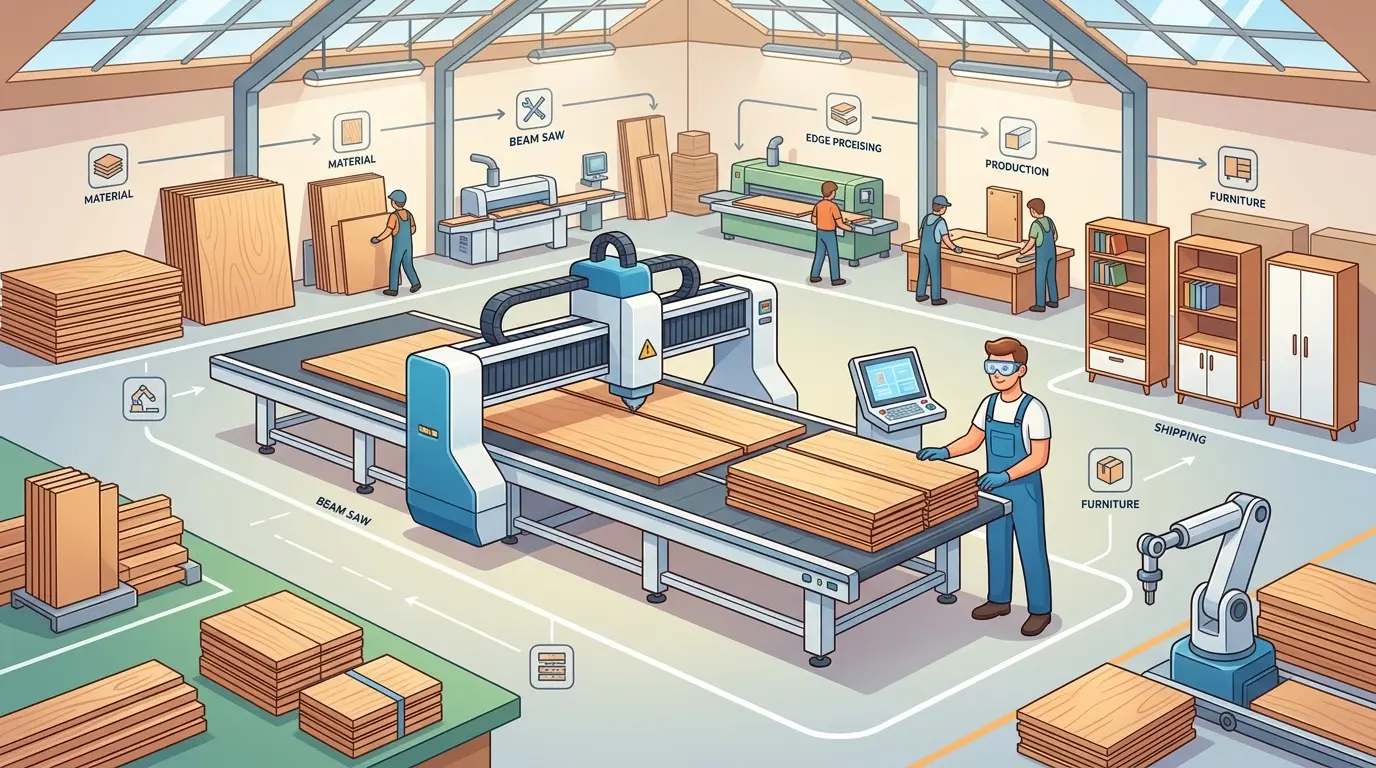
Evaluate the Whole Workflow, Not Just the Cutting Cell
The strongest beam saw buying decisions come from looking beyond the saw itself. In furniture production, the cutting cell only adds value if it improves the behavior of the next steps.
For example, a faster front end does not automatically help the factory if cut parts pile up in disorganized batches or if downstream stations still spend time correcting dimensional variation. The point of a beam saw is to stabilize the start of production so later processes can work with fewer interruptions.
That workflow improvement usually shows up in practical outcomes such as:
- Cleaner handoff into edge processing
- More stable drilling and hardware preparation
- Less manual dimension checking before assembly
- Better batch organization across repeated orders
- Lower risk of re-cuts spreading through the line
When factories evaluate the saw in that broader context, the return on the decision becomes much easier to understand.
When a Beam Saw May Not Be the Best Choice
Even in furniture manufacturing, a beam saw is not always the best first investment. It may be less suitable when the factory mainly handles irregular parts, highly customized joinery, or mixed production where flexibility matters more than front-end throughput.
It may also be the wrong priority if:
- The real bottleneck is edge finishing rather than cutting
- Assembly problems come from process control, not panel sizing
- Solid wood work is a major share of daily production
- The factory changes job structure constantly and rarely repeats cut patterns
- Floor layout makes dedicated panel flow difficult to manage
In those cases, a sliding table saw or a CNC nesting workflow may align better with the way the business actually operates.
Questions To Ask Before You Commit
Before buying, factory managers and production teams should pressure-test the decision with questions like these:
- Is cutting truly the bottleneck, or just the most visible step?
- Are our furniture parts repetitive enough to justify a dedicated beam saw workflow?
- Do we need more flexibility, or more repeatability?
- Will better panel sizing noticeably improve downstream edge processing, drilling, and assembly?
- Can our current layout support cleaner material handling around a beam saw cell?
- Are we buying for the production model we have now, or the one we plan to build over the next few years?
Those answers usually make the right direction clearer than a price-first comparison.
Practical Summary
For furniture factories built around sheet-material processing, a beam saw is usually the right choice when the factory needs stable, repeatable, high-volume panel sizing for rectangular parts. Its value comes less from cutting in isolation and more from helping the rest of production run with fewer delays, fewer corrections, and more predictable flow.
If the factory is highly custom, shape-heavy, or driven by flexible low-volume work, another cutting approach may fit better. But when the goal is to bring more order, throughput, and repeatability to the front end of furniture production, a beam saw deserves serious consideration.