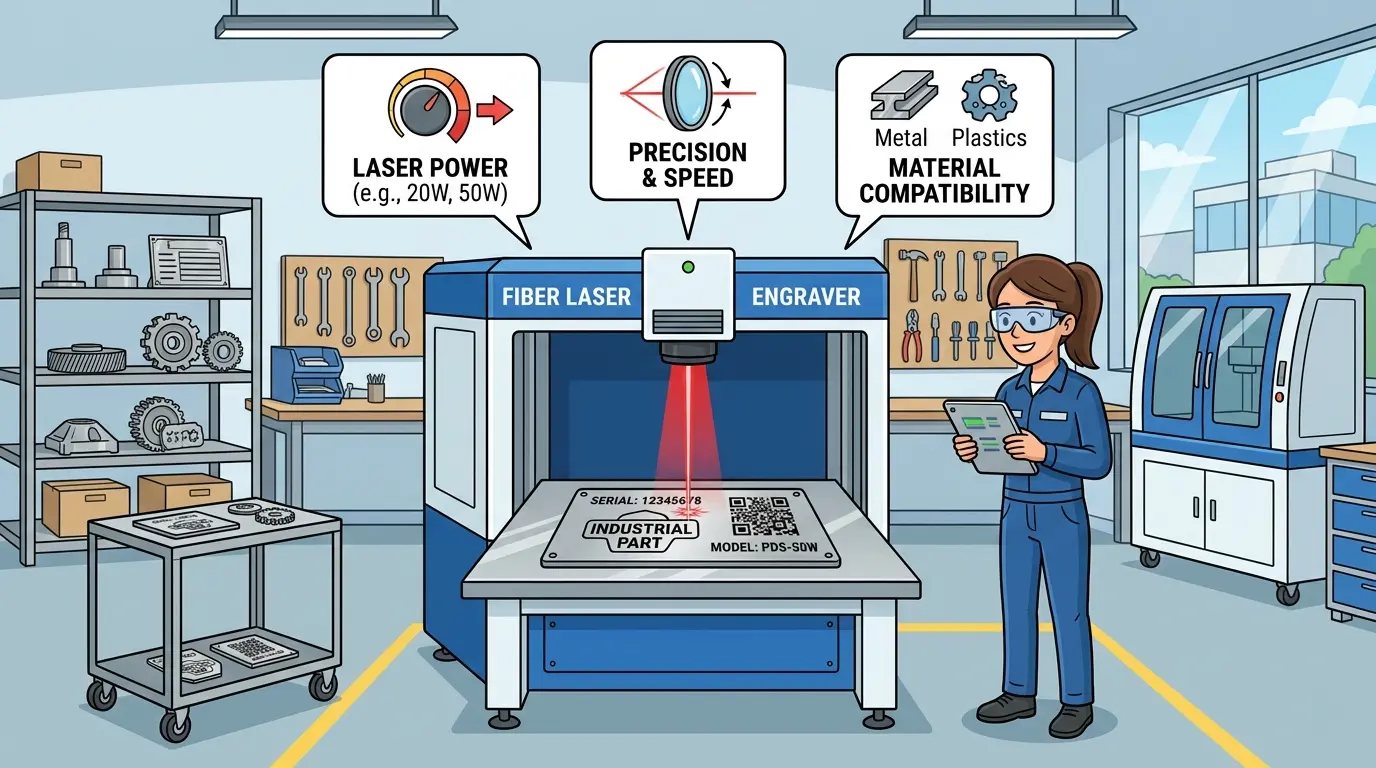
In industrial marking, the question is rarely whether a machine can make a visible mark. The real question is whether serial numbers, data matrix codes, logos, and part IDs remain readable after handling, assembly, coating, or long-term use. When marks become inconsistent, traceability slows down, scanning reliability drops, and operators spend more time reworking parts or matching components to paperwork manually.
That is why buyers evaluating a fiber laser engraving machine for industrial marking should look beyond the sample mark itself. In most factories, the better decision comes from understanding the workflow around the mark: the material mix, the required permanence, the code size, the part presentation method, and the verification process that follows.
Why Fiber Laser Technology Is Commonly Chosen for Industrial Marking
Fiber laser systems are commonly evaluated for industrial marking because many manufacturers need precise, permanent identification on metal parts without relying on labels, inks, or physical-contact marking tools. In those environments, the value is not only permanence. It is repeatability across batches, clearer machine-readable codes, and more stable integration with digital traceability systems.
This becomes especially important when the marking content changes frequently. Serial numbers, lot codes, batch IDs, and matrix codes often vary from part to part. A marking process that can handle that variation consistently is usually more valuable than one that performs well only on a fixed pattern or demonstration sample.
Many buyers also use the term “fiber laser engraving machine” as a catch-all phrase, even when the real production need is part marking, coding, or identification rather than decorative engraving. That wording is common in the market, but the buying decision should still be driven by the required mark result, not by the label used in the quotation.
Not Every Industrial Mark Requires the Same Result
Before comparing machines, buyers should define what the mark actually needs to do in production.
| Marking Objective | Typical Parts | What Buyers Usually Prioritize | What To Watch Closely |
|---|---|---|---|
| Traceability Codes | Machined components, fabricated brackets, production parts | Scan reliability, contrast consistency, repeatable placement | A mark that looks acceptable visually may still fail scanner verification |
| Tool And Fixture Identification | Dies, gauges, holders, jigs, maintenance-critical items | Permanence, legibility in small areas, resistance to repeated handling | Small marking zones make fixturing and focus discipline more important |
| Branding And Product Identification | Housings, panels, metal tags, exposed components | Clean appearance, line sharpness, readable text | Cosmetic expectations are often higher than standard traceability marks |
| Small Component Identification | Compact assemblies, connectors, precision parts | Fine detail, accurate placement, stable repeatability | Handling and positioning often limit real output more than the laser itself |
This distinction matters because a system suited to readable traceability codes may not be the best choice for deeper decorative marking, and a setup that performs well on flat parts may be harder to scale across irregular shapes. Strong buyers define the mark function first, then evaluate the equipment.
Common Fiber Laser Marking Applications in Production
Industrial marking projects usually begin with a production problem rather than with a machine category. In practice, several applications appear again and again because they tie directly to traceability, process control, and downstream efficiency.
Direct Part Marking for Traceability
One of the most common applications is direct part marking on fabricated or machined metal components. Manufacturers often introduce fiber laser marking when they want the identification to stay with the part through inspection, assembly, shipment, and after-sales service.
The workflow benefit is straightforward: fewer labeling errors, more reliable part-to-record matching, and better control when parts move through multiple workstations. In operations where part families look similar, that reduction in identification ambiguity can matter as much as the mark durability itself.
Tool, Die, And Fixture Identification
Traceability needs are not limited to finished goods. Tool holders, gauges, fixtures, maintenance parts, and setup aids also need durable identification in many plants. Fiber laser marking is often considered here because the items are commonly metallic, handled repeatedly, and expected to remain readable over time.
The practical outcome is better tool control, faster setup recognition, and simpler maintenance recordkeeping. When shops lose time identifying the right fixture or verifying tool status manually, durable marking supports daily production discipline in a way that is easy to overlook during machine selection.
Control Panels, Nameplates, And Visible Product IDs
Some industrial marking jobs are driven by appearance as much as permanence. Product plates, operator-facing panels, visible housings, and branded metal components need marks that are readable, consistent, and visually clean.
In these applications, the machine is judged not only on whether the information is present, but on whether the finished result supports the product standard. Clear line definition, readable small text, and consistent placement often matter more than aggressive material removal.
Variable Data Marking in Mixed Production
Factories running many part numbers or frequent order changes often need the marking content to change continuously. In those cases, the laser station functions as part of a data workflow rather than as a simple standalone engraver.
The operational issue is whether code updates, job changes, and verification can happen without turning the station into a bottleneck. That is why buyers should evaluate not only the marking head, but also how the process fits their production data flow and inspection routine.
What Buyers Should Evaluate Before Choosing a Machine
The strongest purchasing decisions come from reviewing the full marking cell, not just the machine headline.
| Evaluation Factor | Why It Matters in Real Production | Common Buying Mistake |
|---|---|---|
| Base Material And Surface Condition | Metal type, finish, coating state, and surface preparation all influence mark quality and consistency | Testing one ideal sample and assuming all production parts will behave the same way |
| Required Mark Type | Some jobs need contrast and readability, while others need stronger permanence or finer detail | Treating all “engraving” needs as if they were identical |
| Code Size And Information Density | Small text and dense matrix codes raise the bar for consistency and verification | Judging quality by a visual sample instead of a real scanning test |
| Part Presentation And Fixturing | Output stability often depends on how consistently parts are positioned | Focusing on the laser source while underestimating workholding requirements |
| Throughput Target | Marking speed matters only if loading, unloading, and verification can keep up | Buying for headline speed instead of cell-level productivity |
| Data And Inspection Integration | Mark generation, scanning, and record capture often determine the real traceability value | Treating the station as isolated when the factory needs process-linked identification |
In many projects, these factors matter more than broad marketing claims. A machine can produce an impressive sample mark and still be the wrong choice if the parts are difficult to fixture, the code content changes constantly, or the verification process has not been planned properly.
Where Fiber Laser Fits Well and Where Tradeoffs Remain
Fiber laser marking is often well suited to workflows that require:
- Permanent Identification On Metal Parts
- Small, Detailed Codes Or Text
- Durable Tool, Fixture, Or Component IDs
- Variable Data Marking In High-Mix Production
- Clean, Repeatable Marks That Support Scanning And Inspection
Even so, it is not a universal answer for every marking requirement. If the primary substrates are non-metallic, if the desired result is more cosmetic than traceability-driven, if the parts are difficult to present consistently, or if the real bottleneck is loading and inspection rather than marking itself, the best process choice may be different.
Buyers should also be careful not to assume that the marking station alone will solve broader traceability problems. If upstream data is unreliable, part presentation is inconsistent, or the inspection method is weak, a new laser machine may improve the mark but not the whole workflow.
How To Think About ROI in an Industrial Marking Project
The return on investment in industrial marking usually comes from process control rather than from the mark in isolation. The most meaningful gains often include:
- Fewer Relabeling Or Remarking Cycles
- Lower Risk of Part Mix-Ups During Inspection And Assembly
- Faster Identification of Tools, Fixtures, And Product Variants
- More Reliable Scanning And Traceability Capture
- Less Operator Time Spent Matching Parts to Paper Records
That is why a marking project should be evaluated as part of a production system. If the mark improves traceability, reduces manual correction, and supports more reliable downstream handling, the value is usually broader than the marking step alone.
For manufacturers comparing marking investments alongside wider equipment planning, the Pandaxis product catalog offers a broader view of industrial machinery categories and production-focused equipment selection.
Practical Summary
A fiber laser engraving machine can be a strong fit for industrial marking applications when the factory needs permanent identification, clear code readability, and repeatable marking on metal components. The best buying decisions come from matching the machine to the real job: the material mix, the mark purpose, the data requirements, the part presentation method, and the verification process that follows.
In other words, buyers should not start with the machine claim. They should start with the production requirement. Once the marking goal is clear, it becomes much easier to judge whether a fiber laser system will improve traceability, reduce manual correction, and fit the wider workflow without creating a new bottleneck elsewhere.