In many factories, marking only gets attention after something breaks downstream. A code cannot be scanned at inspection. Similar parts get mixed at assembly. A branded panel looks inconsistent across batches. Service teams cannot tie a field-returned component back to its production record without checking paperwork manually.
That is why a laser marking machine should be evaluated as a production-control tool, not just as a way to put text on a surface. The right system depends on what the mark must do in real operation. A traceability code, a visible brand mark, and a simple part ID may all sit on the same component, but they do not demand the same level of permanence, contrast, cosmetic quality, or workflow integration.
Why Marking Is Usually a Workflow Decision
Marking sits at the intersection of manufacturing data, inspection, assembly, and product presentation. When the process is weak, the effect is broader than one unreadable part.
- Traceability Records Become Harder To Trust
- Scanner-Based Inspection Slows Down
- Assembly Teams Spend More Time Confirming Part Identity
- Rework Increases On Visible Product Surfaces
- Mixed-Part Production Becomes Harder To Control
That is why a laser marking station should be reviewed in the context of the full process. The question is not only whether the machine can create a mark. The question is whether the mark stays useful after handling, cleaning, coating, packing, or field service.
The Three Jobs Buyers Usually Need a Marking System To Do
| Primary Goal | Typical Output | What Success Looks Like | What Usually Matters Most | Common Mistake |
|---|---|---|---|---|
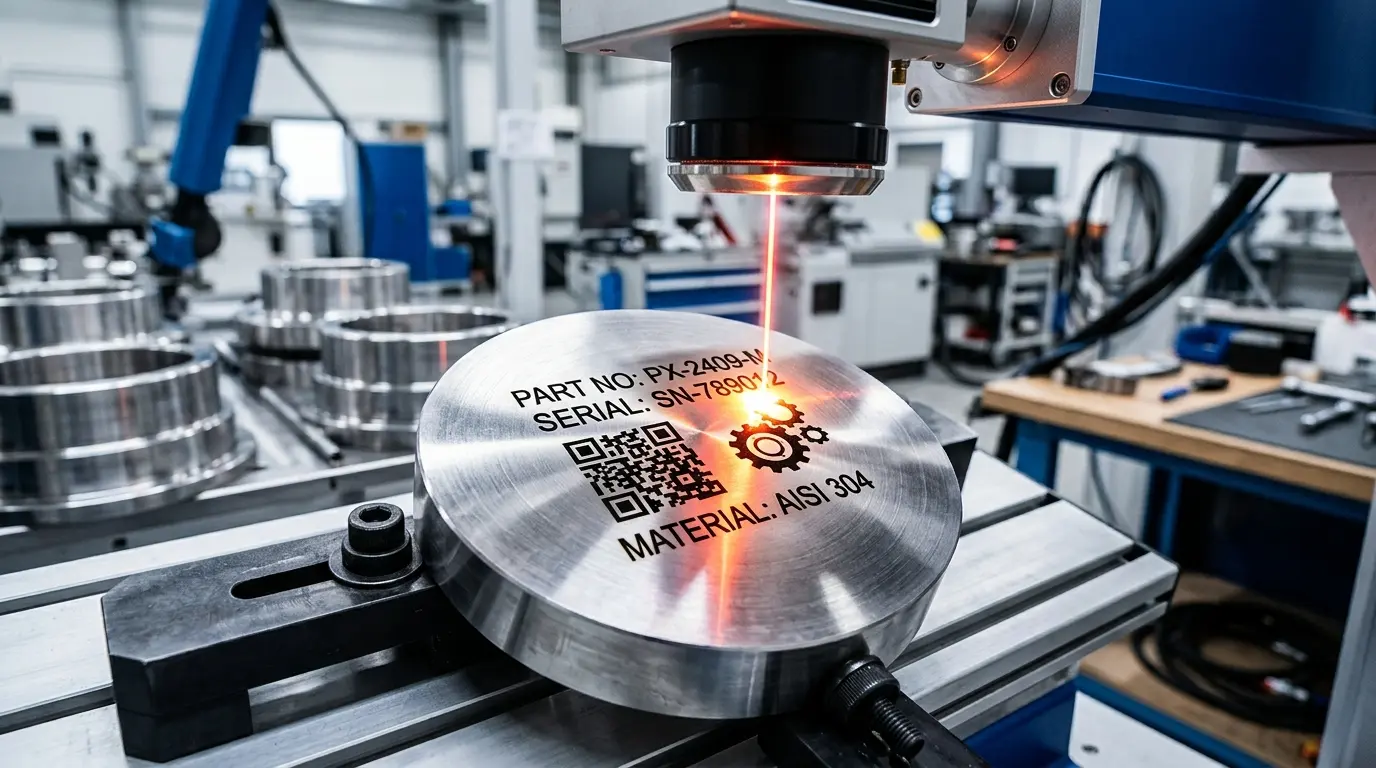
| Traceability | Serial Numbers, Lot Codes, Data Matrix Codes, QR Codes | Reliable link between the part and production records | Scanner readability, repeatability, and verification discipline | Approving marks by appearance instead of by scan performance |
| Branding | Logos, Model Names, Control-Panel Graphics, Product Identity Marks | Clean, consistent visual finish on visible surfaces | Edge quality, contrast control, placement consistency, and cosmetic repeatability | Optimizing for permanence while ignoring appearance standards |
| Part Identification | Part Numbers, Orientation Marks, Tool IDs, Assembly References | Fast recognition by operators and fewer mix-ups between similar parts | Readable character size, fixture consistency, and easy job changeover | Ignoring loading discipline and text-size limits on real parts |
This distinction matters because one setup is not automatically ideal for every objective. A mark that scans well may not be the best-looking brand mark on an exposed housing. A deep or high-contrast result that works for harsh traceability conditions may be too aggressive for a customer-facing surface.
Why Material Match Changes the Buying Decision
One of the most common buying mistakes is treating laser marking as if the part material barely changes the result. In practice, the response of the surface often determines whether the process is clean, durable, high contrast, cosmetically acceptable, or difficult to control.
Bare machined metal, coated metal, anodized surfaces, engineering plastics, acrylic, wood, and laminated substrates do not react the same way. A marking approach that performs well on one surface may produce weak contrast, excess heat effect, or inconsistent appearance on another.
For non-metallic applications such as acrylic panels, wood components, display pieces, templates, or decorative product surfaces, laser cutters and engravers are commonly used where marking and detailed processing need to work together. For direct part identification on metals and other industrial surfaces, buyers usually need to evaluate source type and process behavior against the exact production material instead of assuming that any laser-marking label means the same thing.
The practical lesson is simple: sample testing should be done on the real material, with the real finish, in the real sequence of operations. If the mark is applied before coating, after cleaning, or on a textured surface, that should shape the decision from the beginning.
What Buyers Should Evaluate Beyond the Demo Sample
Strong demo samples are useful, but they are not enough. Many disappointing installations come from buying on a clean flat sample even though production parts are curved, oily, coated, or presented with wide tolerance variation.
Buyers should usually review:
- The Actual Production Material And Surface Finish
- Whether The Mark Happens Before Or After Cleaning, Coating, Or Heat Exposure
- The Required Code Size And Scanning Standard
- Fixture Repeatability And Part Presentation At The Station
- Variable Data Handling Between Jobs Or Batches
- How The Mark Will Be Verified Before The Part Moves Downstream
These details matter because the marking head is only one part of the result. If the part is not positioned consistently, if the data content changes poorly from one work order to the next, or if verification happens too late, a technically capable machine can still turn into a weak production step.
Traceability Marks and Branding Marks Often Pull in Different Directions
Factories sometimes group traceability, branding, and part identification into one buying brief, but the priorities are not identical.
Traceability marks are judged by functional performance. They must be read consistently by scanners or operators, tied to the correct record, and placed where downstream handling will not destroy their usefulness. A mark that is slightly less attractive but highly reliable may still be a good production result.
Branding marks are judged more harshly. If a logo sits on a visible housing, panel, or product-facing surface, buyers often care more about line sharpness, tonal consistency, edge cleanliness, and how the mark looks across batches. A setup that is excellent for industrial traceability can still disappoint if the visual standard is high.
Part identification sits somewhere in between. The mark may not need premium cosmetic quality, but it must remain readable enough to prevent mix-ups during assembly, storage, maintenance, or service. In high-mix production, that often makes speed of changeover and clarity of small text just as important as permanence.
This is why buyers should define the primary job of the mark before comparing quotations. If everything is treated as equally important, the machine evaluation becomes vague and the final choice becomes harder to defend.
Throughput Depends on the Whole Cell, Not Just the Laser
Suppliers and buyers alike often talk about marking speed, but real throughput is shaped by the entire cell.
If operators spend too long loading parts, orienting components, changing programs, or verifying codes, the marking process can become a bottleneck even when the laser itself is fast. The same is true when the part requires careful manual positioning because the mark must land inside a narrow tolerance window.
In practical terms, line performance is often influenced by:
- How Quickly A New Job Can Be Loaded
- Whether Fixtures Hold Part Position Consistently
- How Operators Confirm The Correct Program Is Running
- Whether Scanner Verification Happens In The Cell Or Later
- How Easily The Station Handles Similar-Looking Part Variants
For traceability-heavy production, these cell-level factors are usually more important than headline speed claims alone. A stable station with reliable verification often delivers more value than a nominally faster setup that creates handling delays or remarking work.
When One Marking System Is Enough and When It Is Not
Some factories can cover branding, traceability, and part identification with one process because the parts share similar materials, the visual standard is manageable, and the information density is moderate.
Other factories run into tradeoffs quickly. A visible brand mark on a finished panel may demand a different quality standard than a compact code on a back-side production component. A mixed-material product line may also expose the limits of trying to treat all surfaces as one marking problem.
That does not always mean two separate machines are required, but it does mean the buying decision should be based on the hardest real use case rather than the easiest sample. If the process cannot meet the most demanding marking requirement without slowing the line or degrading appearance, the “one machine for everything” assumption may not hold.
A Practical Shortlist Before Requesting Quotes
- Define The Primary Purpose Of The Mark. Decide whether traceability, branding, or basic part identification is the main priority.
- Test On Real Production Parts. Use actual materials, real finishes, and realistic part geometry rather than ideal flat samples.
- Verify The Mark The Same Way Production Will. If scanners will be used on the line, approve the process with those scanners.
- Review Changeover and Data Flow. Confirm how serials, lot codes, or job-specific content will be managed between batches.
- Evaluate The Whole Station. Consider fixtures, loading, verification, and operator handling along with the laser itself.
These steps usually produce clearer decisions than comparing only power, sample photos, or headline speed claims.
Practical Summary
A laser marking machine is rarely purchased just to make a visible mark. In real manufacturing, it is usually expected to support traceability, reinforce branding, reduce part-mix errors, and keep identification readable through the rest of the workflow. The best buying decision comes from understanding which of those jobs matters most, how the material behaves, and whether the full marking cell can stay stable under daily production conditions.
For manufacturers evaluating marking equipment as part of a broader machinery-planning project, the Pandaxis product catalog provides a broader view of related production equipment categories. The practical rule remains the same: choose the marking approach that fits the workflow, not just the sample.