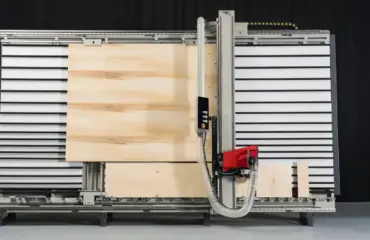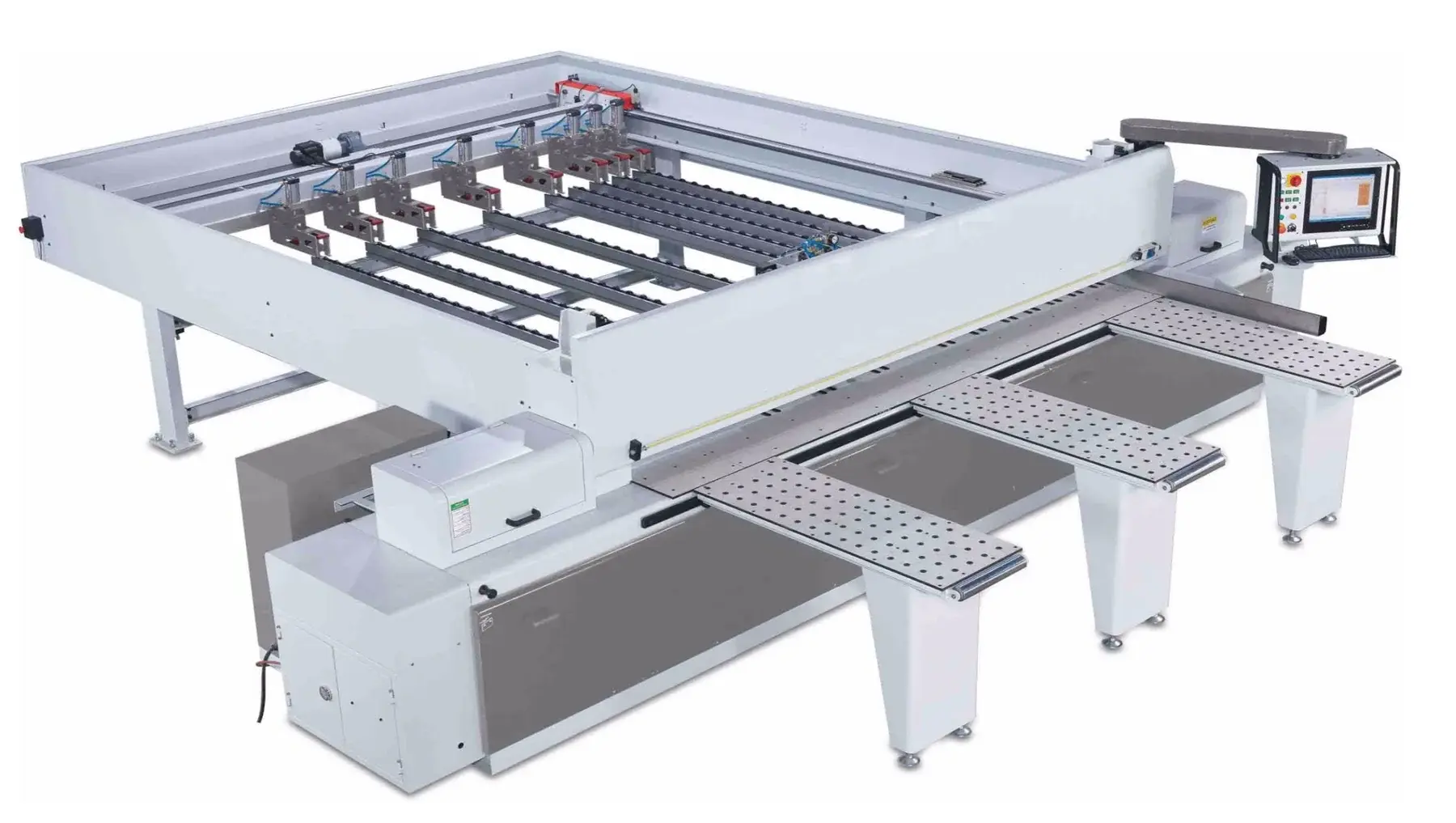
When a factory cuts plywood, MDF, and melamine-faced boards in the same production flow, the saw cell stops being a simple cutting station. It becomes the point where face quality, edge condition, squareness, and batch stability are either protected or lost before edge banding, drilling, and assembly even begin.
That is why buying a panel saw machine for these materials should not start with a generic question about cutting capacity. It should start with a more practical one: can the machine keep different board types moving through the line with consistent sizing and acceptable cut quality, without turning every material change into a quality-control problem?
Why Material Mix Changes The Buying Decision
Plywood, MDF, and melamine may all be sheet materials, but they do not behave the same way in production.
- Plywood brings veneer-face sensitivity, which means breakout and edge cleanliness matter quickly on visible parts.
- MDF is valued for uniformity, but it also puts pressure on dust management, blade condition, and edge consistency.
- Melamine-faced board is less forgiving on decorative surfaces, so even small chips can become immediate reject or rework issues.
In practice, this means a panel saw should be judged by how reliably it handles the material mix the factory actually runs, not by how impressive it looks on a broad feature list. A machine that performs well on raw board but struggles to keep decorative melamine clean, or one that cuts accurately but creates unstable batch flow, can still become a bottleneck.
What Good Panel Saw Performance Looks Like In Daily Production
For repeated rectangular part production, dedicated panel saws are usually chosen because they help standardize the front end of the workflow. The real benefit is not simply faster cutting. It is more stable cutting.
In a practical board-processing environment, that usually means:
- Consistent panel sizing across batches
- Reliable squareness for downstream drilling and assembly
- Cleaner edge quality before edge banding or exposed-edge finishing
- Better organization of repeated cut lists and part sorting
- Less operator-dependent variation from shift to shift
If the saw cell delivers those outcomes, downstream processes usually become easier to control. If it does not, problems spread quickly into edge treatment, hole positioning, hardware fit, and final assembly accuracy.
Material-Specific Priorities To Evaluate
| Material | Typical Processing Concern | What Buyers Usually Focus On | Why It Matters Downstream |
|---|---|---|---|
| Plywood | Veneer breakout and face damage | Stable sheet handling, accurate cut setup, and clean cutting discipline | Reduces edge repair and protects visible finished parts |
| MDF | Dust load and edge consistency | Repeatable sizing, extraction effectiveness, and blade-maintenance discipline | Helps edge banding consistency and reduces dimensional re-checking |
| Melamine | Chipping on decorative faces | A strong chip-control approach and consistent cutting conditions | Protects appearance quality and lowers reject risk on finished panels |
This is where many buying decisions improve. Instead of asking which saw is “best” in the abstract, the factory can ask which machine setup is better aligned with its actual board mix, finish standard, and rework tolerance.
For example, a kitchen cabinet line running large volumes of melamine-faced board may place much more weight on chip control and repeatability than a workshop cutting construction-grade plywood for hidden structural parts. A furniture producer that processes raw MDF before edge banding may care more about stable sizing and clean workflow handoff than about decorative face protection alone.
When A Panel Saw Fits Better Than A Sliding Table Saw
The real comparison is often not between one panel saw and another. It is between a dedicated panel saw and a more flexible manual-guided option such as sliding table saws.
| Production Situation | Panel Saw Fit | Sliding Table Saw Fit |
|---|---|---|
| Repeated rectangular parts in batches | Strong fit because throughput and repeatability matter most | Usually workable, but more labor-dependent |
| Frequent one-off jobs and constant cut variation | Less ideal if flexibility is the main need | Stronger fit when operator control matters more than line speed |
| Plywood, MDF, and melamine moving into edge banding and drilling in volume | Strong fit because process stability matters downstream | Can work, but variation depends more heavily on operator consistency |
| Shops with many irregular or nested parts | May need another process to complement it | More flexible than a dedicated panel saw, though highly shaped work may still point toward CNC routing or nesting |
That tradeoff matters. A panel saw is commonly the better choice when the factory mostly sizes sheet goods into repeated rectangular parts and wants the rest of the production line to run from a more predictable starting point. A sliding table saw usually makes more sense when job variety is high, order sizes are smaller, or the business still depends heavily on operator judgment and flexible cut sequencing.
Questions That Matter More Than Headline Specifications
Before comparing machine lists, ask the production questions that actually drive return on investment.
- What share of daily output is repeated rectangular cutting in plywood, MDF, or melamine?
- Are current losses coming from slow throughput, chipped faces, sizing variation, or poor batch organization?
- Which material creates the most downstream trouble today?
- How often does the line switch between decorative boards and raw boards in the same shift?
- Is the factory trying to solve a flexibility problem or a repeatability problem?
- Will better front-end cutting stability improve edge banding, drilling, and final assembly enough to justify a dedicated solution?
These questions usually produce a clearer decision than comparing unsupported claims or isolated machine features. They also keep the conversation where it belongs: on workflow fit.
Where Buyers Often Make The Wrong Choice
One common mistake is buying only for peak cutting speed, then discovering that the real issue was quality variation on melamine or part-flow instability before downstream operations. Another is buying for maximum flexibility when most of the work is already repetitive enough that a dedicated panel-cutting process would create a more stable line.
For plywood, MDF, and melamine processing, the strongest buying decisions usually come from balancing three things:
- Material sensitivity
- Production volume
- Downstream process dependence
If the line depends on clean, square, repeatable panels to keep edge finishing and assembly moving, then a panel saw should be evaluated as part of the whole workflow, not as an isolated machine purchase.
Practical Summary
A panel saw machine is usually the right fit for plywood, MDF, and melamine processing when the factory runs repeated rectangular parts, needs more predictable batch flow, and cannot afford cut variation to spread downstream. Its value is not limited to cutting sheet goods faster. It lies in helping the line stay consistent across materials with different surface and edge demands.
If the shop is highly custom, shape-heavy, or driven more by flexible one-off work than by repeatable panel production, another cutting approach may be the better match. But when the goal is stable sizing, cleaner part flow, and fewer quality surprises across common board materials, a well-matched panel saw becomes a practical production decision rather than just another machine category.