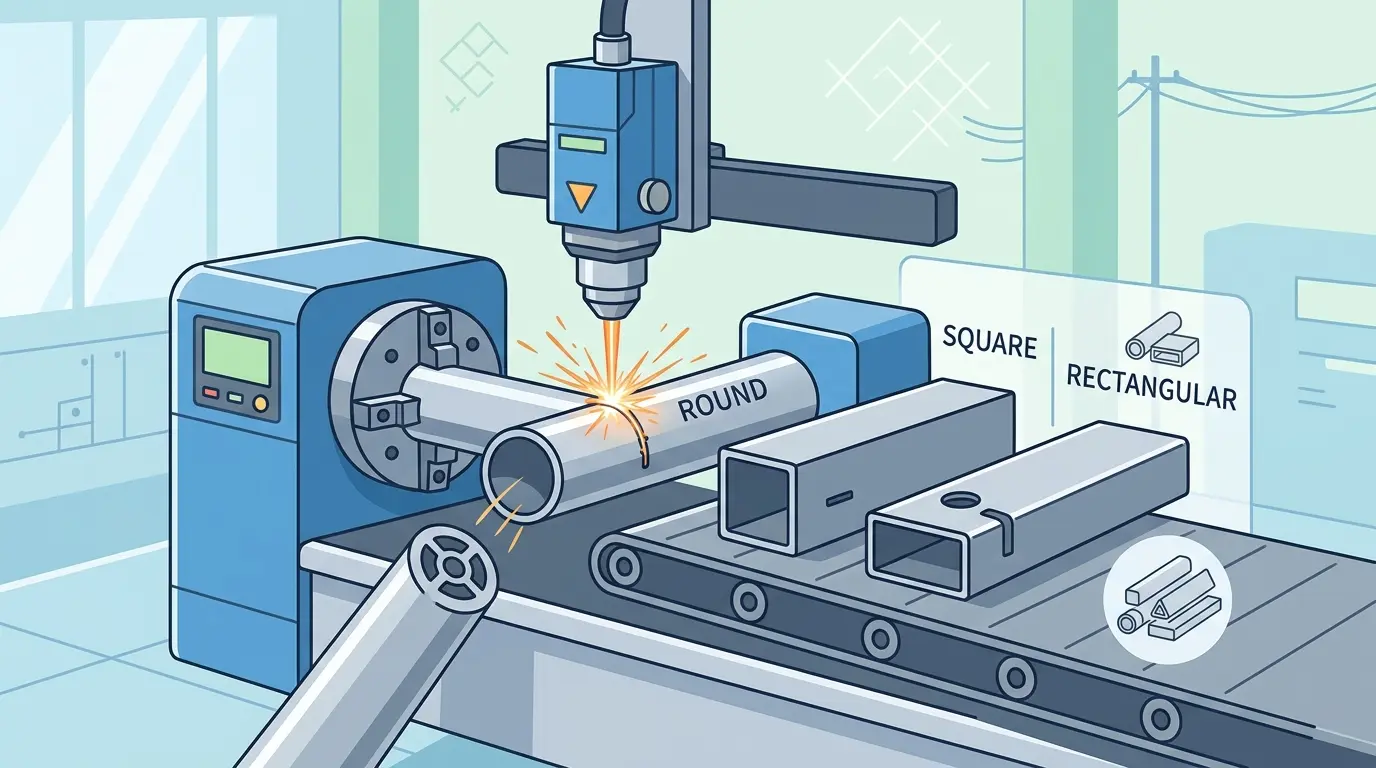
For many fabrication shops, profile cutting stops being a simple cutting task once production starts moving between round tube, square tube, and rectangular sections in the same workflow. The parts may all fall under “tube processing” on a quote sheet, but in production they behave differently in clamping, orientation, feature placement, and downstream fit.
That is why a tube laser cutting machine should be evaluated as a profile-processing system, not just as a faster way to separate stock. The right machine helps a shop cut cleaner features, reduce secondary operations, and move more consistent parts into welding, bending, coating, or assembly.
Why Profile Shape Changes the Machine Decision
A tube laser that looks strong in a round-tube demonstration is not automatically the best fit for a mixed-profile workload. Round sections, square sections, and rectangular profiles place different demands on material support, rotation stability, face alignment, and feature consistency.
When a shop processes mostly one profile family, the buying decision can focus more heavily on routine throughput and repeatability. When the order mix shifts constantly between different shapes and sizes, the machine has to stay stable across those changes without turning every new job into a setup problem.
What Changes by Profile Type
| Profile Type | Common Production Challenge | What the Machine Must Handle Well | Practical Workflow Outcome |
|---|---|---|---|
| Round Profiles | Rotational stability, branch-cut geometry, and consistent end preparation | Reliable clamping, smooth motion, and accurate feature placement around the tube | Better weld fit-up and less manual coping or layout work |
| Square Profiles | Face alignment, corner quality, and repeat hole positioning | Stable orientation control and clean processing across flat faces and corners | More consistent assembly and less downstream adjustment |
| Rectangular Profiles | Major-axis orientation, support balance, and feature alignment on different faces | Secure material support and repeatable positioning when section proportions change | Cleaner transfer into fixtures, frames, and fabricated assemblies |
This matters because many shops do not lose the most time on cutting alone. They lose time when one profile processes smoothly and the next one requires more checking, more correction, or more manual finishing before it can move forward.
The Buying Factors That Matter Most
| Buying Factor | What to Evaluate | Why It Matters in Production |
|---|---|---|
| Real Profile Range | The round, square, and rectangular sections actually processed every week | A machine should fit the daily part mix, not just the broadest theoretical claim |
| Clamping and Support Stability | How well the system controls different section shapes during cutting | Stable handling supports better feature accuracy and more predictable part quality |
| Orientation Control | Whether face-specific features can be placed consistently on square and rectangular profiles | Better orientation control reduces assembly errors and part mismatch |
| Integrated Feature Processing | Holes, slots, miters, notches, and fitted end geometry processed in one workflow | Integrated cutting helps reduce manual drilling, marking, and secondary prep |
| Changeover Efficiency | How easily operators move between profile types, sizes, and job batches | Faster, cleaner changeovers matter in high-mix production environments |
| Programming Flow | How easily repeated profile families and revised parts can be prepared for cutting | Better programming discipline supports faster response to customer demand |
| Downstream Fit | How consistently parts enter welding, coating, and final assembly | The real value appears when cut parts cause less rework later in the process |
This is where many buying decisions improve. Instead of asking which machine sounds most impressive in isolation, the better question is which one improves the entire path from raw stock to usable fabricated part.
Start With the Real Part Mix Before Comparing Quotes
Before requesting serious proposals, buyers should document what the shop actually runs rather than what a supplier demo happens to highlight.
That usually includes:
- The dominant profile shapes in weekly production
- The materials most often processed
- The typical size range and part families handled by the shop
- The most common holes, slots, miters, or end-cut features
- The balance between repeat orders and high-mix custom work
- The downstream operation most affected by part inconsistency
Without that internal picture, it becomes easy to buy a system that looks versatile on paper but creates hidden friction in loading, setup, or downstream fit.
Why Integrated Feature Cutting Often Delivers the Real ROI
Most buyers do not look at tube laser cutting because they simply want to cut stock into shorter pieces. They look at it because profile parts often need more than length reduction. They may need connection holes, slots, fitted ends, intersection geometry, or repeated assembly features that would otherwise require separate marking, drilling, or manual preparation.
When those features can be processed within the same cutting workflow, the benefit is usually broader than raw speed. Shops often gain cleaner handoffs, less repositioning, and better repeatability in welded or assembled parts. That is where a machine starts affecting labor efficiency and downstream quality at the same time.
How Mixed-Profile Shops Should Think About Changeovers
If production shifts frequently between round tube, square tube, and rectangular sections, changeover discipline becomes part of machine selection. A platform that performs well on long, repetitive runs may still create avoidable friction if operators spend too much time resetting support conditions, checking orientation, or correcting part setup between jobs.
This is especially important for job shops, contract fabricators, and manufacturers with changing product lines. In those environments, mixed-batch stability can matter as much as cutting productivity. The machine has to support variation without letting variation show up in the finished part.
Questions Buyers Should Ask Before Requesting Proposals
- Which profile shapes make up most of our actual workload?
- How often do we switch between round, square, and rectangular sections in the same production cycle?
- Which parts require holes, slots, fitted intersections, or face-specific features?
- Where do we currently lose the most time: loading, setup, cutting, or secondary operations?
- Which downstream team complains most about inconsistency: welding, assembly, or finishing?
- Are we solving for high-volume repeat work, high-mix custom work, or both?
- Do we need more automation, or do we need better control over material handling and part preparation?
- What level of programming simplicity and operator support is necessary to keep output stable?
These questions help keep the buying process tied to actual production conditions instead of generic machinery comparisons.
Common Buying Mistakes to Avoid
Several mistakes appear repeatedly when buyers compare tube laser systems for mixed-profile work.
The first is assuming round, square, and rectangular profiles behave similarly enough that one strong sample proves overall fit. In real production, those shapes can create different handling and feature-placement demands.
The second is over-focusing on headline cutting speed while underestimating clamping stability, orientation control, and downstream fit. A fast machine that creates avoidable assembly correction is rarely the best workflow choice.
The third is ignoring the value of integrated feature cutting. If parts still need too many separate drilling or layout steps after cutting, the machine may not be solving the real bottleneck.
The fourth is treating software and job preparation as secondary. In high-mix environments, programming flow and repeat job handling can influence output almost as much as the cutting process itself.
Practical Summary
The best tube laser cutting machine for round, square, and rectangular profiles is not the one with the broadest marketing claim. It is the one that fits the real section mix, feature requirements, changeover rhythm, and downstream quality standards of the shop.
If a business processes profile parts every day, the right system can help reduce manual preparation, improve repeatability, and move cleaner parts into the next operation. If the workload is more variable, flexibility and changeover stability usually matter more than pure demo performance.
For teams reviewing profile-processing investment alongside broader machinery planning, the Pandaxis product catalog provides a wider view of adjacent industrial equipment categories.
In the end, the most useful buying guide is still the production floor itself. The clearer a shop is about what it cuts, where it loses time, and what downstream quality really requires, the easier it becomes to choose a machine that supports real fabrication performance.