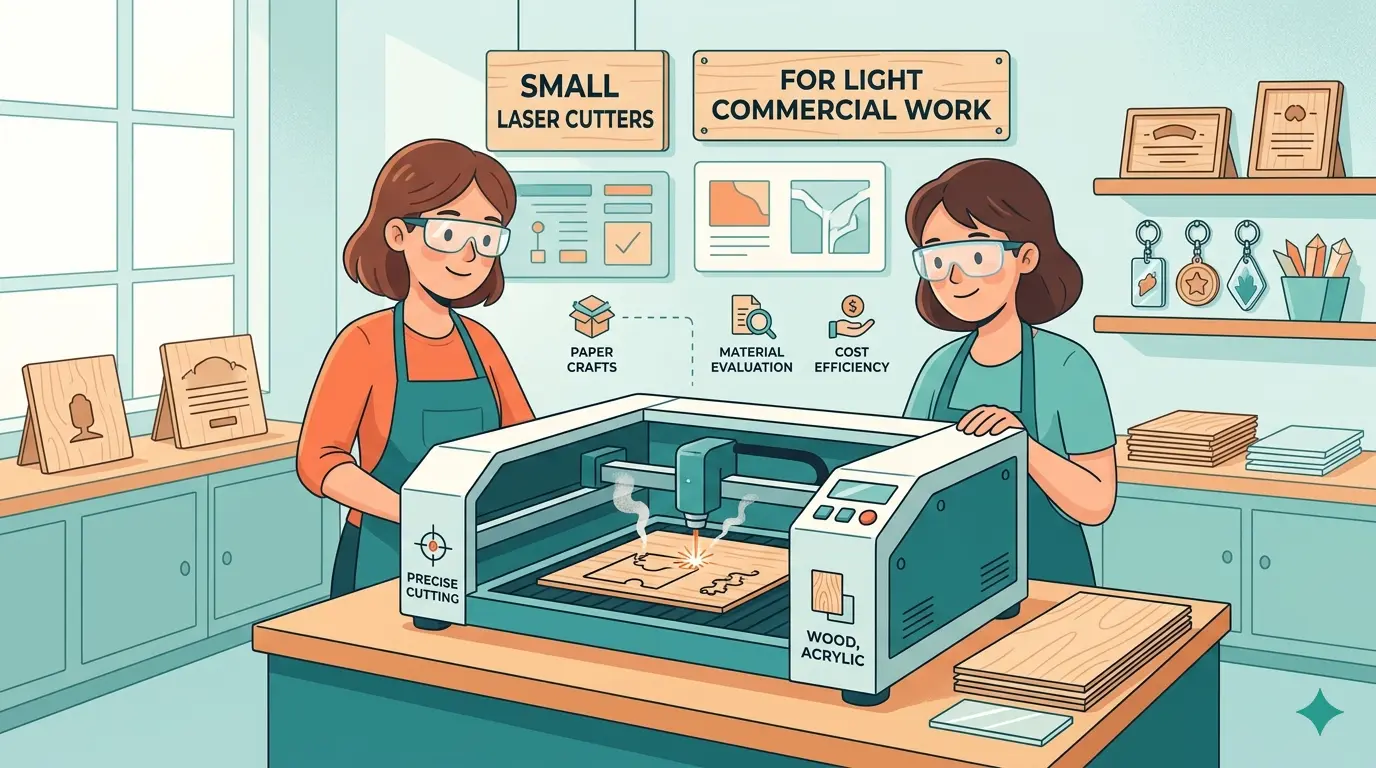
A small laser cutter can be a practical production tool for light commercial work, but only when the job mix matches the machine. For sign makers, gift-product businesses, small-batch decor shops, packaging prototyping teams, and custom-product workshops, the real question is not whether a machine is small. It is whether that smaller format can deliver enough consistency, changeover speed, and material fit to support paid work without creating a bottleneck.
In most cases, buyers get better results when they evaluate workflow first and machine size second. A compact laser system may be well suited to short runs, frequent design changes, and detailed cutting or engraving on wood, acrylic, and similar non-metallic materials. It becomes a poor fit when the business starts asking that same machine to behave like a higher-throughput production cell.
What Light Commercial Work Usually Looks Like
Light commercial work sits between hobby use and full industrial production. The work is paid, deadlines matter, and repeatability affects margins, but production volumes are still moderate enough that a smaller machine footprint can make sense.
Typical examples include:
- Custom acrylic signage and display parts
- Wood engraving for branded gifts or decorative items
- Short-run packaging inserts and presentation components
- Personalized products with frequent artwork changes
- Prototype parts for retail displays or product presentation
In these environments, a small laser cutter often earns its place through flexibility. It can help a business move quickly from artwork to finished part, reduce tooling changes, and handle mixed short-run jobs more efficiently than a more manual cutting method.
When A Small Laser Cutter Is The Right Fit
A smaller-format machine usually makes the most sense when the business depends on detail, customization, and quick job turnover rather than maximum sheet throughput.
It is commonly well suited to:
- Short production runs with frequent file changes
- Engraving-heavy workflows where visual finish matters
- Small and medium part sizes that do not require oversized beds
- Shops with limited floor space but real commercial output
- Product lines built around acrylic, wood, and similar non-metallic materials
For buyers comparing available laser cutters and engravers, this is usually the main decision point: does the machine support the way work enters and leaves the shop, or does it only look attractive because of its footprint and entry price?
Where Small Machines Reach Their Limit
The biggest mistake in this category is expecting a small commercial laser cutter to solve every production need. A compact system can improve output in the right workflow, but it still has limits.
Those limits usually show up when:
- Part size regularly exceeds the practical working area
- Jobs require long unattended cutting cycles across many identical parts
- Material thickness or edge-quality expectations push the process beyond its efficient range
- The shop needs faster loading, unloading, and batching than a small machine layout can support
- Demand grows faster than the machine’s practical daily output
At that point, the issue is not simply speed. It is overall workflow friction. Operators spend more time nesting around size constraints, splitting jobs into extra cycles, rehandling material, or waiting for the next batch window. A machine that once felt efficient starts to slow down quoting, scheduling, and delivery.
What Buyers Should Evaluate Before They Buy
Small laser cutter selection becomes much clearer when the machine is judged against actual work patterns instead of generic marketing language.
| Evaluation Factor | Why It Matters In Light Commercial Work | What Buyers Should Watch For |
|---|---|---|
| Job mix | Cut-heavy and engrave-heavy shops place different demands on the machine | Whether most revenue comes from cutting, engraving, or mixed jobs |
| Material range | Results depend heavily on material fit, not just machine size | Whether the planned materials align with the machine’s intended non-metal processing role |
| Part size | Even profitable short-run work can become inefficient if parts must be split across setups | Whether the usable work area fits the real product range |
| Changeover frequency | Frequent artwork and order changes reward simple workflow and reliable setup routines | How quickly operators can move from one order to the next |
| Ventilation and fume control | Commercial use raises the cost of poor extraction and contaminated optics | Whether the shop is ready for proper exhaust and maintenance discipline |
| Output expectations | Revenue depends on repeatable delivery, not just one-off success | Whether daily workload matches realistic machine utilization |
| Operator workflow | A machine that looks simple on paper can still create unnecessary handling steps | How files are prepared, loaded, checked, and finished in daily use |
This table matters because light commercial buyers often focus too early on the headline specification and too late on the order pattern. In practice, a smaller machine that fits the workflow well can outperform a larger but mismatched purchase.
Material Fit Matters More Than “Small” Or “Commercial”
For this segment, material compatibility is usually more important than labels. Many light commercial laser applications center on wood, acrylic, coated decorative materials, and similar substrates where edge cleanliness, engraving detail, and repeatability affect product value.
That is why buyers should evaluate the machine around their dominant applications, not around the widest possible list of hypothetical future jobs. A sign-focused shop has different priorities from a gift-product workshop. A business producing small decorative wood components will judge success differently from a shop making acrylic display pieces.
Good buying decisions usually come from questions like these:
- Which materials generate the highest-margin work today?
- Is the business mostly cutting, mostly engraving, or switching constantly between both?
- Are customers paying for detail, speed, customization, or all three?
- Will the machine support the current order pattern for the next stage of growth?
Workflow Issues That Often Get Underestimated
Small commercial laser systems are often purchased for their compact footprint, but the surrounding workflow determines whether they stay profitable.
Buyers commonly underestimate:
- File preparation time for customized orders
- Material loading and unloading frequency on short-run jobs
- Cleaning and routine optical maintenance
- Fume extraction requirements for regular commercial use
- Post-process sorting, masking removal, and packing labor
None of these points are glamorous, but all of them affect real output. If a shop wins business through fast custom turnaround, then operator flow, maintenance discipline, and material handling can matter just as much as the cutting process itself.
When A Bigger System Or Different Process Makes More Sense
A small laser cutter is not always the right next step. If the work is moving toward larger panel formats, higher-volume batching, or more aggressive throughput targets, a buyer may need to think beyond a compact laser platform.
Likewise, if the process requires thicker-part machining, more structural shaping, or workflow integration that depends on routing and drilling in the same cycle, another equipment path may be more appropriate. The wrong move is not buying a small system. The wrong move is buying one because it feels safer, then forcing production around its limits.
Practical Summary
Small laser cutters for light commercial work make sense when the business depends on short runs, customization, clean detail, and manageable part sizes in wood, acrylic, and similar non-metallic materials. They are strongest when they reduce setup friction, support frequent job changes, and help deliver consistent results without demanding a large production footprint.
They become a weaker investment when order sizes, part dimensions, or throughput expectations start pushing the machine into constant rehandling and scheduling pressure. The best buying decision usually comes from matching the machine to the real workflow, not the broadest possible wish list.
For light commercial buyers, that is the practical benchmark: choose the small laser cutter that fits the work you actually run, the materials you actually sell, and the output rhythm your shop can realistically maintain.