If output targets are slipping, the issue is rarely the beam alone. High-throughput laser production depends on how fast jobs are prepared, how consistently sheets are loaded, how cleanly parts are separated, and how reliably the next process can keep moving. That is why an industrial laser cutting machine should be evaluated as a production system, not just a cutting head.
For manufacturers processing wood, acrylic, and similar sheet materials, the right laser setup can reduce manual trimming, shorten changeovers, and support cleaner, more repeatable output. The wrong setup can create a new bottleneck at unloading, sorting, nesting, or rework.
Throughput Is a Workflow Metric, Not Just a Speed Number
In industrial buying conversations, throughput is often reduced to a headline cutting speed. That is too narrow. Real throughput is the number of usable parts a line can deliver over a shift with stable quality and manageable labor.
A laser cutting machine contributes to throughput when it helps a shop:
- Move from file to finished part with less setup delay
- Keep cut quality consistent across long runs
- Reduce scrap from poor nesting or unstable cutting results
- Minimize secondary cleanup before downstream assembly or packaging
- Keep operators focused on supervision and material flow instead of constant manual intervention
This is why production teams should look beyond isolated machine claims and study how the laser fits the full process from job preparation to part handling.
Where High-Throughput Laser Cutting Usually Wins
Laser cutting becomes especially valuable when a factory needs precise, repeatable cutting across frequent design changes or varied part geometries. In those cases, mechanical tooling changes can slow the line, while laser processing maintains flexibility without introducing a new cutting tool for every pattern.
Typical high-throughput fit includes:
- Repeated sheet processing with complex cut paths
- Production environments where edge cleanliness affects downstream quality
- Factories balancing batch efficiency with product variation
- Workflows that benefit from engraving, marking, or detailed contour cutting in the same general process family
For manufacturers comparing available solutions, the Pandaxis laser cutters and engravers category is the most direct place to evaluate how laser processing fits specific applications.
The Main Factors That Determine Real Output
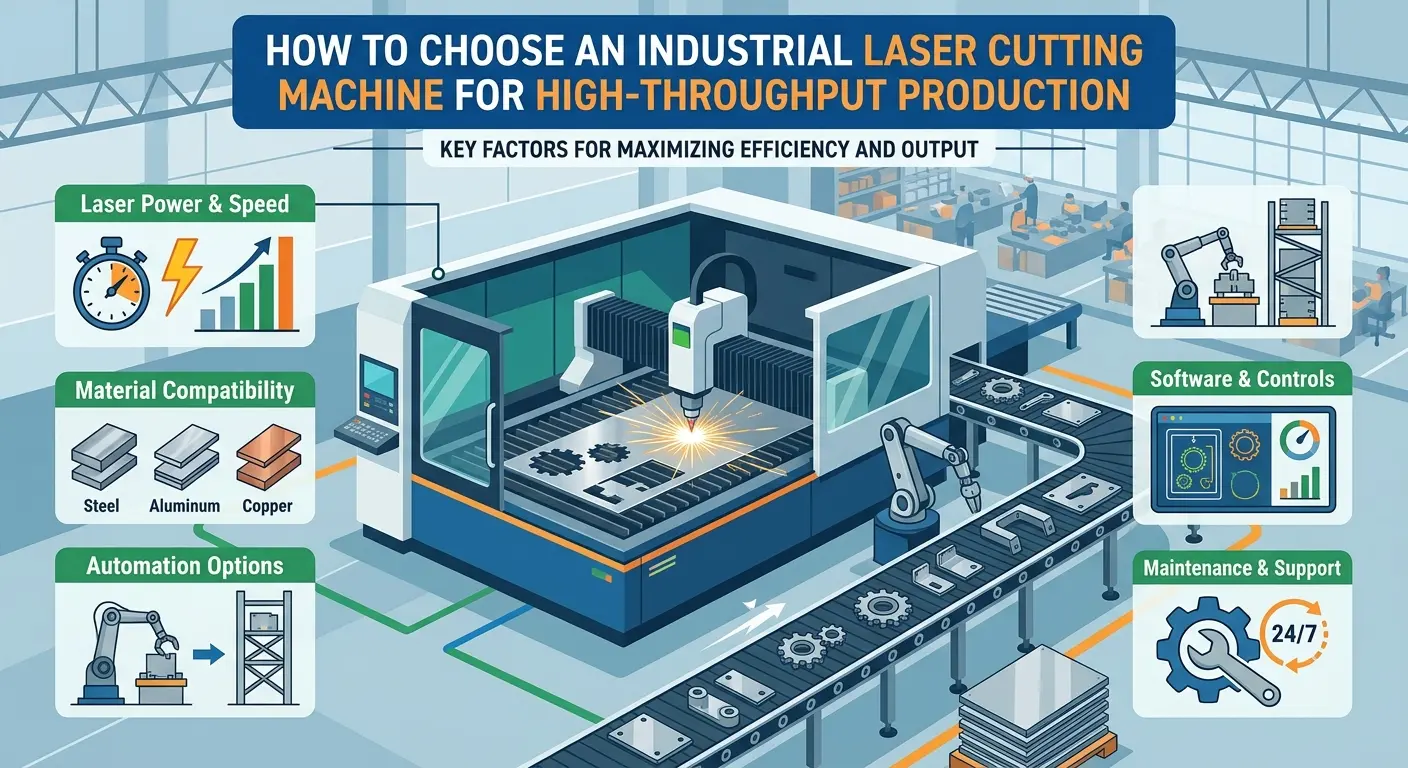
The most productive laser installations are usually built around a few practical variables rather than one dramatic feature. The table below is a better guide than any single headline metric.
| Production Factor | What to Evaluate | Why It Matters for Throughput |
|---|---|---|
| Material fit | Whether the machine is well matched to the substrates and thickness range actually being processed | Poor material fit creates unstable cut quality, slower optimization, and more rework |
| Job changeover | How quickly operators can move between programs, layouts, and batches | High cutting performance loses value if every new job creates avoidable downtime |
| Nesting efficiency | How effectively parts are arranged on the sheet | Better sheet utilization improves output economics and lowers waste at volume |
| Loading and unloading flow | How material enters and finished parts leave the cutting area | Manual bottlenecks can erase gains from fast cutting cycles |
| Edge quality consistency | Whether cut edges stay clean enough for the next step | Cleaner output reduces sanding, trimming, or reject handling |
| Operator dependence | How much continuous manual correction the machine needs | Stable, predictable processes scale better across longer shifts |
| Maintenance stability | How reliably the system holds performance over time | Output drops quickly when maintenance interruptions become frequent or unpredictable |
A strong buying process uses these factors to judge overall line productivity, not just isolated machine capability.
Material Handling Often Decides the Winner
A surprising number of factories invest in cutting capacity but keep losing time between sheets. If operators are manually repositioning material, separating finished parts slowly, or stopping to clear scrap too often, the cutting process is not the real limit anymore.
In high-throughput environments, material flow matters just as much as cutting performance. Production teams should look closely at:
- How raw sheets are staged before cutting
- How parts are removed without damaging finished edges
- Whether cut parts are easy to identify, sort, and move downstream
- How scrap is cleared so the next cycle starts quickly
- How often operators need to pause the process to correct avoidable interruptions
This is one reason laser buyers should think in terms of line design rather than machine isolation. A machine that is slightly less aggressive on paper can outperform a supposedly faster option if its surrounding workflow is cleaner and easier to sustain.
When Laser Is the Right Choice and When It Is Not
An industrial laser cutting machine is not the universal answer to every cutting problem. It performs best when the production need aligns with laser processing strengths such as contour flexibility, detailed profiles, and repeatable non-contact cutting.
A laser solution is often a strong fit when the priority is:
- Consistent processing of detailed shapes
- Fast switching between programs
- Cleaner edge results on suitable materials
- Reduced dependence on physical tooling changes
- Integration with marking or engraving-related workflows
Another process may be more appropriate when the factory primarily needs heavy machining, deep routing, or process steps that depend on cutter geometry rather than beam-based cutting. The decision should be made around the production outcome, not around the assumption that newer always means better.
For teams comparing multiple process types in one investment cycle, the broader Pandaxis product catalog can help clarify where laser equipment fits relative to other production categories.
How to Evaluate a Machine for High-Throughput Production
A practical buying review should move through the same logic production managers use on the shop floor.
- Start with daily output targets.
Define how many finished parts or sheets need to move through the process per shift, not just how fast a single cut can be completed. - Check material reality.
List the real materials, part sizes, and edge expectations the line handles today, along with likely future variation. - Map the handoffs.
Identify what happens immediately before and after cutting. If upstream staging or downstream sorting is weak, adding cutting speed alone may not improve the result. - Review changeover pressure.
If the factory runs short batches or variable designs, software flow and job transition efficiency become central to productivity. - Evaluate quality stability.
Ask whether the machine can hold acceptable cut quality across long production windows without repeated manual correction. - Think in labor per good part.
A machine may look economical until extra supervision, cleanup, or rework is counted into the real throughput picture.
This evaluation method usually leads to better decisions than comparing headline specifications in isolation.
Common Mistakes That Limit Throughput After Purchase
Factories do not usually lose throughput because they misunderstood the word laser. They lose throughput because they underestimate the system conditions the machine depends on.
Common mistakes include:
- Buying around peak output claims instead of normal production conditions
- Choosing a configuration that is poorly matched to the primary material mix
- Ignoring unloading, sorting, and scrap handling needs
- Treating nesting as a minor software detail instead of a cost and output driver
- Underestimating the importance of maintenance discipline for stable long-run performance
- Expecting one machine to replace unrelated processes with different workflow requirements
Avoiding these mistakes is often the difference between a machine that looks impressive in a quote and one that delivers reliable shift-after-shift production value.
What a Good High-Throughput Laser Setup Should Improve
When the fit is right, an industrial laser cutting machine should improve more than cutting itself. It should make the surrounding workflow easier to manage.
In practical terms, the right system should help a manufacturer achieve:
- Faster movement from design file to production job
- More predictable output across repeat runs
- Lower waste from poor nesting or unstable results
- Cleaner handoff into packaging, assembly, or finishing
- Less dependence on operator workarounds to keep output moving
- More confidence when scaling from smaller batches to steadier volume
That is the standard worth using when comparing options. High-throughput production is not just about what the machine can do at its best. It is about what the line can repeat consistently over time.
Final Thoughts
Choosing an industrial laser cutting machine for high-throughput production is really a decision about workflow discipline, material fit, and repeatable output. The most successful investments are not the ones built around a single speed claim. They are the ones that reduce downtime, support cleaner job transitions, improve part consistency, and fit the broader production system.
If your operation depends on frequent job changes, detailed cutting, and stable output across repeated runs, laser processing can be a strong manufacturing solution. The key is to evaluate the machine the same way you evaluate any production asset: by how well it improves the flow of good parts through the factory, not just by how fast it cuts in ideal conditions.