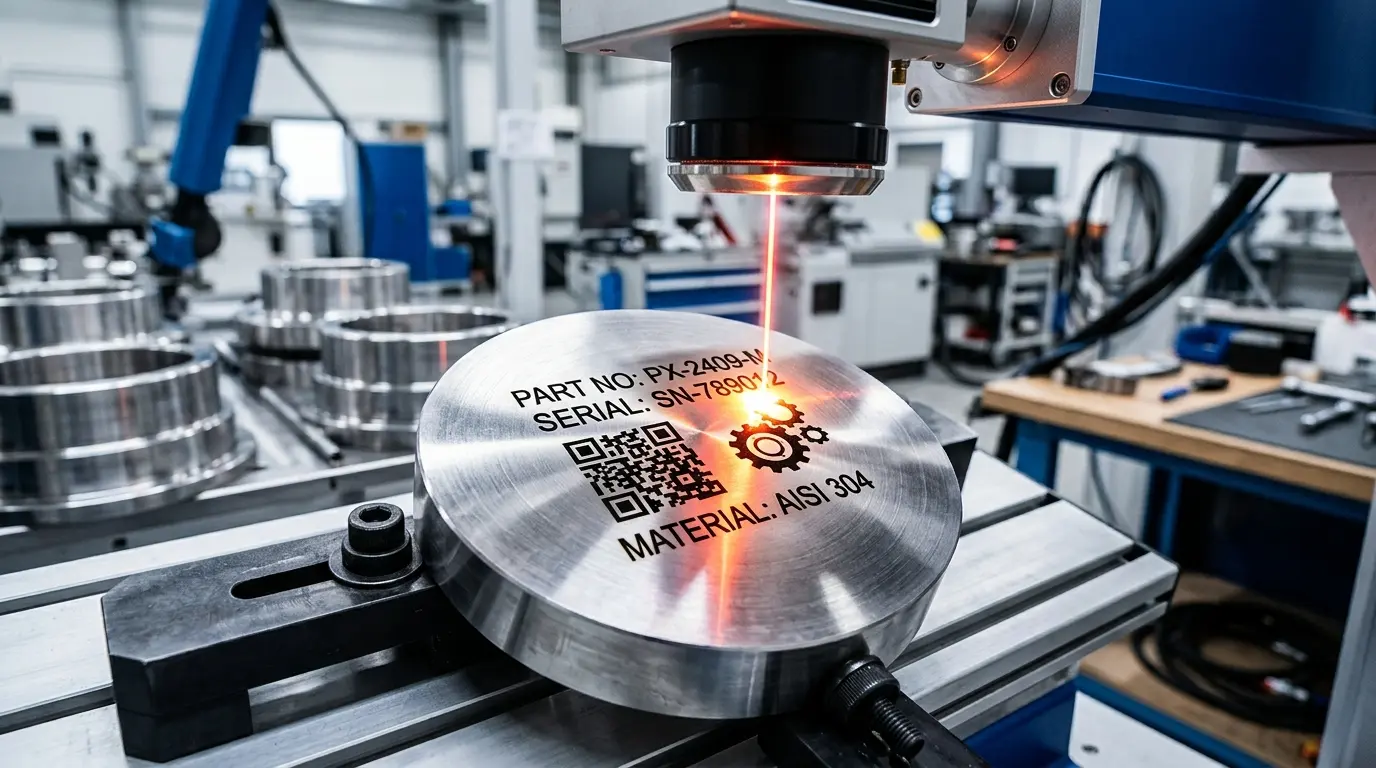
On many production lines, a metal mark looks acceptable at the marking station but fails later in the workflow. A serial number that appears clear under bench lighting may become hard to read after cleaning, coating, handling, or scanner verification. When that happens, the problem is not cosmetic. It affects traceability, inspection speed, part matching, and downstream quality control.
Improving both contrast and permanence usually starts with a simple correction in thinking: these are related goals, but they are not the same goal. High visual contrast helps operators and scanners read the mark quickly. Permanence determines whether that mark still does its job after abrasion, heat, washing, surface treatment, or field use. The best laser marking result comes from matching the mark style to the metal, the surface condition, and the part’s real service life.
Contrast and Permanence Are Different Production Targets
Factories sometimes try to solve both requirements with one sample test and one preferred look. That approach often creates weak results because a mark that looks dark and clean on a new sample is not automatically the mark that survives the full process.
| Requirement | What It Means on the Line | What Commonly Causes Failure | What Usually Improves It |
|---|---|---|---|
| High Contrast | Operators and scanners can read the mark quickly and consistently | Reflective finishes, low edge definition, codes that are too small, unstable focus | Better surface consistency, more stable part presentation, larger or clearer code geometry, a mark style that fits the metal |
| High Permanence | The mark remains useful after handling, cleaning, coating, wear, or service exposure | Marking that is too superficial for the downstream process, poor mark timing in the workflow | A more durable mark style, realistic life-cycle testing, and marking at the right production stage |
| Both Together | The mark stays readable and survives real operating conditions | Qualification based only on ideal samples before downstream processing | Testing on actual parts under actual process and service conditions |
This distinction matters because the wrong optimization can create a false win. A darker mark is not always the most durable mark. A deeper mark is not always the most readable mark. The right answer depends on what the part must survive and how the mark will be used.
The Part Material and Surface Usually Decide the Process Window
The phrase metal parts covers a wide range of marking behavior. Stainless steel, aluminum, carbon steel, plated parts, coated parts, machined surfaces, blasted surfaces, and cast surfaces do not all respond the same way. That is why the same laser system and the same broad machine category can produce very different results from one part family to another.
In practical terms, contrast is heavily influenced by how the surface reflects light and how the material responds to laser energy. Some stainless workflows are often associated with dark annealed marks. Some aluminum workflows produce lighter, frosted-looking marks that may be readable but less visually bold under certain lighting. Rougher or less uniform surfaces can reduce edge definition, especially on small codes or dense data matrix patterns.
Surface condition matters just as much as base material. Oil, oxide, coolant residue, scale, plating variation, and cosmetic grain all change the mark. If the sample part is cleaner or smoother than the real production part, the approved result may not hold up on the line.
That is why buyers should qualify the process on real parts from real lots, not on a convenient substitute sample.
Choose the Mark Type by What the Part Must Survive
In industrial metal marking, laser systems are commonly used to create different effects depending on the material and setup. The important decision is not only whether the part is laser marked. It is what kind of mark the workflow actually needs.
| Mark Style | Where It Often Fits Best | Contrast Profile | Permanence Profile | Main Tradeoff |
|---|---|---|---|---|
| Annealed or Discoloration Mark | Finished parts where surface disruption should stay low | Can deliver strong visual contrast on some stainless applications | Often useful when the surface will not face aggressive abrasion or later removal steps | Not every alloy responds the same way, and later blasting or refinishing can reduce readability |
| Etched Mark | General part identification where some material removal is acceptable | Usually produces a visible mark with clearer edge separation than a purely superficial color change | Commonly stronger than a purely cosmetic surface effect | May change the surface appearance more noticeably |
| Deeper Engraved Mark | Parts that may face wear, repainting, blasting, or harsher service conditions | Contrast may come more from geometry than dark color alone | Often a better fit when the mark must remain identifiable after later abuse | Typically slower and more intrusive than lighter marking strategies |
This is also where honesty matters. If the part must survive very harsh treatment, over-optimizing a light surface mark may be less effective than moving to a more material-removing strategy. In some cases, manufacturers should compare laser marking against other industrial marking methods rather than forcing one laser recipe to solve every permanence requirement.
How to Improve Contrast Without Creating a Cosmetic Problem
In many factories, poor contrast is not caused by the laser head alone. It is usually the result of inconsistent surface condition, unstable part positioning, or a mark design that is too ambitious for the available marking area.
The most practical improvements usually include:
- Standardize Surface Preparation Before Marking
- Use Stable Workholding So Focal Position Does Not Drift Between Parts
- Increase Code or Character Size When Scanner Reliability Matters More Than Minimum Footprint
- Match the Marking Area to a Cleaner, More Consistent Part Surface When the Design Allows It
- Verify the Mark Under the Same Lighting and Scanner Conditions Used in Production
- Separate Recipes by Material Family Instead of Forcing One Universal Setup Across Mixed Alloys
One of the most common mistakes is tuning only for the darkest possible appearance. On cosmetic or finished parts, that can create more heat tint, roughness change, or inconsistent visual quality than the product can tolerate. A better target is functional readability with acceptable surface appearance, not maximum darkness at any cost.
How to Improve Permanence Without Over-Specifying the Mark
Permanence problems often come from workflow timing as much as from the mark itself. A code may look excellent immediately after marking and still fail if the part is later polished, blasted, coated, or exposed to repeated contact in handling fixtures.
To improve permanence, manufacturers should define the real threat to the mark:
- Abrasion During Handling or Service
- Solvent or Cleaning Exposure
- Heat Exposure
- Shot Blasting or Surface Refinishing
- Painting or Powder Coating
- Outdoor or Corrosive Operating Conditions
Once that threat is clear, the mark can be designed around it. Sometimes the answer is a deeper interaction with the base metal. Sometimes it is a different mark location. Sometimes it is moving the marking step later in the process so the code is not damaged by downstream operations.
That is why permanence should be specified in workflow terms, not in vague language. If the real requirement is that a data matrix code must remain scanner-readable after wash, coating, and warehouse handling, that should be the qualification standard. If the real requirement is that an identification mark must remain visible after years of service wear, that should drive the process selection from the beginning.
Common Line Problems and What They Usually Point To
| Problem Seen in Production | What It Often Indicates | Practical Response |
|---|---|---|
| The Mark Looks Good on Samples but Fades After Cleaning or Handling | The mark is too superficial for the downstream process, or sample cleanliness hid the real problem | Re-qualify on production-finish parts and test a more durable mark style if needed |
| The Code Is Readable by Eye but Scanner Rejection Is High | Cell size is too small, edge definition is inconsistent, or part presentation varies too much | Increase code size where possible, stabilize fixturing, and validate with the production scanner |
| Results Are Good on Flat Parts but Weak on Curved or Irregular Parts | Focus consistency changes across the marking area | Improve nesting and workholding, or qualify separate setups by part geometry |
| Some Batches Mark Well and Others Do Not | Material, finish, or coating variation is wider than the approved process window | Group parts by verified material and surface condition, then qualify recipes accordingly |
| The Mark Is Durable but Visually Too Harsh | The process is tuned more for depth than for surface appearance | Rebalance for the cosmetic requirement or separate visible-part marking from heavy-duty ID marking |
These line-level symptoms are useful because they shift the discussion away from general machine claims and toward root cause. In most cases, better results come from tighter process definition, better part presentation, and more realistic testing rather than from chasing a single headline specification.
Validate the Mark After Real Downstream Processing
The strongest qualification plan is the one that mirrors the real life of the part. Before locking in a machine choice or a standard recipe, manufacturers should test marked samples through the same events the production part will actually face.
That validation should usually include:
- Post-Cleaning Inspection
- Post-Handling Inspection
- Post-Coating or Post-Finishing Inspection If the Mark Comes Earlier in the Process
- Scanner Verification Under Real Line Conditions
- Comparison Across Normal Production Lot Variation
- Cycle-Time Review That Includes Loading, Positioning, Marking, and Verification
This step is where many expensive mistakes become visible early. A mark that survives only the lab bench is not production-ready. A mark that survives the real process but slows the line too much is not production-ready either.
For manufacturers reviewing metal marking projects alongside broader factory-equipment planning, the Pandaxis product catalog offers a wider view of industrial machinery categories and buying paths.
Practical Summary
Improving contrast and permanence in laser marking for metal parts is usually less about chasing one stronger setting and more about matching the mark style to the metal, the surface, and the part’s real life cycle. Contrast comes from readability under actual lighting and scanner conditions. Permanence comes from surviving the real handling, finishing, and service environment.
The most reliable path is straightforward: qualify on real parts, separate recipes by material and surface condition, stabilize workholding, and judge the mark after the downstream process has done its damage. When buyers follow that logic, they usually make better equipment decisions, reduce remarking risk, and get closer to a mark that stays useful long after the sample trial is over.