Many buyers assume tumbler engraving becomes simple as soon as a rotary attachment is added to a laser machine. In practice, most quality problems show up after that point. The tumbler slips, the artwork stretches across a tapered wall, the seam does not close cleanly, or the mark quality changes from one side of the cup to the other.
That is why the real buying question is not just whether a laser engraver can run tumblers. It is whether the machine, rotary attachment, and setup method can hold cylindrical parts securely, keep the surface in the right focus zone, and repeat the same result across mixed drinkware shapes and finishes.
Start With the Tumbler, Not the Attachment
The rotary attachment matters, but it is not the first decision. Tumbler work changes significantly based on four variables:
- Material And Surface Finish
- Straight-Wall Or Tapered Geometry
- Part Weight And Diameter Range
- Output Goal: Branding, Decorative Graphics, Personalization, Or Deeper Engraving
Across the broader laser market, that matters because one tumbler job may involve coated metal drinkware, another may involve glass, and another may involve non-metal cylindrical promotional products. Those are not identical applications, and they should not be treated as one generic “tumbler laser” purchase.
For shops already evaluating laser cutters and engravers for wood, acrylic, glass-surface frosting, and similar non-metal work, tumbler jobs should be judged by the same rule: confirm material fit first, then decide whether a rotary attachment can support stable cylindrical processing.
What the Rotary Attachment Actually Has to Control
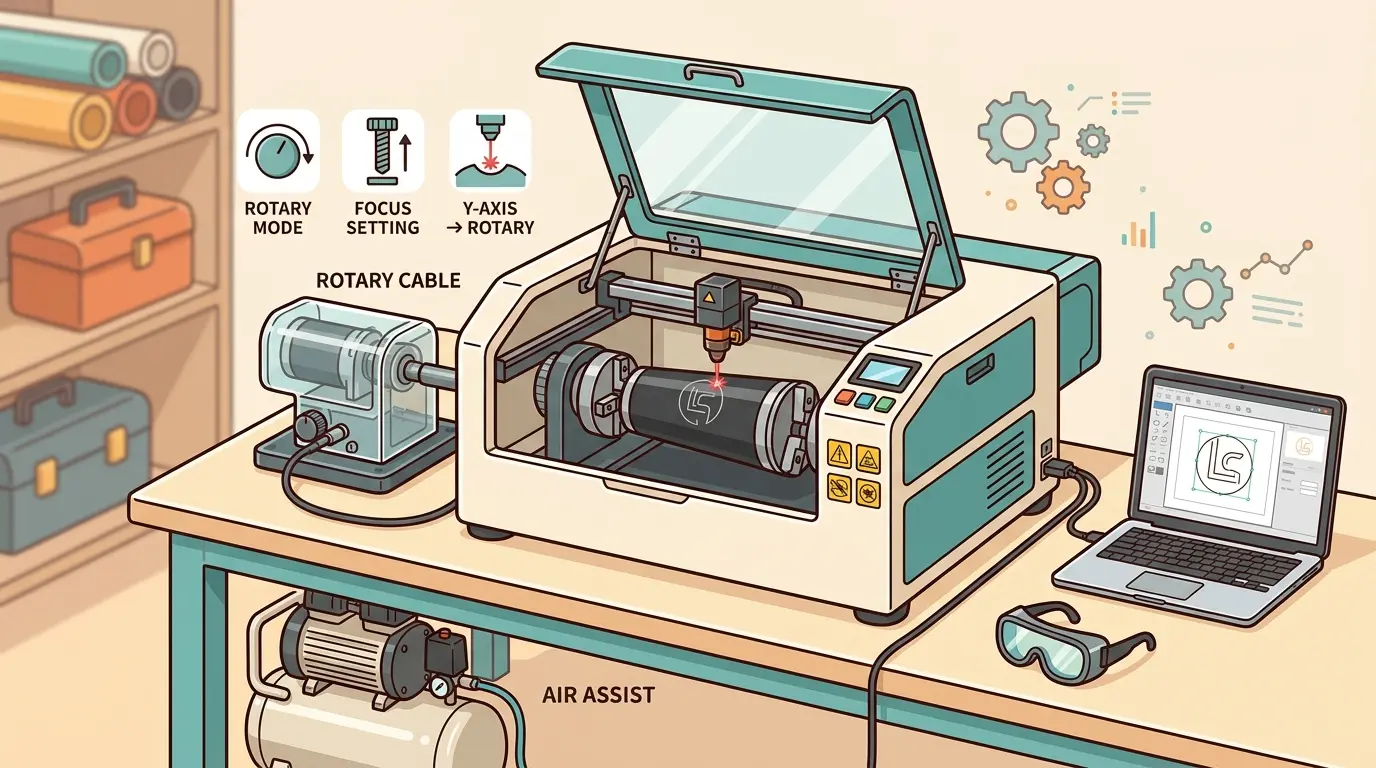
In tumbler production, the rotary is doing more than turning the part. It has to protect the relationship between the artwork and the physical cylinder.
The attachment usually needs to do five things well:
- Hold the part without visible slippage during a full rotation
- Keep the axis stable enough to prevent wobble or banding
- Support the real tumbler diameter range without improvised clamping every time
- Handle taper without distorting the artwork wrap
- Maintain repeatable start position so the seam closes where the operator expects
If any one of those conditions is weak, the laser result may still look acceptable in a short demo but become unreliable in daily use.
Roller Rotary vs Chuck Rotary
The best rotary style depends on the tumbler geometry and how standardized the product mix really is.
| Rotary Type | Where It Usually Fits Best | Main Strength | Main Limitation |
|---|---|---|---|
| Roller Rotary | Straight tumblers, common drinkware diameters, and shops changing SKUs often | Fast loading and practical support for many cylindrical parts | More sensitive to slip if the surface is uneven, heavy, or highly tapered |
| Chuck Rotary | More controlled holding on parts that need stronger grip or more fixed positioning | Better control over start position and part retention | Slower changeovers and less convenient when diameters vary often |
| Dedicated Mug Or Irregular-Part Fixture | Parts with unusual bases, irregular profiles, or geometry that standard rollers cannot stabilize | Better adaptation to difficult part shapes | Added setup complexity and lower flexibility across mixed jobs |
For many tumbler workflows, the wrong rotary type creates more waste than the wrong laser parameter. If the production queue includes frequent taper changes, heavier insulated drinkware, or difficult-to-grip finishes, the holding method deserves as much scrutiny as the laser source itself.
Tumbler Geometry Changes the Setup More Than Many Buyers Expect
Buyers often focus on artwork size and ignore the physical profile of the cup. That is usually a mistake.
| Tumbler Condition | Rotary Requirement | What Goes Wrong If It Is Ignored |
|---|---|---|
| Straight-Wall Tumbler | Stable axis height and enough grip to avoid drift | Seam shift, light banding, or gradual artwork creep |
| Tapered Tumbler | Taper compensation through fixture adjustment, shimming, or controlled artwork scaling | Design distortion, uneven wrap, and inconsistent focus |
| Heavy Insulated Tumbler | Sufficient support, torque stability, and clearance around the full circumference | Lost position, wobble, and unstable marking consistency |
| Powder-Coated Or Finished Surface | Controlled contact pressure and verified material response | Slippage, surface damage, or poor contrast target |
| Glass Tumbler | Gentle mechanical support and conservative handling of stress points | Cracking risk, unstable support, or inconsistent frosting |
| Handle, Base Lip, Or Irregular Shape | Special fixture or a different process decision entirely | Collision, skipped rotation, or unusable artwork placement |
This is why tumbler samples can be misleading. A straight, empty, light cup may run cleanly on a simple roller setup, while a heavier tapered insulated tumbler from the actual customer order may expose every weakness in the fixture.
Rotary Setup Steps That Actually Protect Quality
The best tumbler setup routines are boring in the right way. They reduce improvisation and make the result repeatable across shifts.
- Verify Material And Finish Compatibility.
If the tumbler substrate or coating is not a good match for the laser source and output goal, the rotary setup will not fix that mismatch. - Match the Rotary Type to the Part Geometry.
Do not default to the same attachment for every cylinder. Straight drinkware, tapered tumblers, and irregular profiles need different holding logic. - Level the Rotary Axis to the Beam Path.
If the part sits too high on one end or the axis is not aligned cleanly, the mark may drift or the seam may fail to close correctly. - Secure the Tumbler With Enough Pressure, But Not Excessive Force.
Too little pressure encourages slip. Too much pressure can damage the finish, deform support points, or create unstable rolling behavior. - Check Taper Before Final Artwork Layout.
On tapered drinkware, the design may need compensation before production begins. Ignoring taper and hoping software will rescue the output later usually creates avoidable rejects. - Set Focus at the Actual Working Surface.
Do not focus on an empty assumption of diameter. Focus should reflect the real highest point of the usable marking zone. - Establish a Reliable Start Position.
Operators should know where the seam begins, where the design closes, and how repeat jobs align from one part to the next. - Run a Low-Risk Circumference Test.
A short outline, guide box, or low-impact test pattern usually reveals slip, taper distortion, and seam mismatch before the real job is ruined. - Validate Exhaust and Debris Control for the Real Finish Standard.
Tumbler work often fails cosmetically before it fails mechanically. Smoke, residue, and surface contamination matter when the product is customer-facing.
The Most Common Rotary Problems in Tumbler Work
When tumbler jobs fail, the cause is usually mechanical setup discipline rather than headline machine capability.
Common problems include:
- Artwork That Stretches Or Compresses Around the Wrap
- Start And End Points That Do Not Meet Cleanly
- Inconsistent Mark Depth Or Contrast Around the Circumference
- Part Slip During Longer Jobs
- Uneven Results on Tapered Drinkware
- Clearance Issues Near Bases, Lips, Or Handles
Those defects usually point back to one of four root causes:
- The Wrong Rotary Style for the Part
- Weak Part Retention Or Support
- Poor Taper Compensation
- Inaccurate Axis, Origin, Or Focus Setup
That is important for buyers because it changes how a machine should be evaluated. A tumbler demo is only useful if it reflects your actual cup geometry, finish, weight, and artwork coverage.
When a Rotary Attachment Is Worth the Investment
A rotary attachment usually makes the most sense when cylindrical jobs are recurring enough to justify standardized setup, saved recipes, and operator training.
It is commonly a stronger investment when:
- Tumblers Or Other Cylindrical Products Are a Repeat Product Line
- The Shop Needs Better Seam Consistency Than Manual Repositioning Can Deliver
- Artwork Wrap Accuracy Affects Brand Quality
- Changeovers Between Diameter Ranges Can Be Standardized
- The Business Needs a More Repeatable Drinkware Workflow Rather Than Occasional Custom One-Offs
It is often a weaker investment when tumbler work is rare, highly irregular, or disconnected from the machine’s core material fit. In those cases, the rotary may be technically possible to use but operationally hard to justify.
Practical Summary
A rotary attachment does not automatically turn a laser engraver into a reliable tumbler-production system. The real requirement is stable cylindrical control: secure holding, consistent axis alignment, taper management, repeatable seam positioning, and focus discipline that matches the actual cup geometry.
For buyers, the safer path is to evaluate tumbler work as a full workflow, not as an accessory checkbox. Start with the real tumbler material and profile, choose the right rotary style, standardize the setup sequence, and test the exact part family that will consume machine hours. That is usually what separates a convincing demo from a dependable production process.