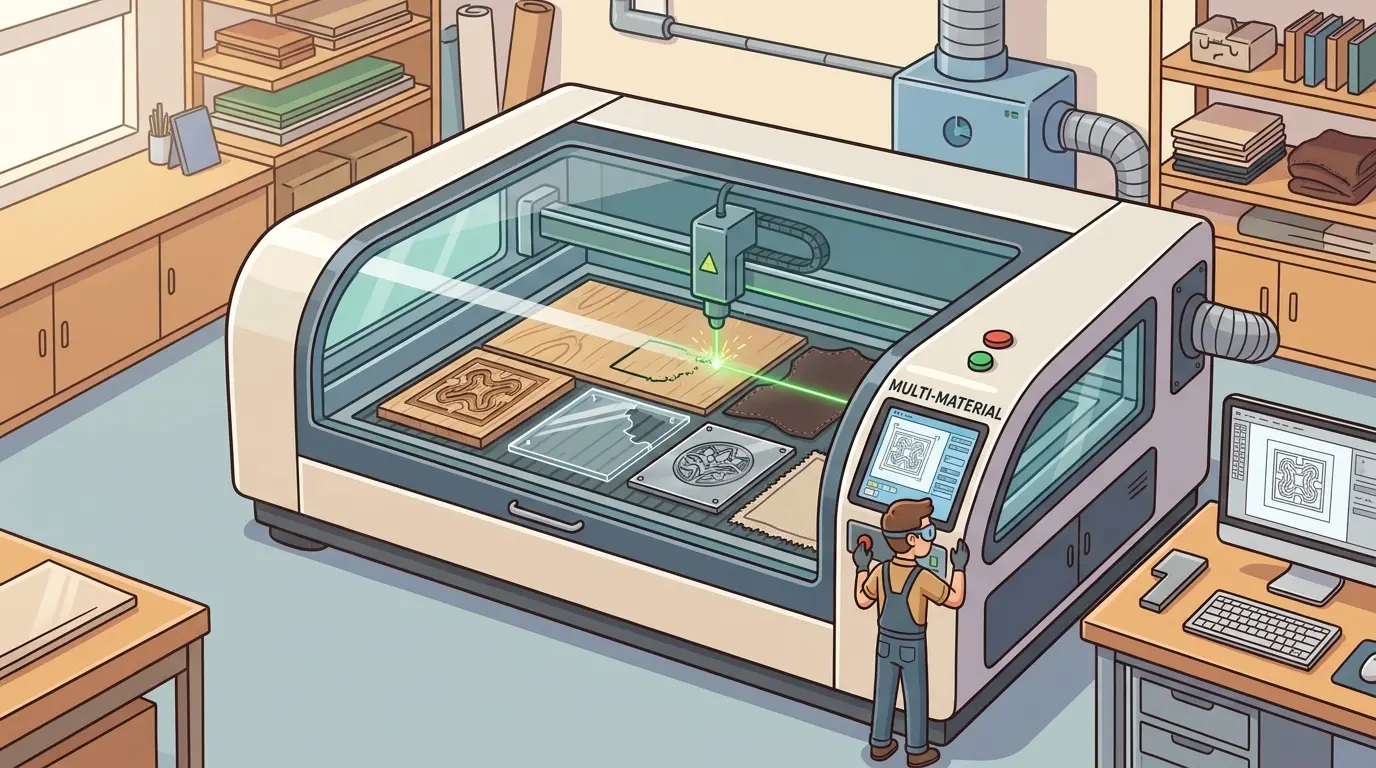
Mixed-material engraving sounds efficient until the queue becomes real. A shop may engrave acrylic display parts in the morning, switch to plywood brand panels after lunch, and then run laminated nameplates, MDF inserts, or leather accessories before the shift ends. At that point, the buying question changes. The problem is no longer whether one machine can engrave several substrates. The real question is whether the engraving workflow stays repeatable when heat response, residue load, visual standards, and setup rhythm all shift from one job to the next.
For manufacturers evaluating laser cutters and engravers for wood, acrylic, MDF, leather, laminates, and similar non-metallic work, the right equipment choice usually depends less on the broad phrase mixed materials and more on what changes inside the production cell when the material mix rotates.
Why Mixed-Material Engraving Is Harder Than It Looks
Single-material production is easier to stabilize because the acceptable process window stays narrow. Mixed-material engraving is different because each substrate changes what counts as a good result.
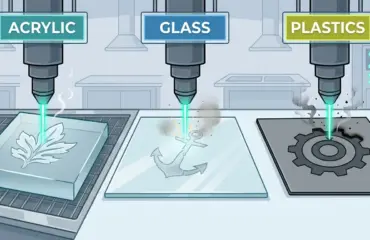
Acrylic jobs often raise the standard for surface clarity, line crispness, and visual cleanliness. Wood products shift attention toward controlled contrast, readable graphics, and acceptable edge darkening around engraved areas. MDF and similar engineered boards increase smoke and cleanup pressure. Laminated or coated panels add another risk because a part can be dimensionally correct and still be rejected if the engraved face looks scorched, hazy, or inconsistent.
That changes the equipment decision in practical ways:
- Recipe Stability Matters More Than Peak Demonstration Speed
- Extraction Performance Matters More As Material Variety Increases
- Fixturing And Bed Referencing Matter More When Artwork Placement Must Stay Consistent
- Queue Management Matters More When Decorative Work And Utility Work Share The Same Machine Time
- Accepted Parts Per Shift Matter More Than Simple Cycle Speed
In other words, mixed-material engraving exposes weak workflow fit very quickly. A machine that looks productive on one ideal sample can become much less efficient when operators keep moving between substrates with different visual standards and maintenance demands.
What Usually Changes By Material Family
The simplest way to understand mixed-material engraving is to stop treating every substrate as one category.
| Material Group | What Production Usually Prioritizes | What Changes In Engraving | Main Workflow Risk |
|---|---|---|---|
| Acrylic | Clean visual finish, sharp graphics, repeatable appearance | Heat buildup, haze, residue visibility, masking discipline | Cosmetic rejects on otherwise usable parts |
| Plywood And Similar Wood Panels | Readable contrast, stable appearance, controlled darkening | Grain variation, glue-line inconsistency, changing surface response | Uneven mark tone across production batches |
| MDF And Other Engineered Boards | Reliable legibility and predictable output over long runs | Higher smoke load, more residue, heavier cleanup pressure | Throughput loss from contamination and rework |
| Laminated Or Coated Boards | Crisp graphics without face damage | Top-layer sensitivity, narrow process window, stricter inspection | Saleable panels becoming rejects because of surface damage |
| Leather And Similar Soft Non-Metallic Materials | Controlled detail and consistent placement | Material movement, odor load, changing surface response | Registration drift and variable finish quality |
This is why mixed-material buyers often underperform when they choose equipment around one good sample. The better question is which machine setup stays stable across the weekly production mix rather than which one looks strongest on the easiest material.
The Main Equipment Configurations for Mixed-Material Engraving
Most factories are not really choosing between one good machine and one bad machine. They are choosing between different ways to organize engraving, cutting, and queue flow.
| Equipment Configuration | Best Fit | Main Strength | Main Tradeoff |
|---|---|---|---|
| Combination Cut-And-Engrave Laser System | Parts that regularly need both contour cutting and engraving in one cycle | Reduces handling and supports flexible short runs | Cutting and engraving compete for the same machine time |
| Engraving-Focused Laser Workstation | Decorative panels, branded parts, repeat artwork, and surface-detail work | Better schedule control for engraving-heavy production | Less attractive if most machine hours actually go to contour cutting |
| Split Cutting And Engraving Cells | Plants with steady demand for both operations | Protects throughput by separating two different workloads | Requires more investment, floor planning, and process discipline |
| Laser As A Secondary Cell In A Larger Production Line | Furniture, signage, or mixed-part factories where engraving adds value after primary machining | Keeps laser focused on high-value detailing instead of carrying every upstream task | Demands stronger coordination with the rest of the line |
The combination setup often looks attractive first because it appears to solve everything with one purchase. It can be a very practical choice when the same part needs both shaping and engraving, especially in short- to medium-run production.
The problem starts when the queue splits. If contour-cut jobs dominate one day and decorative engraving dominates the next, the same flexible machine can turn into a scheduling bottleneck. That is when an engraving-first cell or separate stations begin to make more operational sense.
How the Real Job Mix Usually Points to the Right Setup
The phrase mixed-material production is too broad to support a buying decision on its own. The better approach is to map the actual order pattern.
| Real Job Mix | Usually Points Toward | Why |
|---|---|---|
| Acrylic signs, wood brand panels, and short-run cut-and-engrave parts | Combination Cut-And-Engrave System | One setup can complete both geometry and graphics with fewer handoffs |
| Mostly engraved panels, logos, labels, and decorative surface work across several non-metallic substrates | Engraving-Focused Workstation | Surface quality and queue stability matter more than cutting capacity |
| Repeated product lines that need engraving while another queue keeps feeding cut parts | Split Cutting And Engraving Cells | Protects throughput and reduces schedule conflict |
| Furniture or display parts that are structurally machined elsewhere and only need final branding or decorative detailing | Laser As A Secondary Cell | Keeps the laser focused on the value-added finishing step |
| Frequent one-off jobs with many material changes and high appearance sensitivity | Flexible Engraving Cell With Strong Recipe Control | Fast recall and repeatability matter more than headline speed |
This table matters because factories often buy for the word flexible without asking what flexibility costs in daily scheduling. In many cases, the right answer is not the broadest possible machine. It is the machine arrangement that keeps the queue moving without forcing every job type into the same operating rhythm.
The Features That Protect Repeatability in Daily Production
In mixed-material engraving, the most valuable machine features are usually the ones that make the second, third, and fiftieth run look like the first approved sample.
- Reliable Recipe Storage And Fast Job Recall: Operators need to return quickly to stable settings when the schedule rotates between acrylic, wood, laminates, and other non-metallic materials.
- Stable Motion And Repeatable Positioning: Good positioning control helps maintain artwork alignment, part-to-part consistency, and predictable graphic placement.
- Consistent Bed Referencing And Material Fixturing: Mixed-material cells lose time and quality when parts shift, sit unevenly, or require repeated manual alignment.
- Effective Extraction And Air Management: Smoke control affects engraving clarity, cleanup time, and day-long process stability, especially on wood-based and engineered materials.
- Practical Maintenance Access: Mixed-material work usually creates more contamination than single-material work, so cleaning routines need to be realistic enough to happen on schedule.
- Workflow Fit Around Loading, Inspection, And Unloading: A technically capable laser still underperforms if surrounding handling steps delay the next job or create unnecessary rechecks.
These points are less dramatic than broad speed claims, but in real factories they often decide whether the machine produces stable output over a full shift or only under carefully managed demo conditions.
Where Laser Engraving Fits Best in the Full Production Workflow
Laser engraving is commonly well suited to branding, decorative graphics, shallow identification marks, pattern work, and parts where appearance and detail matter as much as geometry. It becomes especially valuable when non-contact processing helps preserve small features or when a product needs visual customization without extra tooling.
It becomes less convincing when buyers expect the engraving system to solve structural sheet processing, hardware preparation, or other upstream operations that belong elsewhere in the line. For example, if a furniture factory engraves finished-facing cabinet parts or decorative furniture panels after they are machined, the structural panel processing may still be better handled upstream by CNC nesting machines. In that kind of workflow, the laser earns its place by adding branding, detailing, or product differentiation, not by trying to replace the entire machining process.
That distinction matters because mixed-material production often combines two separate goals:
- Producing The Part Correctly
- Finishing Or Identifying The Part At A Higher Value Level
Laser engraving is strongest when it is matched to the second goal or when both goals naturally fit inside the same cut-and-engrave cycle.
If the material mix extends beyond non-metallic engraving into specialized metal marking or other source-specific processes, the evaluation logic changes and should be assessed separately. A machine selected for acrylic, wood, and similar substrates should not automatically be treated as the right answer for a fundamentally different marking requirement.
Common Buying Mistakes in Mixed-Material Engraving Projects
Factories tend to repeat the same selection errors when they buy engraving equipment for varied product lines:
- Evaluating The Machine On One Ideal Sample Instead Of The Weekly Job Mix
- Treating All Substrates As If They Share The Same Visual Acceptance Standard
- Choosing For Maximum Speed Even When Queue Stability Drives Output More Than Cycle Time
- Ignoring Residue Load, Cleaning Frequency, And Extraction Performance
- Forcing Cutting And Engraving Into One Cell Even After The Two Queues Clearly Conflict
- Using Laser To Carry Tasks That Belong To Another Upstream Production Process
Most of these mistakes are not technical failures. They are workflow-matching failures. The machine may be able to engrave the material, but the wrong setup can still produce weaker margins, more rework, and a less stable schedule.
Practical Summary
The best laser engraving equipment for mixed-material production is the setup that stays stable when the order mix changes, not the one that makes the broadest promise. If the same parts regularly need both contour cutting and engraving, a combination system can be a practical choice. If the workload is dominated by decorative graphics, branding, labels, and repeat surface work across several non-metallic materials, an engraving-focused cell usually makes more sense. If cutting and engraving are both steady bottlenecks, separating them often protects throughput better than forcing everything through one machine.
Mixed-material success comes from matching the equipment to the real queue, the real inspection standard, and the real maintenance burden. Factories that choose well are usually the ones that map their actual material families, understand where appearance standards change, and decide early whether one flexible laser is enough or whether engraving needs its own dedicated place in the production workflow.