Many buyers start with a reasonable assumption: if one laser engraver can mark acrylic, it should handle glass and plastic with only minor adjustments. In real production, that assumption usually breaks down fast. The beam may come from the same machine family, but the material response, reject risk, cleanup burden, and recipe discipline can change substantially from one substrate to the next.
For shops evaluating laser cutters and engravers for acrylic and other non-metallic work, the better question is not whether one platform can process all three material groups. The more useful question is what has to change in the workflow when the queue shifts from acrylic display parts to glass branding pieces to mixed plastic components.
The Machine May Stay the Same, but the Material Behavior Does Not
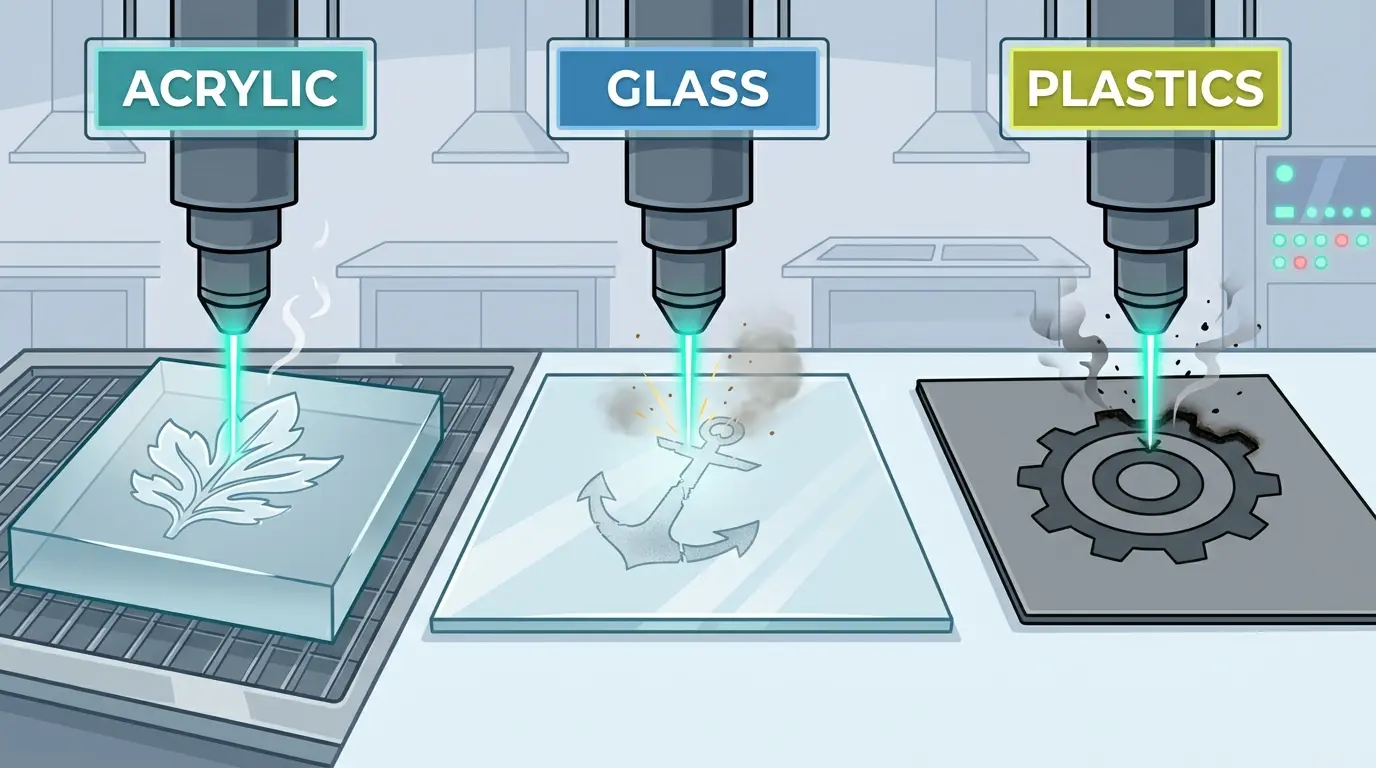
In day-to-day production, acrylic, glass, and plastic do not fail in the same way and they do not reward the same machine strengths.
| Material Group | What Shops Usually Want | What Changes Most in Production | What Commonly Creates Rejects |
|---|---|---|---|
| Acrylic | Clean visual engraving, readable detail, and often a presentable edge if cutting is also involved | Surface finish, edge appearance, and consistency across cast or extruded stock | Haze, inconsistent engraving appearance, residue, or weak cut-to-engrave consistency |
| Glass | Sharp frosted contrast without damaging the part | Heat response, support strategy, and repeatability of surface marking rather than depth | Chipping, uneven frosting, edge stress, or cracked parts |
| Plastic | Legible marks, acceptable cosmetics, and stable output on the specific polymer in use | Material verification, fume behavior, melt response, and contrast stability | Warping, melting, discoloration, poor mark quality, or processing the wrong plastic entirely |
That is why a buyer should not treat this as a single-material decision. The real issue is whether the machine and the operating method can remain predictable when material physics change.
Acrylic Usually Rewards Visual Quality and Workflow Flexibility
Acrylic is often the most straightforward of the three materials to position inside a laser workflow, especially for signage, display parts, branded panels, templates, and decorative components. But even here, the process is not as uniform as many buyers expect.
In production, acrylic engraving is usually judged by:
- Surface Contrast and Clarity
- Edge Appearance If Cutting Is Combined With Engraving
- Repeatable Detail on Logos, Text, and Fine Graphics
- Limited Residue on Customer-Facing Surfaces
- Stable Results Across Different Acrylic Grades
This matters because shops rarely process only one acrylic type forever. Cast and extruded sheets often behave differently enough that recipe discipline becomes part of quality control, not just operator preference. If the workflow combines engraving and contour cutting, alignment and edge presentation matter almost as much as the engraved mark itself.
For acrylic-heavy work, buyers usually benefit most from a machine and process that help protect:
- Consistent Cosmetic Finish
- Reliable Cut-And-Engrave Sequencing
- Fast Job Changeovers for Mixed Orders
- Good Exhaust and Residue Control
When those conditions are in place, acrylic can be a strong fit for laser processing because the value of the part often comes from detail, appearance, and non-contact handling.
Glass Is Usually About Controlled Surface Marking, Not Aggressive Material Removal
Glass changes the decision logic because most laser engraving workflows on glass are trying to create readable, controlled surface contrast rather than deep removal. The production goal is usually a clean frosted effect, brand mark, decorative graphic, or identification field that looks intentional without creating unnecessary breakage risk.
That shifts the operating priorities in a few important ways:
- Part Support Becomes More Critical
- Thermal Stress Matters More Than Apparent Speed
- Contrast Uniformity Matters More Than Mark Depth
- Material Variation Can Create More Reject Risk Than Buyers Expect
Glass also tends to punish unstable process control quickly. A job that looks acceptable on one sample may become expensive if the same approach produces edge stress, uneven frosting, or part loss once batches scale up. Different glass types and finishes can respond differently enough that sample approval and recipe control should be treated as part of the quoting process.
For glass-related work, buyers are usually not selecting a laser workflow because they want the deepest engraving possible. They are usually selecting it because they want repeatable surface decoration, identification, or branding with acceptable aesthetics and manageable reject rates.
Plastic Is Not One Material Category in Practice
Plastic creates the most confusion because “plastic” sounds like one engraving category when it is actually a broad group of materials with very different laser behavior. Some plastics can be marked or engraved cleanly. Others may melt, discolor, deform, or produce fumes that make them a poor fit for a given workflow.
That means a serious buyer should evaluate plastic jobs in two stages.
First, ask whether the exact polymer family belongs in the laser process at all. Unknown plastic is a production risk, not just a quality risk.
Second, ask what the finished part must look like after marking. Some plastic parts only need readable identification. Others need customer-visible branding, fine detail, or cosmetic consistency on a visible surface.
In plastic workflows, the main production challenges usually include:
- Melt Behavior Around the Marked Area
- Color Change or Contrast Stability
- Warping on Thin or Heat-Sensitive Parts
- Fume Handling and Material Compatibility
- Recipe Control by Exact Material, Not by Generic Category Name
This is where many shops lose time. They run “plastic” as though one recipe can cover everything, then discover that a material that looked acceptable on one small test behaves poorly in a larger batch. In mixed-plastic production, material traceability and recipe separation are often more important than the headline feature list on the machine itself.
What Actually Changes in Setup and Daily Operation
The biggest difference by material is not only in the beam-material interaction. It is in what operators have to pay attention to if they want stable output over a full shift.
| Workflow Area | Acrylic | Glass | Plastic |
|---|---|---|---|
| Job Setup Priority | Surface cleanliness, masking strategy when needed, and cut-to-engrave alignment | Stable support, part protection, and conservative process consistency | Exact material identification, ventilation discipline, and recipe selection by polymer |
| Main Quality Focus | Clarity, edge presentation, and consistent detail | Even frosted appearance and lower breakage risk | Readability, cosmetic acceptability, and limited melt or discoloration |
| Main Process Risk | Cosmetic inconsistency across sheet types or visible residue | Cracking, chipping, or unstable appearance | Wrong-material processing, warping, fumes, or poor mark contrast |
| Best Operator Habit | Separate recipes by material grade and job type | Validate support method and mark appearance before full-batch release | Approve the material first, then lock the process recipe to that exact stock |
| Downstream Impact | Affects display finish, assembly appearance, and customer-visible quality | Affects reject rate and presentation on finished pieces | Affects rework, scrap, labeling quality, and handling safety |
The practical takeaway is simple: the same machine can serve all three material groups, but the shop should not expect one operating mindset to serve all three equally well.
When a Mixed-Material Queue Starts To Hurt Throughput
Some operations benefit from running acrylic, glass, and plastic on the same laser platform. Others lose efficiency because the queue changes faster than the process discipline can keep up.
A shared platform is often workable when:
- Jobs Are Short-Run and High-Mix
- Operators Maintain Clear Material-Specific Recipes
- The Shop Verifies Plastic Compatibility Before Release
- Cosmetic Standards Are Defined Clearly by Product Type
A split workflow may deserve consideration when:
- Acrylic Work Includes Significant Cut-And-Engrave Output With Visual Edge Requirements
- Glass Jobs Carry High Reject Cost if Breakage Occurs
- Plastic Work Involves Several Different Polymers With Different Responses
- Operators Spend Too Much Time Re-Testing Instead of Running Approved Jobs
This is not always a machine-capability problem. Often it is a workflow-management problem. When the queue includes materials that react very differently, good shops reduce risk by tightening recipe control, improving material labeling, and separating process logic before they blame the equipment.
Buying Questions That Matter More Than Generic Feature Claims
Before comparing quotes or demonstrations, buyers should answer a few operational questions clearly:
- Which Material Family Will Consume the Most Machine Hours?
- Are The Finished Surfaces Customer-Visible or Primarily Functional?
- Will Acrylic Jobs Need Cutting and Engraving in the Same Cycle?
- Does the Glass Workflow Prioritize Decoration, Branding, or Identification?
- Are Plastic Jobs Limited to Approved Materials, or Does the Queue Change Frequently?
- How Strong Is the Shop’s Current Material Identification and Recipe Discipline?
- Where Does Scrap Cost More Today: Cosmetic Rejection, Breakage, or Material Mismatch?
These questions matter because the best laser engraver for a mixed-material workflow is usually not the machine with the broadest generic claim. It is the one that fits the dominant product mix and supports the discipline required to keep quality stable when materials change.
Practical Summary
What changes by material is not just the appearance of the engraved mark. Acrylic, glass, and plastic each change the production priorities around contrast, heat response, support, exhaust, reject risk, and recipe control.
Acrylic usually rewards visual consistency and flexible cut-and-engrave workflows. Glass usually demands controlled surface marking with lower breakage risk. Plastic usually requires the most discipline because material compatibility, fumes, and melt behavior can vary widely from one polymer to another.
For industrial buyers, the strongest selection logic is to start with the real queue, not the broad material list. If the machine, recipes, and handling method can stay repeatable as the workflow moves from acrylic to glass to plastic, the platform is more likely to hold quality and throughput in real production. If not, the problem is rarely solved by a generic promise that one laser setting fits every material.