Many buyers see a clean sample mark on a glass panel or bottle and assume the machine decision is mostly settled. In real production, the harder question is whether that same process can stay consistent across different part shapes, glass types, and order sizes without turning cosmetic variation, breakage, or slow setup into a hidden cost.
For buyers evaluating laser cutters and engravers as part of a broader non-metallic workflow, the practical issue is not whether glass can be marked at all. The real issue is whether the machine, fixturing method, and operating routine can produce repeatable frosted contrast on the actual parts your shop runs every week.
In Glass Work, “Engraving” Usually Means Controlled Surface Frosting
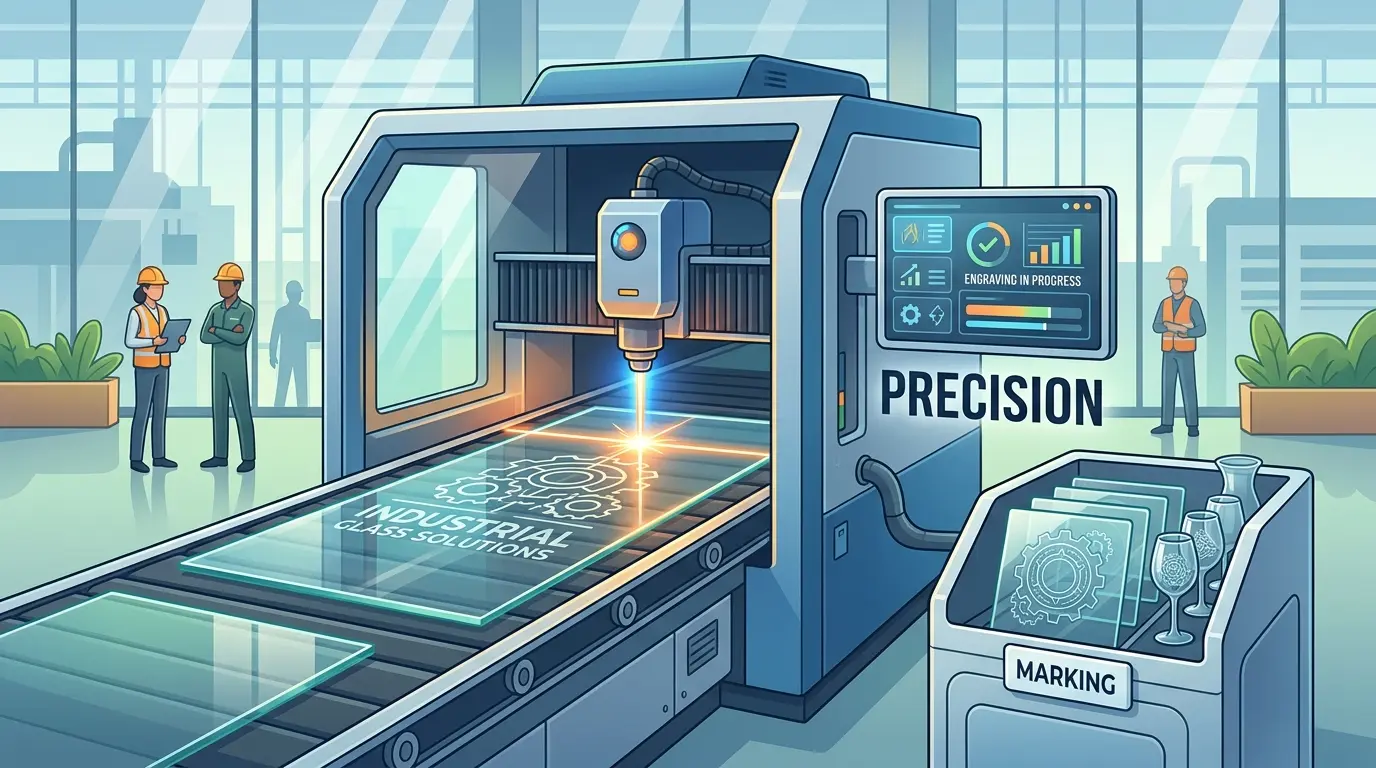
In day-to-day industrial use, glass engraving is often less about deep material removal and more about creating a readable, controlled surface effect. Buyers may use the word engraving, but the production target is usually a consistent frosted appearance, brand mark, decorative pattern, serial field, or logo that looks intentional without damaging the part.
That changes the selection logic in a few important ways:
- Contrast Uniformity Matters More Than Deep Mark Depth
- Part Support Matters More Than Aggressive Cycle Time Claims
- Cosmetic Repeatability Matters More Than A Single Attractive Demo Piece
- Breakage Risk Matters More Than Pushing Maximum Throughput Too Early
- Job Setup Discipline Matters Because Glass Does Not Hide Process Drift Gracefully
This is why glass should not be evaluated like a generic engraving substrate. A process that seems acceptable on one sample can become expensive if it produces uneven frosting, edge stress, or cracked parts once the workload scales.
Start With the Actual Glass Workflow, Not a Generic Demo Sample
Glass jobs that look similar on paper can place very different demands on the machine and the operator. A flat decorative panel, a bottle, an award, and a coated architectural part do not behave like the same production task.
| Glass Workflow | What Buyers Usually Want | What Commonly Creates Rejects | What To Prioritize |
|---|---|---|---|
| Flat Decorative Panels | Even frosted contrast, clean logo detail, and stable positioning across the surface | Uneven appearance, unstable support, or visible variation across larger parts | Bed consistency, fixturing, and repeatable recipes |
| Bottles and Drinkware | Centered graphics and consistent appearance on curved surfaces | Slippage, alignment drift, or inconsistent marking around the curve | Stable cylindrical-part handling and setup repeatability |
| Awards and Display Pieces | Customer-visible finish with sharp branding and low defect risk | Micro-chipping, cosmetic inconsistency, or extra cleanup before packing | Conservative validation and appearance control |
| Mixed Custom Orders | Fast changeovers without re-testing every job from scratch | Too many manual adjustments and operator-dependent results | Program recall, approved fixtures, and disciplined job preparation |
That is why one successful test is not enough. A useful buying evaluation should use the part categories that will consume the most machine hours after the machine arrives, not just the easiest sample to demonstrate.
Glass Geometry Changes the Buying Decision Faster Than Many Buyers Expect
Part geometry usually drives workflow complexity more than buyers first expect. Flat sheets, curved drinkware, small branded gifts, and heavier glass components each demand different handling stability.
Flat work is often easier to fixture, but larger pieces still expose inconsistencies in support, positioning, and mark appearance across the work area. Cylindrical parts introduce a different problem: the mark may look acceptable at one position but drift or distort if the part handling is not stable through the full cycle.
For curved or cylindrical jobs, buyers should pay close attention to whether the process depends on a repeatable rotational setup rather than improvised handling. If the shop expects to run bottles, tumblers, jars, or similar parts regularly, stable cylindrical support and repeatable alignment often matter more than broad claims about speed.
Small decorative or branded pieces create another challenge. The part value may be modest, but the visual inspection standard is often high. In those workflows, cosmetic consistency and setup efficiency usually have a greater effect on profitability than raw marking speed.
The Main Buying Factors Are Process Stability and Part Handling
Glass engraving performance is usually decided by a combination of machine stability and workflow discipline. The useful question is not which feature sounds impressive in isolation, but which conditions protect quality under daily production pressure.
| Buying Factor | Why It Matters in Glass Production | What To Verify Before Buying |
|---|---|---|
| Part Support and Fixturing | Poor support can increase movement, inconsistency, and reject risk | Check whether the supplier can demonstrate stable handling on part types similar to yours |
| Consistency Across the Working Area | A good result in one corner does not guarantee repeatability across the bed | Review several samples from different positions, not one centered test |
| Cylindrical-Part Handling | Bottles and curved pieces require stable, repeatable positioning | Confirm the workflow for round or tapered parts if those jobs matter in your queue |
| Recipe Recall and Repeatability | Glass jobs often become operator-sensitive when settings are not standardized | Ask how repeat jobs are saved, recalled, and controlled across shifts |
| Exhaust, Cleanup, and Work-Area Management | A visually acceptable part can still lose time in cleanup or inspection | Watch the full cycle, including part removal and cleanup, not only the active marking step |
| Operator Access and Inspection Rhythm | Throughput depends on loading, unloading, and checking parts efficiently | Evaluate real handling flow instead of only watching a short demonstration |
These points matter because glass work is rarely judged by simple pass-or-fail cut-through. It is judged by visual outcome, reject rate, and how much handling time the shop needs before the part is ready for packaging, assembly, or customer delivery.
Most Quality Problems Come From Workflow Gaps, Not From “More Power” Alone
When buyers compare laser systems, it is easy to reduce the conversation to output strength or speed. In glass work, that usually oversimplifies the problem.
Rejects more often come from process instability than from a lack of headline capability. Common failure points include:
- Dirty Or Inconsistent Part Surfaces Before Marking
- Unstable Support Or Poor Part Positioning
- Recipe Changes That Are Not Validated Before Full Production
- Too Much Variation Between Different Glass Types In The Same Queue
- Rushing Toward Faster Cycles Before Cosmetic Consistency Is Established
This matters because glass parts are often customer-facing. A mark that is readable but visually inconsistent can still become a reject. A slightly faster cycle is not a real gain if the line then loses time to inspection, rework, or scrap.
For many buyers, the more profitable machine is not the one that produces the boldest sample. It is the one that can hold acceptable appearance over repeated runs with lower operator intervention.
Different Glass Types Deserve Separate Validation
One of the most common buying mistakes is treating glass as one uniform material family. In practice, response can change enough between clear float glass, drinkware, decorative pieces, coated products, and tempered parts that sample approval should be handled carefully.
That does not mean every glass workflow requires a different machine. It does mean buyers should not assume one approved result automatically transfers to every glass product they may run later.
Before buying, it is worth separating the queue into a few realistic groups:
- Flat Versus Cylindrical Parts
- Decorative Versus Functional Marking
- Uncoated Versus Coated Surfaces
- Standard Glass Jobs Versus Higher-Risk Tempered Or Stress-Sensitive Pieces
If the workflow includes tempered, coated, or otherwise less forgiving glass, conservative testing becomes even more important. That is where stable process approval matters more than optimistic assumptions based on easier sample pieces.
Throughput Depends on the Whole Cell, Not Just the Marking Cycle
Many buying discussions focus too narrowly on how quickly the machine completes the engraved area. In production, throughput is shaped by the full operating cycle:
- Loading And Positioning The Part
- Selecting Or Recalling The Correct Recipe
- Running The Mark Without Unplanned Adjustment
- Removing The Part Safely
- Checking Cosmetic Quality
- Cleaning Or Preparing The Next Job
If the line loses time to awkward fixturing, inconsistent alignment, or manual re-testing, the real output can fall short even when the machine itself looks capable.
This is especially important in mixed-order environments. A shop running many short orders on bottles, awards, branded panels, or custom pieces will often benefit more from repeatable setup logic than from chasing the fastest possible individual cycle.
If Glass Is Only Part of the Queue, Evaluate the Broader Material Mix Honestly
Some buyers are not shopping for a glass-only process. They may also expect the same platform to support acrylic, wood, signage components, or other non-metallic work. That can make sense, but it changes the decision.
In that situation, the best machine is usually not defined by glass capability alone. It is defined by whether the shop can switch between materials without losing control of recipes, handling quality, and operator consistency.
A shared platform often works better when:
- The Shop Maintains Material-Specific Recipes
- The Production Team Separates Approved Workflows By Part Family
- Changeovers Are Managed Deliberately Instead Of Ad Hoc
- Cosmetic Standards Are Defined Clearly For Each Product Type
It works less well when every new job forces re-testing, improvised fixturing, or operator judgment that has not been standardized.
That distinction matters because many buying problems blamed on the machine are really workflow-management problems. A stable process often comes from disciplined preparation as much as from the equipment itself.
Questions To Answer Before You Place the Order
Before comparing quotes or asking for one more demonstration, buyers should answer a few practical questions:
- Which Glass Products Will Consume The Most Machine Hours?
- Are The Parts Mainly Flat, Cylindrical, Or Mixed?
- Is The Finished Mark Mainly Decorative, Brand-Oriented, Or Functional?
- How Visible Is Cosmetic Variation To The End Customer?
- What Reject Rate Is Operationally Acceptable?
- Will The Queue Include Tempered, Coated, Or Otherwise More Sensitive Glass?
- How Often Will Operators Change Between Different Part Sizes Or Fixtures?
- Does The Shop Need One Broad Non-Metal Workflow Or A More Narrowly Controlled Glass Process?
These questions usually reveal the real buying criteria faster than a generic feature list. They also help separate a machine that can mark glass from a machine that can support a stable glass workflow under production conditions.
Practical Summary
Buying a laser engraver for glass is rarely just a machine-choice problem. It is a workflow-choice problem that combines part geometry, cosmetic standards, support stability, recipe control, and reject management.
For most industrial buyers, the strongest selection logic starts with the actual production mix. If the machine and handling method can keep appearance stable across flat parts, curved parts, or mixed short-run orders, the investment is more likely to hold value in real production. If not, one attractive demo sample can hide a costly amount of setup time, inspection effort, and scrap.
In glass work, repeatable surface quality usually matters more than dramatic sample depth. That is the buying filter worth using before you commit.