Choosing a laser system by headline specs is one of the fastest ways to create a hidden production bottleneck. A machine can look strong on paper and still be the wrong fit if the working area does not match your sheet flow, if the configuration is built around the wrong material class, or if the motion and exhaust setup cannot support the finish quality your parts require.
The better approach is to treat configuration as a workflow decision, not a catalog decision. Start with the materials, part geometry, finish expectations, and daily job mix. Then match the source, table size, control quality, extraction, and handling features to that reality. For many Pandaxis-relevant applications, that means wood, acrylic, and similar non-metal processing, while metal-heavy production typically belongs to a different system class and should be evaluated separately.
Start With The Material And Part Mix
Before comparing machine layouts, define what the system will cut every day rather than what it might cut occasionally.
The first questions should be practical:
- What Materials Drive Most Of Your Revenue?
- Are You Primarily Cutting, Primarily Engraving, Or Doing Both?
- Do You Run Repeated Parts In Batches Or Constantly Change Jobs?
- How Important Are Edge Appearance, Detail Resolution, And Post-Processing Time?
- Will The Laser Handle Standard Sheets, Small Blanks, Or A Mixed Material Flow?
If your production centers on wood panels, acrylic parts, signage components, or decorative non-metal processing, the relevant Pandaxis category to review is its laser cutters and engravers. If metal is your primary application, do not assume the same buying logic carries over. Source type, gas support, enclosure requirements, and machine architecture move into a different decision category.
Decide Whether You Need Cutting Only Or Cutting And Engraving
Many buying mistakes happen because shops combine two very different needs into one vague request for a laser machine.
If your goal is mostly profile cutting, the configuration should be judged on stable throughput, clean edge quality, material handling, and repeatable production. If the job mix includes branding, decorative detail, panel graphics, or fine marking, then engraving quality, motion smoothness, control consistency, and file-change efficiency become much more important.
A combined cutting-and-engraving workflow can make sense, but only when both functions are central to the business model. Otherwise, the result is often a compromise machine that does not excel at the task that actually makes money.
Good buyers separate three cases early:
- Cutting-Dominant Production That Needs Clean Profiles And Reliable Daily Output
- Mixed Production That Requires Both Shape Cutting And Surface Detail
- Detail-Heavy Work Where Engraving Quality Matters More Than Raw Cutting Speed
Match The Working Area To Real Sheet Flow
Bigger is not automatically better. A larger bed can improve nesting efficiency and reduce the number of setups, but it also changes loading effort, floor-space use, extraction demand, and operator movement.
The right working area depends on how material moves through the plant:
- Standard Sheet Processing Usually Benefits From A Bed That Reduces Repositioning And Preserves Layout Efficiency
- Short-Run Custom Work Often Benefits More From Easy Access And Faster Job Turnover Than From Maximum Table Size
- Small-Part Production Needs Good Part Recovery And Scrap Handling, Not Just A Large Cutting Field
You should also evaluate how the laser cell fits upstream and downstream. If material is pre-cut elsewhere, an oversized table may become wasted footprint. If the laser is intended to absorb more of the cutting load over time, a cramped layout can cap future growth before the machine itself is fully utilized.
Choose Power For Process Stability, Not For Marketing
Power matters, but not in the simplistic way many buyers expect.
More power can expand the usable material range and improve throughput in some workloads, yet it does not automatically produce better parts. In many real-world shops, edge cleanliness, thermal control, focus stability, and exhaust performance matter just as much as raw power when the target is clean acrylic edges, controlled wood cutting, or reliable mixed-material output.
The right approach is to choose power around the dominant job type:
- If Most Work Is Thin, Detail-Sensitive Material, Control Quality And Stability Matter As Much As Output Capacity
- If The Goal Is Faster Processing Across A Broader Material Mix, Capacity And Duty Expectations Become More Important
- If Only A Small Share Of Jobs Require Higher Capability, Buying For The Edge Case Can Lead To Overspending And Underused Capacity
Do not buy around the most extreme part you might someday run. Buy around the jobs that define your weekly throughput, quality standard, and margin.
Evaluate Motion, Control, And Repeatability As One System
Shops often focus heavily on the source and not enough on the quality of the complete motion and control package. That is a mistake.
Real production quality depends on how well the frame, drive system, control logic, optics path, and focus behavior work together. If motion is unstable or repeatability is inconsistent, the machine may still cut, but output quality, fit accuracy, and process reliability will suffer.
This matters in different ways depending on the application:
- Engraving-Heavy Jobs Depend On Smooth Motion And Consistent Detail Reproduction
- Repeated Cut Kits Depend On Start-Point Accuracy And Reliable Part-to-Part Repeatability
- Mixed Workflows Depend On Fast, Predictable File Changes Without Constant Re-tuning
When buyers compare configurations, they should ask how the system holds quality over long runs, not just how it performs during a short demonstration.
Do Not Ignore Exhaust, Safety, And Maintenance Access
Laser configuration is not just about what happens at the beam. It is also about how the machine behaves after hours of real production.
In wood and acrylic processing, smoke control, residue management, optics cleanliness, and safe operator access directly affect both part quality and uptime. A machine that is difficult to clean or awkward to maintain tends to lose consistency long before its core hardware becomes the issue.
At minimum, review these operational points:
- Exhaust Capacity Relative To The Smoke Load Of Your Main Materials
- Air Assist And Cleanliness Control For Better Edge Quality And Lens Protection
- Ease Of Access For Routine Cleaning And Optics Checks
- Practical Offcut, Scrap, And Dust Removal
- Safe Visibility And Operator Interaction During Daily Production
These details rarely headline a brochure, but they often determine whether the machine remains stable and profitable six months after installation.
Compare Configurations By Workflow, Not By Brochure Language
The easiest way to shortlist laser systems is to map each configuration to the production condition it must support.
| Production Situation | Configuration Priority | Why It Matters |
|---|---|---|
| Short-Run Custom Work | Fast Job Changeovers And Easy Access | Reduces setup delay between varied files and materials |
| Batch Acrylic Parts | Stable Cutting Quality, Clean Exhaust, Sheet-Friendly Layout | Helps preserve edge appearance and reduce rework |
| Decorative Wood Panels | Balanced Cutting And Engraving Capability | Supports both profile accuracy and surface detail in one workflow |
| Repeated Kit Production | Larger Working Area And Strong Repeatability | Supports predictable nesting, output consistency, and downstream fit |
| Growing Plant Layout | Room For Better Handling And Process Integration | Prevents the laser cell from becoming the next bottleneck as volume rises |
This kind of comparison is more useful than generic claims about speed, precision, or flexibility because it keeps the buying decision tied to actual factory conditions.
Know When Laser Is The Right Choice And When It Is Not
Laser systems are highly effective when the job requires clean contours, fine internal features, decorative processing, repeatable non-contact cutting, or combined cutting and engraving. They are not automatically the best answer for every cutting task in a plant.
For example, if the real bottleneck is high-volume panel breakdown, a saw-based solution may be more productive. If the workflow depends on routing, drilling, and sheet optimization in one pass, CNC nesting may be the better primary investment. In many factories, the best result comes from giving each machine type a clear role instead of forcing one system to do everything.
If you are planning a broader processing line rather than a standalone laser cell, the Pandaxis product catalog is the right place to compare how laser equipment fits alongside panel processing, routing, drilling, sanding, and other production machinery.
Build A Shortlist Before You Ask For Quotes
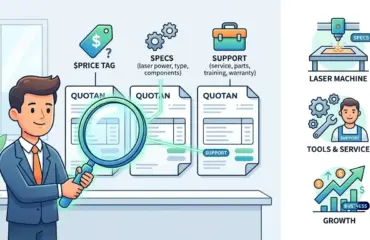
A useful quote request starts with a clear internal checklist. Before talking to suppliers, define the configuration priorities that will actually decide success.
- Define Your Dominant Materials And Part Types.
- Separate Cutting-Dominant Work From Combined Cutting-And-Engraving Work.
- Match The Working Area To Material Flow, Floor Space, And Handling Reality.
- Choose Power Around Daily Production Needs, Not Rare Edge Cases.
- Evaluate Motion Quality, Repeatability, Exhaust, And Maintenance As Part Of The Core Configuration.
- Decide Whether The Laser Will Operate As A Standalone Cell Or As Part Of A Broader Process Line.
This step sounds basic, but it immediately improves quote quality because suppliers can respond to an actual workflow instead of a vague request for the “best” machine.
Choose The Configuration That Solves The Real Bottleneck
The right laser cutting system configuration is not the one with the most impressive headline. It is the one that matches your material mix, job structure, quality expectations, and plant flow with the fewest compromises.
For wood, acrylic, and similar non-metal production, that usually means focusing on application fit, cut-and-engrave balance, working area, control stability, and operational support features such as extraction and maintenance access. Buyers who start there make better long-term decisions than buyers who start with generic spec comparisons.
If you evaluate the machine through the lens of workflow fit, the final configuration becomes much easier to justify because it is tied to throughput, quality, and production efficiency rather than brochure language.