Buying a laser engraver gets expensive when the machine is chosen around a demo sample instead of the real workload. A small shop usually feels the pain through wasted floor space, slow changeovers, and jobs that never quite fit the weekly mix. An industrial user feels it through queue instability, inconsistent output, operator dependency, and a production cell that cannot hold repeatability across shifts.
That is why the better buying question is not simply which laser engraver is more advanced. The better question is which system fits the material mix, job pattern, finish standard, and throughput target of the operation. For wood, acrylic, and similar non-metal processing, the right choice usually comes from workflow fit first and machine format second.
Start With the Actual Workload
Before comparing models, define what the machine will be asked to do every day. That sounds obvious, but many buyers still start with advertised speed, table size, or a general promise of precision instead of the job mix that will determine real output.
Four questions usually clarify the decision quickly:
- What Materials Will The Machine Process Most Often?
- Are Most Jobs Engraving-Only, Or Do They Also Need Contour Cutting?
- Does The Schedule Lean Toward Short Custom Runs Or Repeated Production Batches?
- Will The Laser Be A Standalone Workstation Or Part Of A Larger Production Flow?
For a small shop, those answers often reveal whether flexibility and fast setup matter more than steady-volume efficiency. For an industrial buyer, the same answers usually point to loading discipline, repeatability, and how well the laser fits upstream and downstream operations.
If the application extends into metal marking or metal cutting, the evaluation logic changes and should be treated as a separate equipment decision rather than folded into a non-metal laser purchase.
Small-Shop Priorities vs Industrial Priorities
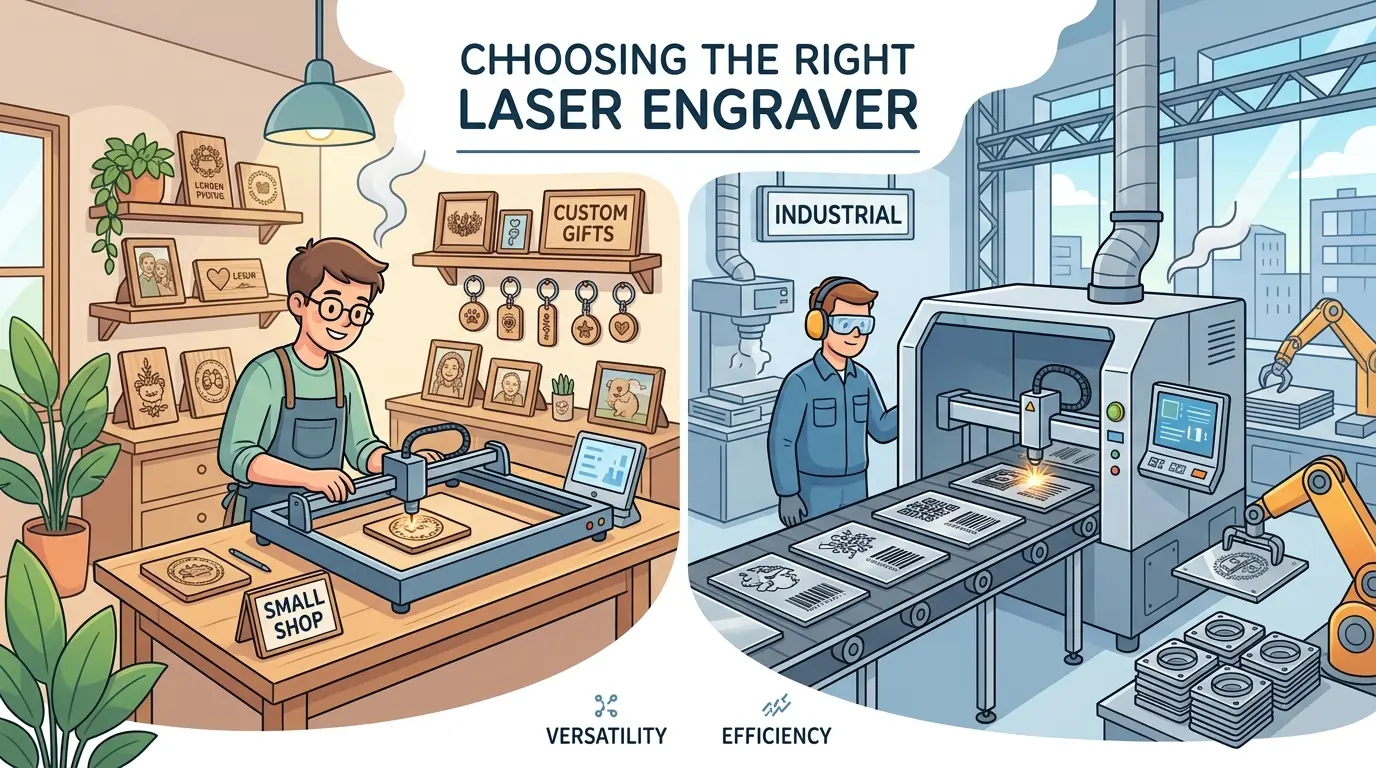
The phrase laser engraver covers very different buying environments. Small shops and industrial users may both need clean detail and dependable operation, but they usually value different things first.
| Buying Factor | Small-Shop Focus | Industrial Focus | Why It Matters |
|---|---|---|---|
| Job Mix | Flexibility Across Different Orders | Stability Across Repeated Production Patterns | A machine that fits one environment may slow the other |
| Setup Rhythm | Fast Changeovers And Easy Operator Control | Standardized Process Control And Fewer Variable Adjustments | Setup time becomes either a daily bottleneck or a repeatability risk |
| Part Size And Work Area | Enough Range For Mixed Jobs Without Overspending On Capacity | Layout That Matches Part Flow And Batch Handling | Oversized capacity can waste capital, while undersized capacity creates workarounds |
| Duty Expectations | Reliable Performance Without Complex Support Demands | Consistent Output Across Long Shifts And Multiple Operators | The real buying issue is stable production, not one successful sample |
| Loading And Unloading | Simple Handling For Low-Volume Work | Reduced Manual Intervention And Better Cell Rhythm | Material handling often decides actual throughput |
| Quality Standard | Clean Visual Results Across Varied Jobs | Repeatable Output With Fewer Cosmetic Rejects | Appearance quality matters in both cases, but inspection pressure rises in production lines |
| Maintenance Burden | Easy Cleaning And Service Access | Predictable Maintenance Without Schedule Disruption | Downtime hurts margins differently, but it hurts both buyers |
This is the core tradeoff. Small shops usually pay for complexity they never fully use if they buy like a factory. Industrial users usually create hidden labor and quality problems if they buy like a custom shop.
When a Laser Engraver Should Also Handle Cutting
Some buyers do not actually need a pure engraving workflow. They need one machine to engrave artwork, logos, labels, or decorative details and then cut the finished shape in the same cycle. In that case, evaluating laser cutters and engravers for wood, acrylic, and similar non-metal materials can make more operational sense than treating engraving as a separate step.
That approach is often well suited to:
- Acrylic Signage And Display Components
- Engraved Wooden Panels And Decorative Pieces
- Short-Run Parts That Need Both Shape Accuracy And Surface Detail
- Shops Trying To Reduce Manual Transfers Between Processes
It is less compelling when engraving and cutting compete for the same machine time in a way that disrupts scheduling. If engraving demand is steady and cutting demand is also steady, combining both functions on one system can improve flexibility but weaken throughput control.
The Buying Criteria That Change Real Output
Most engraving buyers do not lose money because they misunderstood the concept of laser processing. They lose money because they chose a machine that looked capable in theory but did not hold up inside a real workflow.
- Engraving Quality And Visual Consistency: The relevant question is not whether the machine can mark the sample. The question is whether it can maintain readable detail, consistent contrast, and acceptable finish quality across the parts that actually make up the schedule.
- Work Envelope And Part Fit: A larger work area is only useful when it matches the real part range. If most jobs are smaller, unused capacity can become cost without benefit. If parts regularly need awkward repositioning, the machine can become inefficient even if the nominal bed size looks acceptable.
- Changeover Speed: Shops with varied orders need quick job switching. Production users need fewer adjustment points and more stable process recall. In both cases, changeover discipline affects output more than buyers often expect.
- Repeatability And Fixturing: Consistent placement matters when branding panels, engraving repeated parts, or aligning graphics with cut geometry. Stable referencing reduces rework and protects cosmetic quality.
- Extraction And Housekeeping: Smoke, residue, and general contamination do not just affect cleanliness. They affect inspection results, lens-cleaning intervals, operator time, and how stable the process remains over a full shift.
- Duty Cycle Expectations: A machine selected for occasional use behaves differently from one expected to support steady production. The buying decision should reflect actual utilization, not optimistic future assumptions.
- Serviceability And Training: Easy maintenance access and realistic operator training requirements matter because a technically capable machine still underperforms if routine upkeep or job setup depends on one highly experienced person.
Choosing by Workflow, Not by Spec Sheet
The easiest way to simplify the decision is to match the machine to the role it will play in production.
| Workflow Profile | Best-Fit Buying Logic | Why |
|---|---|---|
| Custom Shop With Varied Orders | Prioritize Flexible Job Handling And Fast Setup | Mixed order flow usually rewards adaptability more than maximum theoretical throughput |
| Prototype And Short-Run Workshop | Look For A System That Can Shift Cleanly Between Materials And Designs | Frequent changes make process control and operator usability more important than one headline metric |
| Repeated Batch Engraving On Wood Or Acrylic Parts | Prioritize Repeatability, Fixturing Stability, And Clean Inspection Results | Batch work magnifies small variation into meaningful rework |
| Industrial Production Cell Adding Branding Or Decorative Detail | Evaluate How The Laser Fits Material Handling, Scheduling, And Downstream Quality Standards | The laser succeeds when it strengthens the larger workflow rather than interrupting it |
| Multi-Process Plant Comparing Several Equipment Categories | Assess The Laser Inside A Broader Pandaxis Product Catalog Review | The correct choice often depends on how engraving supports the full production route, not just the engraving station |
This is where honest tradeoffs matter. One flexible machine may be enough for a small business with changing order patterns. A larger operation may get better output by narrowing the laser’s role and making the surrounding workflow easier to control.
Common Buying Mistakes
Laser engraver projects usually go off track for predictable reasons:
- Buying For Maximum Advertised Capability Instead Of The Weekly Job Mix
- Treating Engraving And Cut-And-Engrave Work As If They Have The Same Scheduling Impact
- Ignoring Smoke Management, Cleanup Pressure, And Daily Maintenance Reality
- Assuming A Machine Suited To Custom Work Will Scale Smoothly Into Production Duty
- Assuming A Production-Oriented Setup Will Stay Efficient In A Small Shop With Frequent Changes
- Focusing On The Machine Alone Instead Of The Full Operator And Material Flow Around It
None of these mistakes are dramatic during the quotation stage. They become expensive after installation, when the real workload reveals where the process does not fit.
A Practical Decision Path
If the goal is to buy well rather than buy quickly, this sequence usually works:
- Define The Core Material Mix And Separate Frequent Work From Occasional Work.
- Decide Whether The Main Need Is Surface Engraving, Combined Cutting And Engraving, Or A Mix That Must Be Scheduled Carefully.
- Map The Real Order Pattern: Custom, Short-Run, Batch, Or Continuous Production Support.
- Evaluate How Parts Will Be Loaded, Referenced, Inspected, And Unloaded Instead Of Looking Only At the Machine Table.
- Choose The Setup That Protects Quality And Workflow Stability, Even If It Looks Less Impressive On A Spec Sheet.
That sequence prevents two common failures: overbuying for flexibility that never generates return, and underbuying for production demands that the machine will be asked to carry every day.
Practical Summary
The right laser engraver for a small shop is usually the one that handles varied jobs cleanly, changes over without friction, and delivers dependable quality without creating a maintenance burden that overwhelms the team. The right laser engraver for an industrial user is usually the one that supports repeatable output, stable scheduling, controlled handling, and lower intervention across production runs.
In both cases, the best buying decision comes from matching the machine to the real workflow instead of the broadest possible promise. If the operation works mainly with wood, acrylic, and similar non-metal materials, and if engraving must fit into a larger manufacturing process, the strongest purchase is the one that makes quality easier to hold and production easier to manage.