In industrial and commercial environments, laser safety is not just about the beam. Most real-world problems start earlier in the workflow: the wrong material goes onto the bed, extraction performance drops, residue builds up around the cut zone, or an operator treats an active job like a machine that can safely run unattended. When that happens, safety risk and production risk rise together.
That is why good laser safety should be treated as a process-control discipline, not a last-minute compliance task. Shops that manage material approval, ventilation, housekeeping, supervision, maintenance, and machine setup in a consistent way usually get more stable cut quality, less unplanned downtime, and fewer fire or fume incidents.
Start With Material Risk, Not Just Machine Power
For most commercial laser shops, material choice is the first safety decision. Wood, acrylic, coated panels, laminates, adhesives, protective films, and composite substrates do not behave the same way under heat. A machine can be running within normal settings and still create a serious hazard if the material releases heavy smoke, corrosive residue, or harmful fumes.
Before any new job reaches production, the shop should know exactly what is being processed, not just what the top surface looks like. That means checking the core material, coating, adhesive layer, surface film, and supplier guidance rather than relying on visual assumptions.
An approved-material process usually works best when it includes:
- A Clear List Of Approved And Prohibited Materials
- Supplier Documentation Or Safety Data Review For New Substrates
- Small Controlled Test Cuts Before Full Production Runs
- Special Attention To Coatings, Films, Adhesives, And Unknown Fillers
- A Stop Rule For Any Material That Produces Unexpected Smoke, Odor, Or Residue
In practice, this is one of the simplest ways to prevent both operator exposure and machine contamination. It also reduces scrap caused by poor edge quality, surface damage, or unstable cutting behavior.
The Four Safety Risks That Deserve Priority Attention
The most useful safety discussions focus on control priorities, not generic warnings. In most industrial and commercial laser workflows, the following risk areas deserve first attention.
| Risk Area | What Commonly Causes It | Basic Control | Workflow Benefit |
|---|---|---|---|
| Fire And Heat Buildup | Incorrect settings, dirty beds, residue accumulation, or unattended cutting | Active operator supervision, regular cleaning, air-assist verification, and accessible fire response equipment | Fewer emergency stoppages and more stable cutting |
| Fume Exposure | Material mismatch, weak extraction, clogged ducts, or overdue filter service | Approved-material rules, dedicated extraction, and routine airflow checks | Cleaner air, cleaner optics, and less contamination |
| Beam Or Enclosure Exposure | Open access during operation, bypassed covers, or poor service discipline | Intact enclosures, interlocks, restricted access, and formal service procedures | Lower operator risk and fewer unsafe shortcuts |
| Mechanical Or Electrical Incidents | Deferred maintenance, damaged cables or hoses, blocked emergency stops, or unsafe servicing | Preventive maintenance, clear emergency-stop access, and isolation procedures during service | More reliable uptime and safer intervention when problems appear |
This framework helps managers and operators put daily attention where it has the biggest effect. It also makes training more practical because the team can connect each rule to a visible production outcome.
Build Ventilation And Extraction Into The Workflow
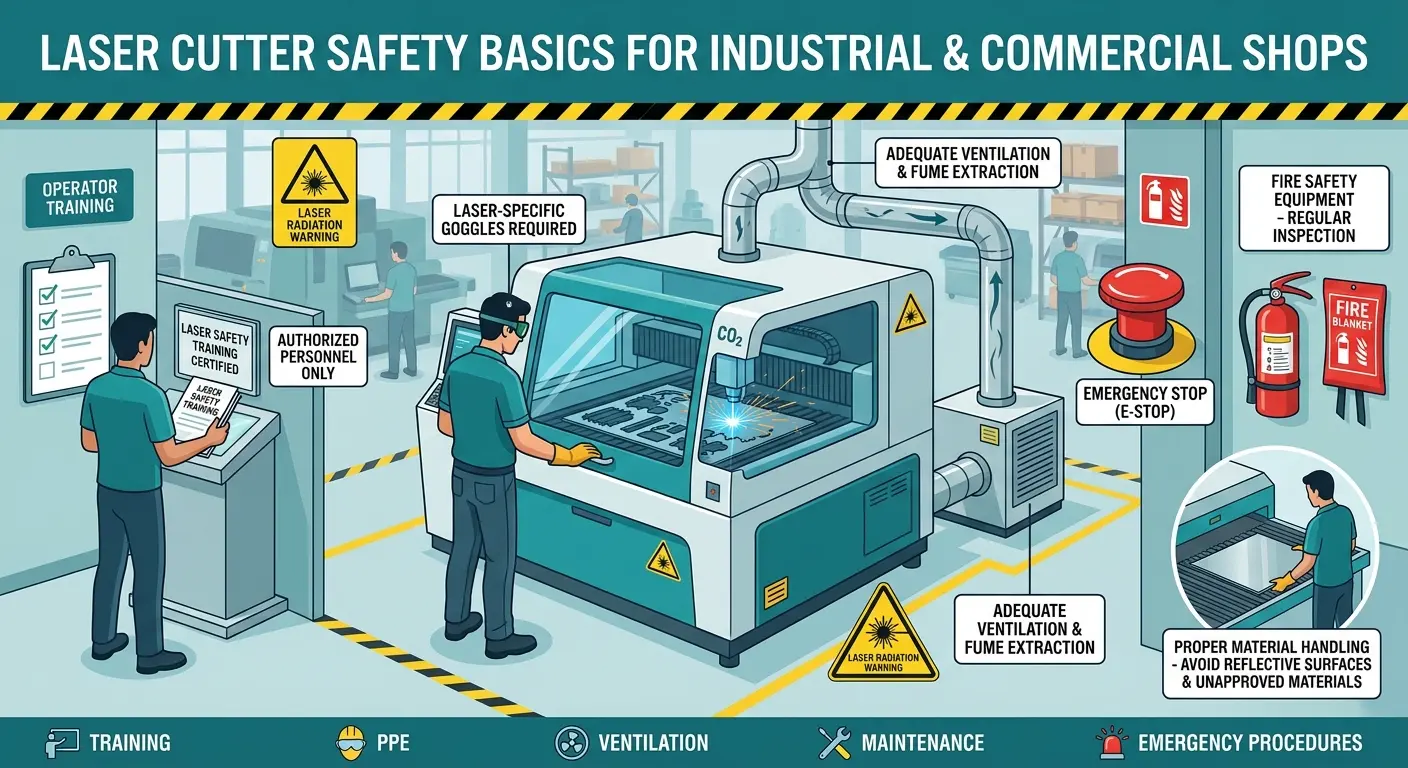
Extraction should never be treated as an accessory. In laser processing, ventilation affects operator exposure, machine cleanliness, optical stability, and final part quality at the same time. If smoke is not being removed consistently, the shop is not just accepting an air-quality problem. It is also allowing residue to settle where it can reduce cut consistency and increase cleanup demands.
For shops evaluating laser cutters and engravers for wood, acrylic, and similar non-metallic applications, extraction design should be part of the machine decision from the beginning. A safe workflow depends on capture at the source, maintained ducting, reliable airflow, and service access that makes cleanup realistic instead of occasional.
Strong extraction discipline usually includes:
- Checking Airflow Before Production Starts
- Cleaning Ducts, Beds, And Collection Areas On A Set Schedule
- Replacing Or Servicing Filters Before Performance Falls Too Far
- Watching For Persistent Odor, Smoke Haze, Or Residue As Early Warning Signs
- Keeping The Surrounding Work Area From Recirculating Smoke Back Toward Operators
If a shop normalizes visible smoke or lingering odor, it usually means the process has already drifted away from a safe operating baseline.
Treat Fire Prevention As A Daily Operating Discipline
Laser cutting concentrates heat into a very small area, which is why it works so well for detailed processing and shaped cutting. That same concentration means fire prevention has to be managed continuously, not only when something looks abnormal.
In day-to-day production, fire risk rises when dust and offcuts collect around the bed, when residue is allowed to build up under recurring jobs, when focus or air assist is poor, or when operators leave the machine during active cutting because the program appears routine. In other words, many fire events start with normal habits becoming too casual.
Basic fire discipline should include:
- Never Leaving Active Cutting Unattended
- Cleaning The Bed, Scrap Area, And Nearby Surfaces Frequently
- Verifying Air Assist And Other Cut-Stability Settings Before Running A Batch
- Removing Fine Waste And Flammable Debris Before It Accumulates
- Keeping Fire Response Equipment Accessible According To Site Rules And Local Requirements
- Stopping The Job Immediately If Flame Behavior, Smoke Volume, Or Burning Residue Looks Unusual
These habits protect more than operators. They also help preserve lenses, nozzles, fixtures, and surrounding machine condition.
Protect Operators With Training, Access Control, And Clear Rules
Even with an enclosed machine, operator behavior still matters. Shops need clear boundaries around who can load materials, start jobs, adjust settings, clean internal areas, or open access panels. Without those boundaries, the same machine can be handled safely on one shift and poorly on the next.
Training should focus on the specific failure points operators actually face:
- How To Confirm A Material Is Approved Before Loading It
- What Smoke, Odor, Or Residue Changes Mean During A Run
- When A Job Must Be Stopped Instead Of Observed Further
- Why Covers, Doors, And Interlocks Must Not Be Bypassed
- How To Escalate Service Issues Instead Of Improvising Around Them
It is also important to separate normal operation from service or alignment work. Any maintenance activity that exposes internal components, electrical areas, or optical paths should follow the site’s formal safety procedure rather than informal shop-floor habit.
Safer Jobs Start Before The First Cut
Many avoidable safety issues appear before the laser is turned on. A poor fixture setup, warped material, inconsistent bed support, leftover scrap, blocked exhaust path, or unreviewed program file can all create unstable cutting conditions that raise both scrap and hazard levels.
That is why pre-run checks should be short, repeatable, and mandatory. A useful pre-run routine often covers:
- Confirm The Material Matches The Approved Job Specification
- Inspect The Bed For Scrap, Dust, And Residue From Prior Runs
- Verify Extraction And Airflow Before Starting The Program
- Check Material Placement, Support, And Stability Across The Cut Area
- Review The Program, Origin, And Job Setup Before Running The Full Sheet Or Batch
- Run A Controlled Sample If The Material, Coating, Or Settings Are New
This does not need to slow production down. In most shops, a disciplined five-minute pre-run check prevents much more time-consuming stoppages later.
Maintenance Is A Safety Control, Not Just An Uptime Task
Maintenance is often discussed as a productivity issue, but in laser work it is also a direct safety control. Dirty optics, worn hoses, unstable airflow, contaminated beds, and neglected enclosures make it harder for the process to behave predictably. Once predictability falls, safety margins usually fall with it.
The most useful maintenance routines are the ones tied to visible production indicators. If cut edges are getting dirtier, smoke is lingering longer, residue is appearing faster, or cleaning frequency is rising, those are not only quality symptoms. They are signals that the process environment is drifting and needs attention.
Preventive maintenance should commonly cover:
- Optics Cleaning And Inspection According To The Machine’s Service Guidance
- Extraction System Inspection, Including Ducts, Fans, And Filters
- Cable, Hose, And Air-Line Condition Checks
- Emergency Stop Accessibility And Function Checks
- Enclosure, Door, And Interlock Condition Verification
- Safe Isolation Procedures Before Any Internal Service Work
When maintenance is documented and scheduled, safety becomes easier to manage because the team is no longer guessing which problems are minor and which ones are escalation points.
How Equipment Selection Supports Safer Operation
Safer operation does not come from training alone. Equipment selection also matters because some machine layouts make safe work easier to sustain over time. Enclosed cutting zones, practical access for cleaning, clearly positioned emergency stops, stable material support, and extraction-friendly designs reduce the number of unsafe workarounds a shop is tempted to accept.
That becomes even more important when laser processing is only one part of a larger fabrication plan. If a business is comparing laser systems with other production equipment as part of a broader process upgrade, the Pandaxis product catalog can help frame where laser processing fits within a wider machinery workflow.
The important principle is simple: safety should not be separated from production logic. The safer choice is often the one that also improves repeatability, reduces cleanup, and limits manual intervention.
A Practical Safety Baseline For Every Shift
If a shop wants a simple operating standard, it should be able to answer yes to the following questions before and during production:
- Is The Material Clearly Approved For The Intended Process?
- Is The Bed Clean And Free Of Old Scrap Or Dust Buildup?
- Is Extraction Performing Properly Before The Job Starts?
- Are Operators Staying With The Machine During Active Cutting?
- Are Covers, Doors, And Safety Functions Being Used As Intended?
- Is Unusual Flame, Smoke, Odor, Or Residue Treated As A Stop Signal?
- Is The Machine Being Cleaned And Maintained On A Defined Schedule?
- Are Service Tasks Handled Under Formal Safety Procedures Rather Than Informal Fixes?
When those answers stay consistent, laser safety stops being a reactive topic and becomes part of normal production control.
Laser cutter safety in industrial and commercial shops is built on disciplined material approval, reliable extraction, fire prevention, operator training, consistent setup checks, and maintenance that keeps the process stable. Shops that manage those basics well usually do more than reduce risk. They also protect cut quality, machine condition, and daily throughput.
That is the real value of laser safety done properly. It is not separate from production performance. It is one of the conditions that makes dependable production possible in the first place.