Buyers often assume that a laser carving machine and a laser engraving machine must be two clearly different categories. In actual production, the difference is usually less about a separate machine class and more about the finished result the job requires. The real decision is whether the workflow depends on shallow surface marking, deeper relief-style removal, or a different process altogether.
For factories comparing laser cutters and engravers for wood, acrylic, and similar non-metallic materials, the useful question is not which label sounds more advanced. It is whether the machine can deliver the needed depth, finish quality, and throughput without creating too much cleanup, heat effect, or cycle-time pressure elsewhere in the line.
Why the Terms Get Blurred
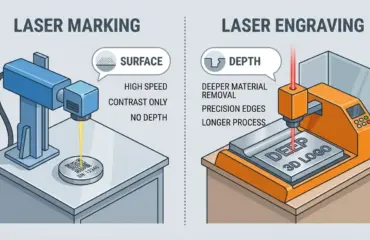
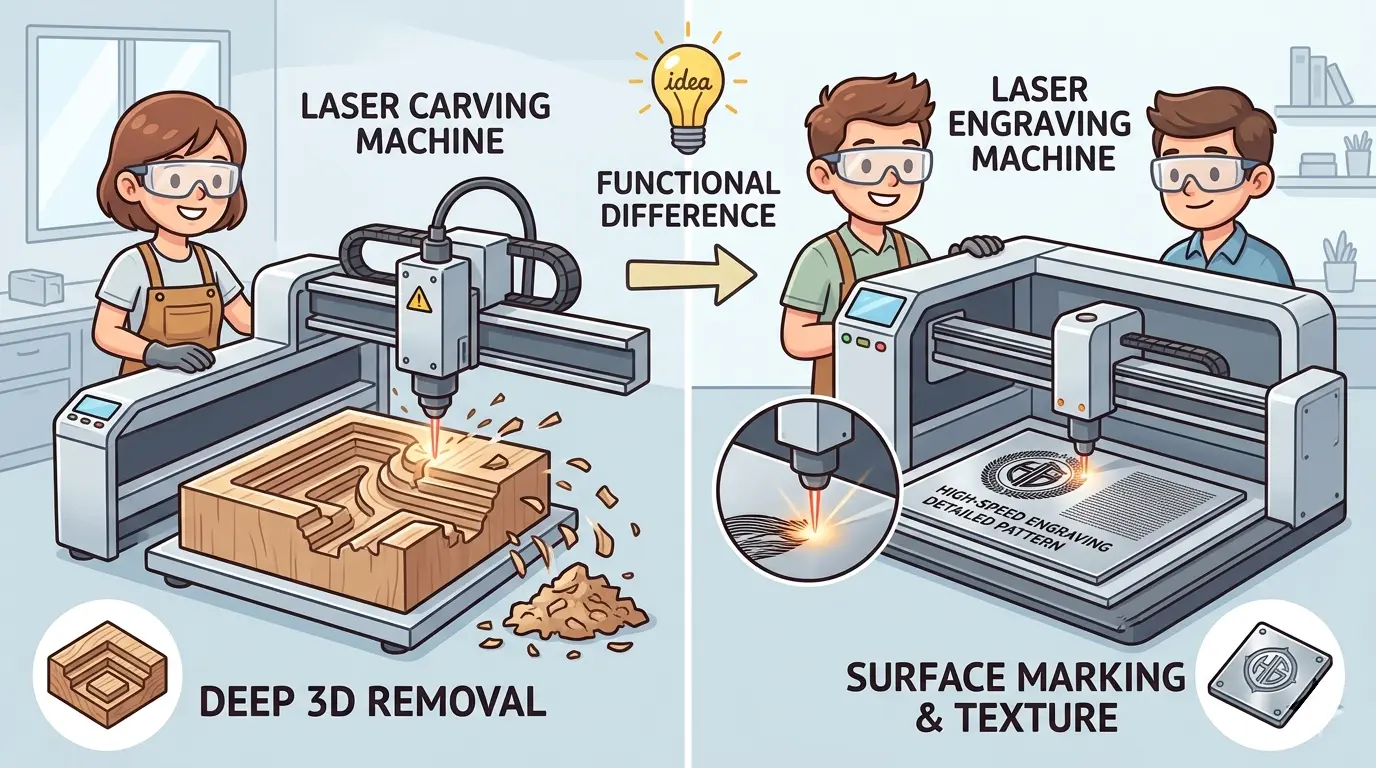
In many industrial buying conversations, “laser engraving” is the broader term. It usually covers surface marking, decorative graphics, text, logos, filled areas, and other shallow-detail work. “Laser carving” is often used when the customer wants a more recessed, textured, or relief-like result.
That is why the two labels are frequently blurred in the market. A machine described as a laser carving machine may still be doing what is technically an engraving workflow, only with more passes, more material removal, and a stronger emphasis on visible depth.
From a production standpoint, this matters because naming can hide the real tradeoff. The deeper the result needs to be, the more the job starts to behave differently in terms of cycle time, residue, finish control, and downstream labor.
Is There a Strict Hardware Difference?
In many cases, no strict hardware boundary exists between the two labels. A laser platform used for engraving can often handle what buyers call carving if the material, artwork, and depth expectation stay within a reasonable range for laser processing.
What buyers are really evaluating is whether the machine can hold stable quality when the job shifts from light surface detail to deeper removal. The same core platform may still be judged on the same fundamentals:
- Motion Stability
- Focus Consistency
- Exhaust and Smoke Removal
- Cooling Reliability
- Repeatable Job Setup
- Surface Quality Across Repeated Orders
So the answer is usually not that one machine engraves while another machine carves in a completely separate way. The answer is that deeper, more tactile work places heavier demands on the same production system.
What Actually Changes When the Job Moves From Engraving to Carving
The most useful comparison is not machine label versus machine label. It is workflow versus workflow.
| Real-Use Factor | Engraving-Led Workflow | Carving-Led Workflow | Why It Changes the Decision |
|---|---|---|---|
| Main Goal | Clear text, logos, graphics, and fine surface detail | More visible depth, texture, and relief effect | The acceptable finish standard changes |
| Material Removal | Light surface removal | Deeper, more repeated removal | Job time and heat exposure usually increase |
| Throughput Pressure | Better suited to frequent design changes and shorter cycles | More likely to slow the queue on depth-heavy jobs | Output planning becomes more important |
| Surface Risk | Contrast, clarity, and placement are the main concerns | Residue, darkening, and edge cleanliness become more visible | Rework shifts from alignment problems to finish problems |
| Artwork Style | Fine text, linework, logos, fills | Broader shaded areas, layered textures, recessed details | File preparation and visual expectations change |
| Downstream Work | Often limited to light cleaning or direct use | More likely to need brushing, sanding, or finish correction | Labor cost after the laser may rise |
Once a job starts asking for depth rather than only contrast, the production logic changes. The machine is no longer being judged only by how accurately it marks the surface. It is also being judged by how efficiently it removes material while preserving acceptable appearance.
When a Laser Engraving Machine Is Usually Enough
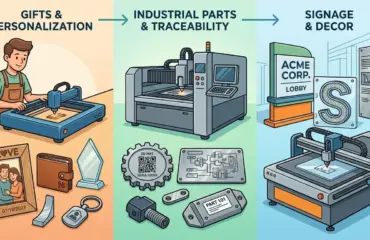
An engraving-oriented machine is commonly the right fit when the product value comes from visible detail rather than deep relief. That is often the case in commercial workflows such as:
- Logos and Brand Graphics On Wood Or Acrylic Parts
- Decorative Panels With Shallow Surface Patterns
- Nameplates, Signage, and Presentation Pieces
- Customized Short-Run Orders With Frequent File Changes
- Product Identification, Light Decorative Marking, and Repeat Graphics
In those jobs, the main production gain usually comes from cleaner detail, fast artwork changes, and reduced manual marking work. The factory is trying to hold readability, visual consistency, and repeat placement without turning every variation into a tooling problem.
If that is the real workload, calling the machine a carving machine adds very little. The practical priority is still engraving performance.
When “Carving” Starts To Mean Something More Serious
The term becomes more meaningful when the customer is not just asking for visible contrast, but for meaningful depth that changes the feel and look of the part. At that point, the question is not only whether the laser can do it. The question is whether it can do it economically and cleanly enough for the production target.
This is where buyers often run into confusion. They search for a laser carving machine because they want:
- Deeper Recessed Graphics
- Relief-Style Decorative Effects
- More Noticeable Texture On Wood Surfaces
- Parts That Feel Machined Rather Than Only Marked
Those expectations may still fit a laser workflow on some jobs, especially when the material is non-metallic and the required depth is moderate. But once the requested depth becomes a major part of the product value, material-removal rate starts to matter more. The deeper the result, the more the operation must absorb longer cycle times, higher residue management, and a greater chance of finish correction after processing.
In other words, “carving” often signals not a separate machine family, but a more demanding engraving application.
When the Real Comparison May Be Laser vs Another Process
This is the point many buyers miss. Sometimes the customer thinks the choice is laser carving machine versus laser engraving machine, when the real comparison should be laser processing versus a mechanical carving or routing process.
That happens when the job requires:
- Strong Depth Across Large Filled Areas
- Repeated Relief Work On Production Parts
- Faster Material Removal Than A Laser Workflow Can Comfortably Support
- A Surface Finish That Cannot Tolerate Much Heat Effect Or Residue
- Sculpted Features Where Depth Geometry Matters More Than Surface Marking
In those cases, the buyer may not need a different laser label. The buyer may need to reassess whether a laser is still the best primary process for the finished result.
That distinction matters because it affects total workflow performance. A laser can look flexible in a sample-driven sales discussion, then become expensive in real production if every deep job adds too much machine time and too much cleanup.
How Industrial Buyers Should Evaluate the Question
The safest way to evaluate the difference is to start with the finished part and work backward through the workflow.
Ask these questions first:
- Is The Product Value Coming From Fine Surface Detail Or From Tactile Depth?
- How Deep Does The Finished Mark Actually Need To Be To Meet The Customer Requirement?
- How Much Cycle Time Per Part Is Acceptable?
- Will Smoke, Residue, Or Surface Darkening Create Secondary Labor?
- Are Most Orders Graphic-Heavy And Shallow, Or Decorative And Depth-Heavy?
- If Depth Increases, Does Laser Processing Still Fit The Business Model Better Than Another Process?
These questions usually reveal the answer quickly. If the queue is dominated by logos, text, decorative linework, and shallow branded detail, the workflow is engraving-led even if some buyers call it carving. If the queue is dominated by repeated depth-heavy decorative work, then the factory should evaluate the economics of that deeper removal requirement rather than rely on the machine name alone.
Practical Summary
Yes, there can be a real difference between a laser carving machine and a laser engraving machine, but in production it is usually not a clean hardware split. Most of the time, the real difference is the job profile: how much material is being removed, how much visible depth is expected, how much cycle time the factory can tolerate, and how much post-process cleanup is acceptable.
For many wood, acrylic, and similar non-metallic applications, “laser carving” is often a deeper or more demanding form of engraving rather than a completely separate machine category. If the work is mostly shallow detail, logos, text, and decorative graphics, an engraving-led evaluation is usually the right one. If the work depends on consistent depth and relief-style visual effect, then buyers should test the process against real throughput and finish expectations before assuming the different label solves the problem.
The practical takeaway is simple: compare the workflow, not just the wording. That is where the real difference shows up.