Laser cutter pricing still confuses buyers for the same reason it always has: one quote covers a bare machine, another includes cooling and extraction, and a third is built around daily production rather than occasional cutting. That makes the lowest number easy to notice and hard to trust.
For buyers evaluating laser cutters and engravers for wood, acrylic, and similar non-metallic materials, price should be treated as a workflow decision rather than a catalog figure. The useful question is not simply what the machine costs to buy. The useful question is what the full setup costs to install, standardize, and keep productive with acceptable cut quality, repeatable results, and manageable operator effort.
Why Laser Cutter Prices Are Hard To Compare
Two machines can both be described as laser cutters and still belong to very different buying situations.
One may be intended for light cutting on simpler parts. Another may need to support combined cutting and engraving, larger-format work, or repeated daily production. A third may look attractively priced only because extraction, training, fixtures, or commissioning are left outside the proposal.
That is why price comparison only becomes meaningful when buyers normalize the quote structure and compare machines intended for the same production role. Without that step, buyers are often comparing different purchase scopes rather than different levels of machine value.
Start With the Job Before You Start With the Budget
Laser cutter pricing usually changes in line with the work the machine is expected to carry every week.
Before comparing quotes, buyers should define:
- Whether The Main Work Is Cutting Only Or Cutting Plus Engraving
- Whether Jobs Are Mostly Short-Run Custom Orders Or Repeated Batch Production
- Whether The Material Mix Is Narrow And Stable Or Changes Frequently
- Whether Customers Will Judge Parts Primarily By Edge Appearance, Detail Quality, Or Delivery Speed
- Whether The Shop Needs One Dedicated Process Or A Flexible Shared Machine
These questions matter because a machine bought for light acrylic signs is not priced like a machine expected to handle repeated wood panels, mixed-material job changes, or customer-visible decorative parts with tighter finish expectations.
If the real requirement is metal cutting, tube processing, or industrial metal marking, that should be treated as a separate technology-selection decision rather than folded into one vague laser-cutter quote comparison.
What Actually Changes the Price
The biggest pricing differences usually come from the parts of the system that affect workflow fit, stability, and usable output rather than from headline marketing language.
| Cost Driver | Why It Changes the Price | When It Matters Most |
|---|---|---|
| Work Area and Material Handling | Larger cutting zones and better sheet support change machine scope and daily handling efficiency | Larger parts, nested layouts, and shops trying to reduce loading interruptions |
| Cutting-Only vs Combined Cut-and-Engrave Use | A broader process role usually requires a more controlled and repeatable setup | Signage, decorative panels, and mixed custom production |
| Motion Stability and Positioning Control | Better consistency helps protect contour accuracy and repeat-job reliability | Customer-facing parts, repeat orders, and multi-operator use |
| Extraction, Cooling, and Process Environment | These systems affect cleanliness, runtime stability, and finish consistency | Acrylic edge quality, wood processing, and longer production runs |
| Job Setup and Recipe Recall | Easier repeat setup lowers variation between jobs and operators | High-mix workflows and frequent material changes |
| Fixtures and Part Location Support | Better positioning improves usable throughput and reduces setup drift | Small-part batches, repeat branding work, and multi-piece layouts |
| Installation, Training, and Service Scope | A better ramp-up package reduces the risk of slow commissioning and unstable early output | First-time laser buyers and plants adding a new process |
Commercial buyers should read pricing through that lens. A lower quote is not automatically better if the missing items are the same items that prevent waste, rework, and slow changeovers later.
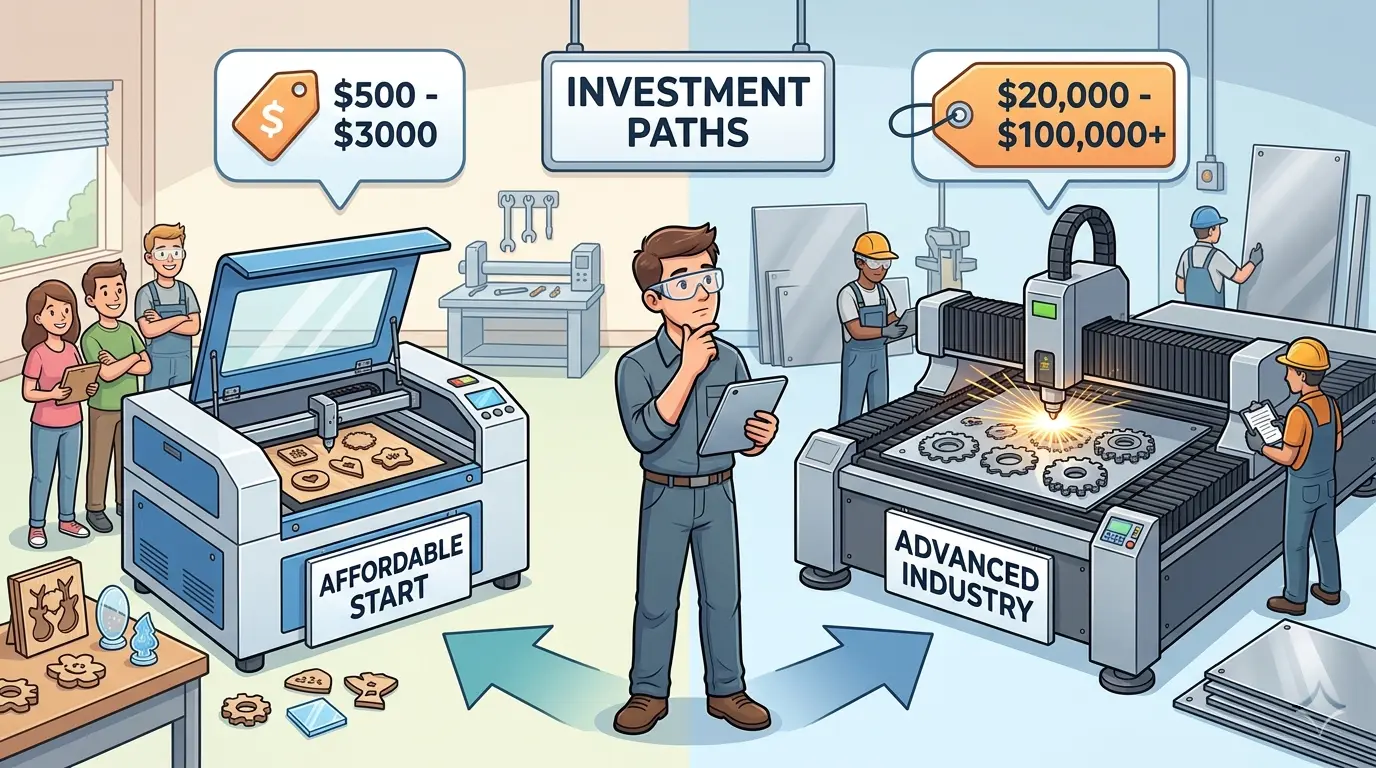
The Budget Positions Buyers Commonly See
Instead of looking for one universal market price, it is usually more useful to understand what type of purchase the quote is really describing.
| Buying Position | What the Budget Is Usually Paying For | Best Fit | Where Buyers Commonly Overspend |
|---|---|---|---|
| Basic Commercial Entry | Access to laser processing with limited workflow ambition | Simpler short-run work with forgiving quality demands | Paying for production-oriented features that the queue rarely uses |
| Mixed-Work Commercial Setup | A more balanced cut-and-engrave workflow with better repeatability | Shops handling acrylic, wood, signage, and varied custom jobs | Assuming every option improves throughput equally |
| Production-Focused Configuration | Stability, repeatability, and lower setup variation across repeated work | Daily commercial output and tighter finish expectations | Buying too lightly and then fighting avoidable downtime or rework |
| System-Level Purchase | A broader operating package that supports standardization and ramp-up | Multi-operator environments and more structured production planning | Adding complexity that the plant will not actually use consistently |
This is where many pricing discussions go wrong. Buyers compare a lighter-duty quote to a production-oriented quote without recognizing that the second proposal is priced against a more demanding operational role.
Bare Machine Price and Installed Price Are Not the Same Thing
Laser cutter buyers should always ask suppliers to separate the proposal into clear cost buckets. That makes it much easier to see whether a machine is truly lower-priced or whether important project costs have simply been moved off the main line.
Common items that should be broken out include:
- Cooling and Extraction Equipment
- Software and Job-Preparation Tools
- Material Fixtures or Positioning Accessories
- Installation, Commissioning, and Operator Training
- Spare Parts and Preventive Maintenance Items
- Service Coverage During Early Production
- Freight, Site Preparation, and Import Terms
Without that separation, buyers often approve what looks like the lowest machine price only to discover that the real installed cost is not meaningfully lower.
A Lower Quote Can Still Produce a Higher Cost Per Good Part
The real pricing question is not what the machine costs on the day it is purchased. The real pricing question is how much it costs to keep producing acceptable parts with reasonable labor input and stable quality.
A cheaper machine can become more expensive when it causes:
- More Setup Drift Between Jobs
- More Residue, Cleanup Time, Or Edge Inconsistency
- More Operator Intervention During Runs
- More Variation Across Repeat Orders
- More Rework On Customer-Visible Parts
- More Lost Time During Troubleshooting Or Early Production Ramp-Up
For many buyers, that is the most useful version of a 2026 price guide. Not a generic headline number, but a clearer view of the cost of getting reliable output from the machine in daily use.
When Paying More Usually Makes Sense
Paying more is not automatically the right move. But a higher-priced quote often makes sense when the business depends on one or more of the following:
- Repeatable Output Across Several Operators Or Shifts
- Cleaner Results On Customer-Facing Acrylic Or Wood Products
- Faster Changeovers Across Different Job Types
- More Predictable Combined Cutting-And-Engraving Workflows
- Lower Risk During Installation and Production Ramp-Up
In those cases, the extra spend is not about buying prestige. It is about reducing production friction and protecting usable output.
By contrast, if the workload is simple, low-volume, and operationally forgiving, a more basic buying position may be sensible. The important point is to match budget level to workflow risk rather than assuming every laser buyer needs the same configuration.
Questions Buyers Should Ask Before Approving a Quote
Before selecting a supplier or final machine scope, buyers should be able to answer these questions clearly:
- What Percentage Of Machine Hours Will Be Cutting Only?
- How Often Will Jobs Also Require Engraving?
- Which Materials Will Consume Most Of The Weekly Runtime?
- How Sensitive Is The Business To Residue, Edge Appearance, Or Visual Defects?
- How Much Operator Setup Time Is Acceptable Per Job Change?
- Which Items Are Included In The Quote, And Which Are External Costs?
- What Support Is Available During Installation, Early Production, And Ongoing Maintenance?
These questions create a more disciplined quote comparison. They also help buyers avoid approving a lower initial figure that leads to higher operating cost later.
Common Pricing Mistakes in Laser Cutter Buying
Several pricing mistakes appear repeatedly in laser cutter purchases:
- Comparing Quotes Before Defining The Real Production Role
- Treating A Bare Machine Price As If It Represents Installed Cost
- Buying For A Demo Sample Instead Of The Weekly Material Mix
- Ignoring Changeover Efficiency In High-Mix Production
- Underestimating The Value Of Training, Commissioning, And Early Service Support
- Folding Unrelated Processing Needs Into One Generic Laser Budget
Most of these mistakes do not come from misunderstanding what a laser cutter does. They come from misunderstanding where the real cost sits inside the workflow.
Practical Summary
Laser cutter pricing in 2026 is still best evaluated as a structured buying decision rather than a single number. Buyers get the clearest comparison when they define the real job first, separate the quote into comparable cost buckets, and judge the machine by the cost of producing acceptable parts with consistent quality.
For non-metal laser applications such as wood, acrylic, and similar materials, the strongest buying decision usually comes from matching machine scope to recurring production reality, not to the most attractive base quote. A price guide becomes genuinely useful when it helps buyers compare configuration, commissioning, repeatability, and operating friction instead of only comparing the number at the top of the proposal.