In many fabrication environments, the real bottleneck is not simply cutting tube to length. It is getting repeated holes, slots, end cuts, and fit-up geometry into round, square, and rectangular profiles without stacking up manual layout, re-clamping, and secondary operations. That is why tube laser cutting is usually evaluated as a workflow tool, not just a faster cutting method.
A laser pipe cutting machine helps bring several profile-processing steps into one controlled sequence. Instead of moving material from sawing to marking to drilling to coping, the shop can process more of the part while the profile is still referenced inside one machine setup. The result is often better repeatability, cleaner downstream assembly, and less handling between operations.
What a Laser Pipe Cutting Machine Actually Does
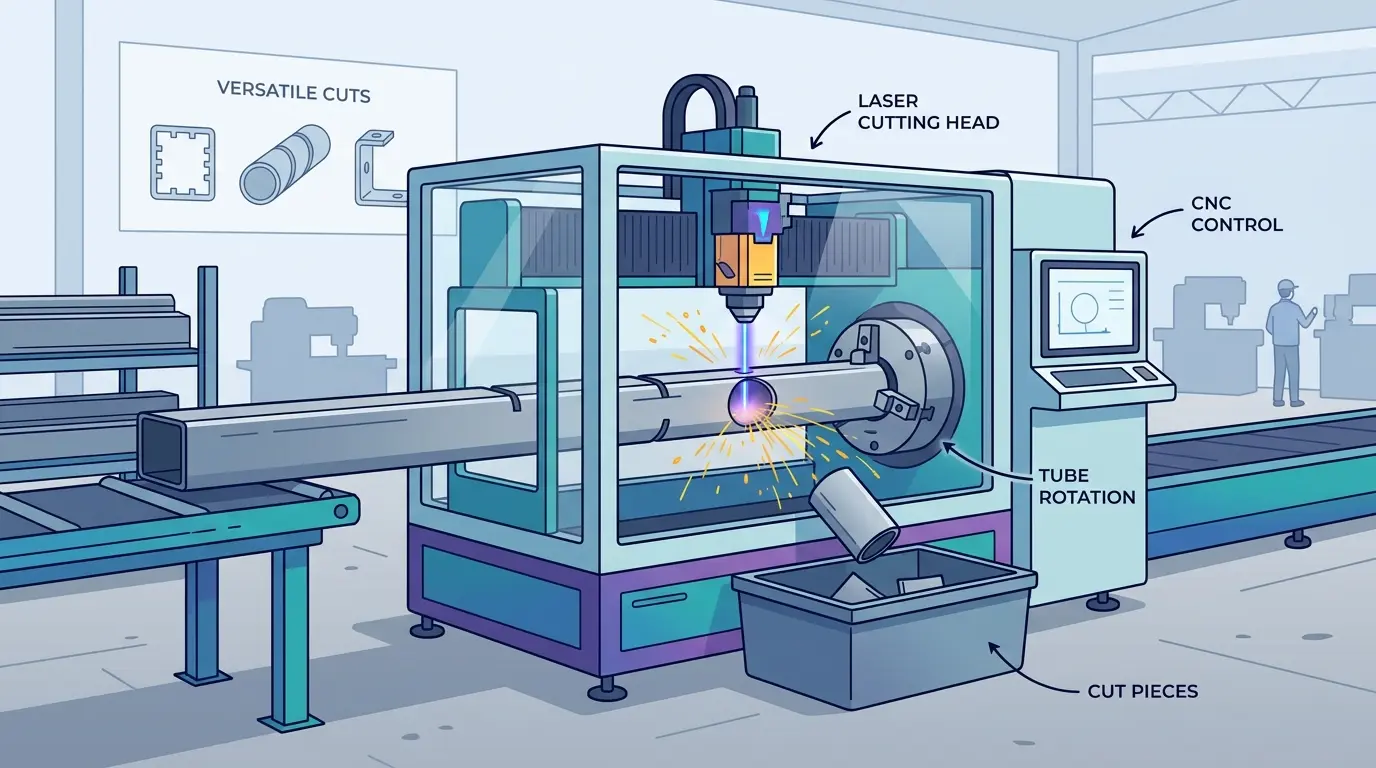
At a practical level, a laser pipe cutting machine holds a tube or pipe section, controls its position, rotates it to the required angle, and directs a laser beam to cut both linear and feature-based geometry. That geometry may include simple cut-to-length operations, but it can also include holes, slots, miters, notches, and end-preparation shapes that would otherwise require separate equipment or manual processing.
In shop language, people often use pipe cutting and tube cutting interchangeably. In production, though, the important issue is less the label and more the profile behavior. Round sections, square tube, rectangular tube, and other structural profiles all place different demands on clamping, rotation, support, and cut-path control.
That is why tube laser cutting should be understood as coordinated profile handling plus controlled feature cutting, not just as a laser head pointed at metal.
Step by Step: How Tube Laser Cutting Works
The cutting sequence usually follows a predictable production logic.
| Stage | What Happens | Why It Matters in Production |
|---|---|---|
| Material Loading | Raw stock is loaded into the machine and supported along its length | Stable loading affects consistency before the first cut is made |
| Clamping and Referencing | Chucks or similar holding systems secure the profile and establish its working position | Reliable referencing supports repeatable feature placement |
| Rotation and Positioning | The machine rotates and advances the profile to align each cut location | Tube parts often need geometry on multiple faces or at changing angles |
| Feature Cutting | Holes, slots, tabs, and other required features are cut before final separation | Integrated feature cutting reduces secondary drilling, marking, or notching |
| End Geometry Cutting | Miters, joints, coping-style shapes, or contour cuts are processed at part ends | Better end preparation can improve downstream fit-up and assembly efficiency |
| Part Separation | Finished parts are cut free from the remaining stock | Clean separation helps maintain part consistency across batches |
| Unloading and Sorting | Processed parts move to the next operation such as welding, bending, coating, or assembly | Smooth unloading supports real throughput, not just machine cycle performance |
This sequence is simple on paper, but each step influences whether the machine actually improves the full workflow or just shifts the bottleneck somewhere else.
Why Tube Laser Cutting Is Different From Flat Sheet Laser Cutting
Flat sheet cutting and tube cutting both use laser energy, but the production challenge is not the same. Sheet processing mainly deals with planar nesting and flat workholding. Tube processing adds rotation, profile support, changing cut orientation, and feature alignment around a three-dimensional shape.
That difference matters because many fabricated tube parts are only useful if features line up correctly from one face to another. A hole pattern may need to match a bracket location. A notched end may need to seat properly into a mating tube. A miter or contour may need to reduce fitting work before welding. If positioning or rotational control is inconsistent, the problem shows up later in rework, slower assembly, or poor weld preparation.
For that reason, tube laser cutting performance should not be judged only by headline speed. It should also be judged by how well the machine maintains alignment, support stability, and repeatability across the actual profile mix the shop processes every day.
Where Tube Laser Cutting Usually Creates the Most Value
Tube laser cutting is commonly used where profile parts carry more than one simple cut requirement. The more a shop depends on repeatable feature placement and cleaner downstream part fit, the stronger the case tends to become.
It is often well suited to workflows such as:
- Welded frames and structural subassemblies
- Tube-based furniture and fixture production
- Handrails, racks, supports, and guard structures
- Equipment frames and machine enclosures
- Repeated profile parts with holes, slots, or angled end cuts
- Mixed production environments that need faster changeover between part families
In these settings, the gain is not only that the machine cuts profile stock. The gain is that it can reduce the number of separate preparation steps needed before the part is ready for welding or assembly.
What Tube Laser Cutting Often Replaces or Reduces
Many shops first notice the value of tube laser cutting when they map the older process honestly. A conventional route may involve sawing stock, marking features, drilling holes, trimming ends, and manually fitting joints. Each of those steps can be workable on its own, but together they add labor, handling, and more opportunities for variation.
Tube laser cutting often helps reduce:
- Manual measuring and layout time
- Multiple re-clamping between operations
- Secondary hole-making or slotting steps
- Separate coping or end-preparation work
- Inconsistent fit-up at the welding table
- Delays caused by moving profile parts between several machines
That does not mean laser cutting eliminates every secondary process. It does mean many fabrication shops can consolidate more of the profile-preparation workflow into one controlled stage.
Which Machine Elements Matter Most
When people first look at tube laser equipment, they often focus on the laser source or the visual cutting demo. Those matter, but they are only part of the picture. In real production, several machine elements shape the result.
Profile holding matters because poor clamping consistency affects feature location and cut repeatability. Support design matters because long or lighter sections can behave differently as they move through the process. Control and programming matter because high-mix work depends on fast job setup and reliable part definition. Unloading and part handling matter because a strong cut cycle still loses value if finished parts create a traffic jam at the exit.
In other words, a laser pipe cutting machine should be judged as a profile-processing system, not just as a cutting head.
The Main Tradeoffs Shops Should Understand
Tube laser cutting is not automatically the right answer for every fabrication environment. The tradeoffs should be clear before a shop moves forward.
If most work is simple cut-to-length processing with minimal features, a more basic process may still fit the workload. If part variation is high but programming discipline is weak, the machine may not deliver its full value. If material handling is the real bottleneck, cutting technology alone will not solve the issue. If downstream welding and assembly are inconsistent for reasons unrelated to part prep, the gains may be smaller than expected.
There is also the question of production mix. Some shops benefit most from tube laser cutting because they process recurring part families with repeated geometry. Others benefit because they need flexibility across many profile types. The correct choice depends on whether the business is constrained more by throughput, labor handling, fit-up quality, or changeover speed.
That is why the most useful evaluation is usually not, “Is tube laser cutting better?” The better question is, “Which current source of waste or delay does it remove from our actual workflow?”
Questions To Ask Before Buying or Upgrading
Before comparing suppliers or machine layouts, it helps to answer a few process questions internally.
- Which profile shapes make up most of our weekly volume?
- How many of our parts require holes, slots, angled ends, or fitted intersections?
- Where do we lose the most time now: loading, setup, secondary operations, or downstream fit-up?
- Do we run repeated batches, high-mix project work, or both?
- How important is quick changeover between part families?
- Are our current quality problems caused by cutting, handling, or later assembly variation?
These questions usually produce a better machine decision than starting with the biggest advertised capability.
Practical Summary
A laser pipe cutting machine works by combining profile handling, positional control, rotation, and laser-based feature cutting into one coordinated workflow. That matters because tube parts often need more than separation cuts. They need accurate holes, slots, end geometry, and repeatable alignment that supports faster welding and cleaner assembly.
For fabrication shops, the value of tube laser cutting usually comes from process consolidation and better downstream part readiness, not from speed claims alone. The best evaluation starts with the real part mix, the real handling problems, and the real sources of rework inside the factory.
If tube processing is only one part of a broader equipment-planning discussion, the Pandaxis product catalog provides a broader view of adjacent industrial machinery categories. The practical decision, however, should always come back to workflow fit: how material moves, how parts are prepared, and how reliably those parts reach the next operation ready to use.