A leather engraving sample can look excellent on the bench and still fail in production. The reasons are usually not dramatic machine faults. They are process problems: inconsistent contrast across hides, dark heat halos around logos, residue on finished surfaces, slow cleanup between orders, or settings that work on one leather finish but not the next.
That is why a leather laser engraver should be selected as a workflow tool, not as a demo machine. The real question is whether the machine can produce readable, repeatable, commercially acceptable marks on the leather types you actually run, at a pace that fits your order mix.
Why Leather Needs A Different Settings Mindset
Leather is less uniform than many buyers expect. Even when two parts look similar, they may react differently because of surface finish, color, grain, coating, tanning method, thickness variation, or moisture condition.
That matters because laser engraving on leather is usually judged by four production outcomes:
- Clear Visual Contrast
- Controlled Edge Definition
- Acceptable Odor, Smoke, And Residue
- Repeatability Across Batches
Natural leather, suede, coated leather, bonded materials, and synthetic leather-like substrates do not always respond in the same way. Some darken quickly and cleanly. Others develop soot, surface hardening, or uneven shading. Some coated materials can also change behavior enough that sample approval on one batch does not guarantee stable production on the next.
In practice, the best leather settings are rarely the most aggressive ones. The stronger target is usually stable contrast with limited heat spread, not maximum depth.
Which Settings Actually Matter On Leather
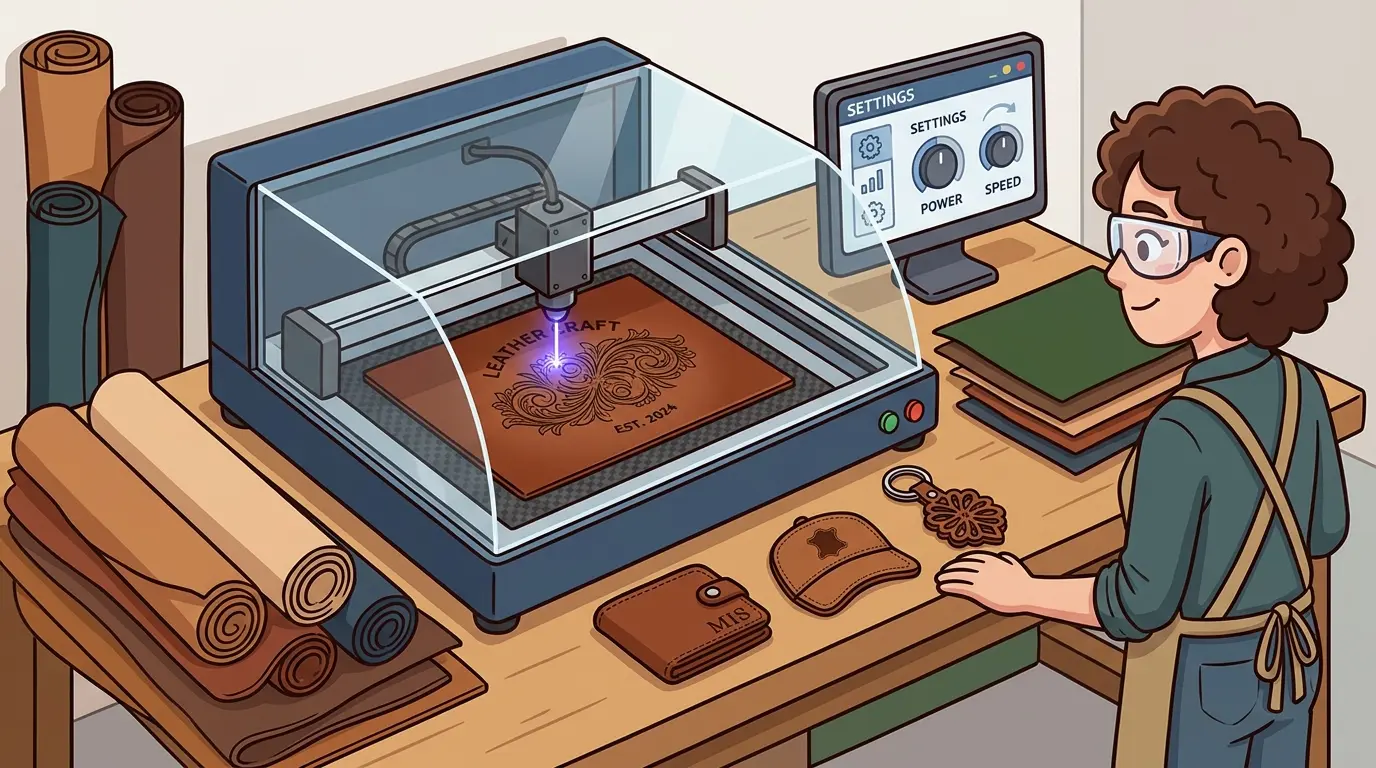
For leather work, settings should be treated as a balance of energy, motion, and cleanup rather than one universal recipe. A machine that can engrave leather well still needs the right parameter strategy for each material family.
| Setting Area | If It Is Too Aggressive | If It Is Too Light | What Good Control Usually Looks Like |
|---|---|---|---|
| Power Or Energy Per Pass | Scorching, dark halo, hardened surface, stronger odor | Weak contrast, incomplete image, low readability | Enough contrast to read clearly without over-burning the surrounding area |
| Speed Or Dwell Time | Heat builds up, edges widen, residue increases | Marks become faint or inconsistent | Stable tone and line quality at usable cycle time |
| Focus Position | Lines can widen and detail can soften if energy spreads poorly | Mark quality can become uneven and shallow | Clean edges and consistent visual response across the full graphic |
| Scan Spacing Or Fill Density | Filled areas can become muddy, overly dark, or slow to process | Coverage can look patchy or weak | Even fills that stay visually consistent without unnecessary heat load |
| Pass Strategy | Extra passes can deepen discoloration and slow throughput | Single-pass output may not meet the visual target | Layered processing only when it improves readability or surface texture |
| Extraction And Airflow | Poor smoke removal leaves soot and odor around the mark | Excessive process instability can still affect consistency if airflow is poorly managed | Clean smoke removal, reduced residue, and more consistent cosmetic results |
The practical lesson is simple: do not ask for “the best settings for leather” as though one answer covers every job. Build separate recipes for each leather family, surface finish, and visual standard.
For many leather products, the target is not deep carving. It is clean branding, decorative contrast, or controlled surface texturing. That often means lower heat accumulation and better process discipline outperform more aggressive engraving.
Best-Fit Applications For Leather Laser Engraving
Leather laser engraving usually makes the most sense when product value depends on appearance, customization, or repeatable branding rather than heavy material removal.
| Application | Why Laser Engraving Fits | Main Workflow Benefit | Main Watchpoint |
|---|---|---|---|
| Wallets, Belts, Notebook Covers, And Small Leather Goods | Logos, artwork, monograms, and decorative patterns can be changed digitally | Faster design changes without physical tooling changes | Finished-goods presentation and part positioning must stay consistent |
| Leather Patches, Labels, And Tags | Repeated branding on small parts can be standardized | Better batch consistency and easier OEM variation | Fixtures and placement control matter as much as beam quality |
| Packaging, Gift Sets, And Presentation Inserts | Branding often changes by customer, series, or campaign | Lower setup friction on short and mixed runs | Cosmetic residue is highly visible on premium products |
| Footwear And Accessory Components | Surface detail, branding zones, and decorative graphics can be added with limited contact | Cleaner artwork changes across multiple product variants | Material finish differences can shift contrast quickly |
| Upholstery Panels, Decorative Inserts, And Low-Volume Interior Components | Laser processing can support patterning and branding on customer-facing parts | Repeatable design detail on visible surfaces | Large or soft parts need stable support and handling |
Laser engraving becomes especially useful when artwork changes often. If the same design will run for long periods and the product depends on a strongly tactile raised or recessed effect, embossing or stamping may still be the stronger primary process. Laser is usually strongest where flexibility, short-run variation, and non-contact detail creation matter more than fixed-tool repetition.
What Usually Separates Clean Leather Output From Scrap
Most production problems with leather engraving come from process inconsistency, not from the idea of using a laser in the first place.
Common causes of scrap include:
- Using One Recipe Across Multiple Leather Types
- Approving Samples On Scrap Pieces That Do Not Match Production Material
- Ignoring Surface Finish Differences Between Batches
- Running Filled Graphics Without Enough Attention To Smoke Removal
- Treating Pre-Cut Parts Like Flat Sheets Without Proper Fixtures
- Accepting Visual Standards That Are Too Subjective Between Operators
Stronger leather workflows usually include a simple but disciplined process structure:
- Separate recipes by leather type, finish, and color family.
- Test on actual production offcuts instead of unrelated sample scraps.
- Approve one clear visual standard for contrast, edge cleanliness, and allowable halo.
- Use fixtures or jigs whenever pre-cut parts need repeat placement.
- Keep extraction performance stable enough to control residue and odor over full shifts.
That process discipline matters because leather is a cosmetic material in many applications. On customer-facing goods, small quality shifts are obvious. A machine that looks capable in a demo will still create waste if the shop cannot hold appearance standards across real batches.
Which Machine Type Usually Makes The Most Sense For Leather
For most commercial leather engraving, CO2 systems usually deserve the closest attention first. They are commonly used for leather together with wood, acrylic, paper, and other non-metal materials, especially where the workflow may involve both engraving and contour cutting.
For manufacturers evaluating laser cutters and engravers for leather and similar non-metal workflows, the more useful selection question is not only source type. It is also whether the machine architecture matches the part format and job flow.
| Production Scenario | Usually Stronger First Machine To Evaluate | Why It Often Fits | Main Limitation To Watch |
|---|---|---|---|
| Flat Leather Sheets With Combined Cut-And-Engrave Work | CO2 Gantry Workflow | Better suited to larger working areas and mixed geometry plus surface detail | The process still depends heavily on extraction, recipe control, and leather consistency |
| Leather Goods Plus Wood Or Acrylic In The Same Queue | CO2 Platform For Non-Metal Work | Easier to standardize one non-metal workflow family across several substrates | Each material still needs separate parameter control |
| Sampling, Prototyping, Or Lighter-Duty Personalization | Lower-Duty Compact System | Can make sense where volume and shift intensity are limited | Usually not the strongest choice for industrial throughput or long-shift stability |
| Repeated Small Marks On Pre-Cut Parts | Marking-Oriented Setup With Strong Fixturing | Part handling and placement repeatability may matter more than wide-area processing | Less flexible if the queue later shifts toward larger cut-and-engrave jobs |
In practical terms, leather buyers should usually prioritize:
- Stable Non-Metal Material Fit
- Reliable Extraction And Cleanup
- Usable Table Size Or Part Presentation Method
- Recipe Repeatability By Material Family
- Whether The Workflow Needs Engraving Only Or Both Cutting And Engraving
This is also where buyers make an expensive mistake: choosing by headline wattage or marketing language instead of by actual part flow. A machine may have enough beam power and still be the wrong fit if the table is poorly matched to the part size, the exhaust control is weak, or the queue depends on frequent changeovers with different leather finishes.
How To Choose The Right Leather Laser Engraver For Your Workflow
The best purchase decision usually starts with the job, not the machine brochure.
- Start With The Actual Leather Mix. Natural leather, suede, coated leather, bonded materials, and synthetic leather-like substrates should not be treated as one settings family.
- Define The Visual Standard Early. Decide whether the product needs light contrast, decorative shading, recessed texture, or simple readable branding.
- Separate Flat Production From Finished-Goods Processing. Sheets, strips, patches, and assembled goods do not present the part to the machine in the same way.
- Decide Whether You Also Need Cutting. If the queue includes both contour shaping and engraving, the best machine choice may differ from a pure marking setup.
- Evaluate Extraction As A Production Variable. On leather, residue and odor control are part of quality, not just housekeeping.
- Check Fixturing And Alignment Discipline. Small branded parts often succeed or fail on repeat placement, not on beam capability alone.
- Plan For Adjacent Materials. If leather work sits beside wood, acrylic, paperboard, or packaging components, a broader non-metal workflow may create better long-term value than a single-material purchase mindset.
Buyers also need to be honest about throughput. If the operation mostly handles premium short runs, personalization, or mixed OEM branding, flexibility may matter more than maximum hourly output. If the operation is high-volume and visually standardized, process repeatability and part presentation control become more important than broad application range.
Practical Summary
A leather laser engraver is usually a strong fit when the product line depends on branding, decorative detail, personalization, or repeatable visual contrast on non-metal materials. It is commonly well suited to leather patches, small goods, presentation packaging, accessory components, and other customer-facing applications where design changes happen faster than fixed tooling should.
The settings side of the decision matters just as much as the machine side. Good leather results usually come from controlled energy, stable speed, correct focus, disciplined extraction, and recipe separation by material family. Shops that treat leather like a uniform substrate often end up with soot, scorch marks, inconsistent contrast, and unnecessary scrap.
For most commercial leather workflows, CO2-based non-metal processing remains the most practical place to start. The stronger investment decision is to match that machine to the real job mix: material type, part format, visual standard, changeover frequency, and whether the same workflow also needs cutting. When those factors line up, leather laser engraving usually becomes easier to standardize, easier to scale, and less likely to create cosmetic rework.