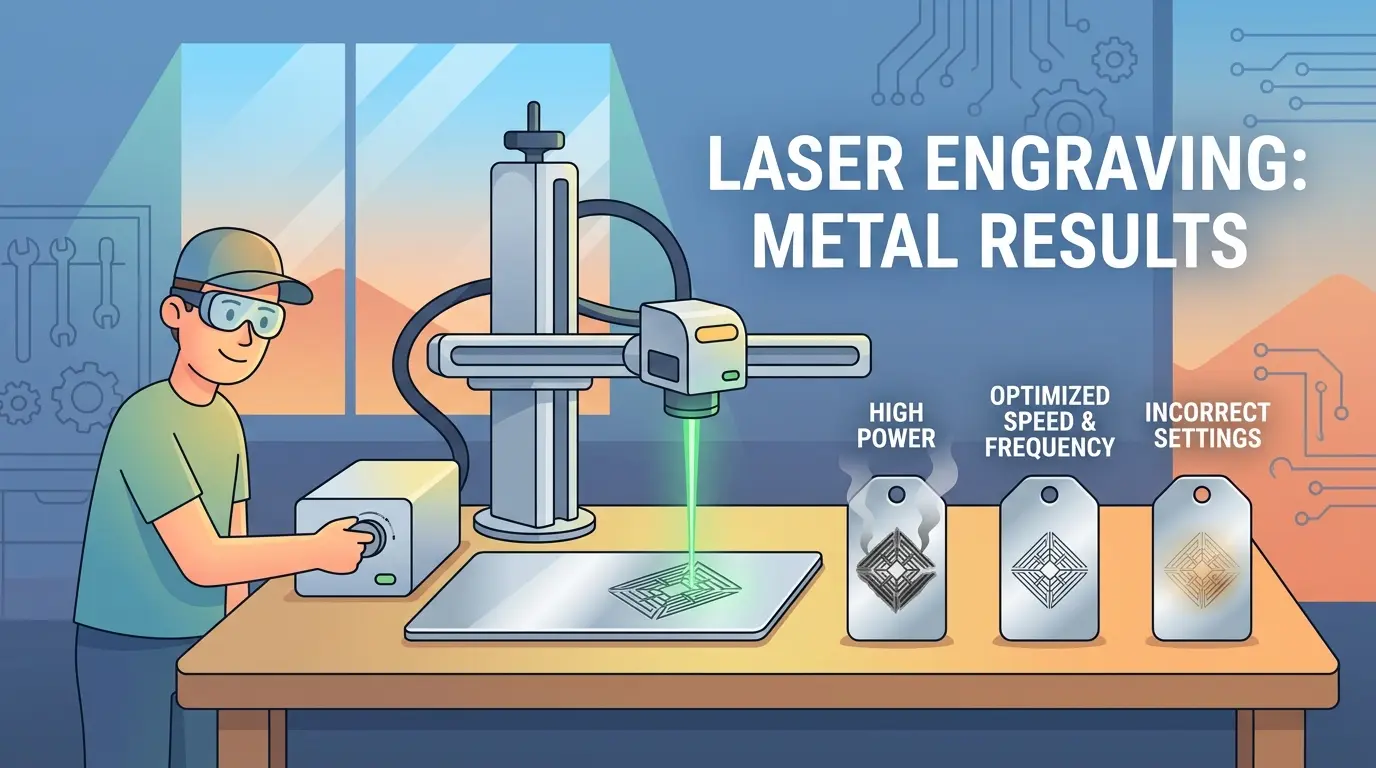
In metal engraving, two machines can share similar headline power and still produce very different results on the same part. One leaves crisp, scanner-readable codes with stable contrast. The other creates wider heat tint, softer edges, inconsistent depth, or longer-than-expected cycle times. In production, that gap usually comes from the supporting specifications, not the brochure headline.
That is why buying a laser engraving machine for metal should not start with wattage alone. It should start with the mark result, the part surface, the required throughput, and the variables that control repeatability over a full shift rather than on a single sample coupon.
Start With The Mark Requirement, Not The Machine Label
“Laser engraving” is often used as a catch-all buying term, but industrial metal work can involve several different outcomes:
- High-Contrast Surface Marking For Serial Numbers And Data Matrix Codes
- Cosmetic Logos Or Branding Marks On Finished Parts
- Shallow Engraving For More Durable Identification
- Deeper Material Removal For Tooling, Fixtures, Or Mold Identification
Those outcomes do not prioritize the same specifications. A line that needs small, readable codes on stainless parts usually cares most about spot quality, focus stability, and process control. A plant filling large logos or pushing for deeper engraving will care more about power margin, hatch efficiency, and thermal consistency.
If buyers do not define the mark outcome first, they often end up comparing machines that look similar on paper but are optimized for different jobs.
The Specs That Most Directly Affect Results
| Spec | What It Changes On The Part | Matters Most When | Common Buying Mistake |
|---|---|---|---|
| Source Type And Pulse Architecture | Contrast window, heat input, surface response | Stainless cosmetic marks, coated parts, mixed production | Buying by wattage without checking process flexibility |
| Beam Quality And Spot Size | Edge sharpness, small text clarity, code readability | Fine codes, compact logos, dense marking layouts | Ignoring minimum feature size |
| Average Power And Pulse Energy | Cycle time, fill speed, material removal rate | Large filled marks, deeper engraving, harder materials | Oversizing for small-code work |
| Frequency And Pulse Width Control | Tone, oxidation behavior, thermal zone, finish quality | Cosmetic parts, heat-sensitive parts, surface-specific recipes | Assuming one parameter set fits every metal |
| Lens Choice And Field Size | Mark area coverage, corner consistency, effective spot size | Large parts, multi-part fixtures, mixed part families | Using one lens setup for every application |
| Z-Axis Or Focus Stability | Depth consistency, edge clarity, repeatability | Curved parts, varying heights, cast parts, multi-level fixtures | Testing only on flat sample plates |
| Fixturing And Motion Repeatability | Mark placement, code position, recipe stability | Automated cells, serialized production, high mix lines | Blaming the laser for workholding problems |
| Software And Data Integration | Changeover speed, traceability reliability, operator consistency | Part serialization, recipe switching, verification workflows | Treating software as an afterthought |
The pattern is straightforward: the best-looking sample is not always produced by the highest-power machine. It is usually produced by the machine and setup whose specifications match the real marking objective.
Source Type And Pulse Control Often Matter More Than Raw Power
For metal engraving, buyers frequently focus on power first because it is easy to compare. In practice, source behavior often affects results more directly.
For many industrial metal applications, pulsed fiber-based systems are the default reference point. But even within that category, the amount of pulse control available can change what the machine does well. A more basic configuration may be fully suitable for straightforward serial numbers or fixture IDs. A more adjustable setup is often favored when the factory needs a wider process window across stainless steel, aluminum, coated parts, or more appearance-sensitive work.
This is especially important when the job is not simply “make a mark.” The real requirement may be:
- Keep Heat Tint Tight On A Finished Surface
- Hold Fine Detail On Small Characters
- Balance Contrast Against Surface Damage
- Switch Between Simple ID Codes And More Cosmetic Logo Work
In those cases, source flexibility can affect results more than a jump in headline power.
Beam Quality And Spot Size Decide Whether Fine Marks Stay Readable
When marks get smaller, beam behavior becomes a quality issue rather than a theoretical specification.
Fine text, small Data Matrix codes, narrow line graphics, and compact traceability layouts all depend on how tightly the laser can place energy on the surface. If the spot is too broad for the feature size, the result may still look acceptable to the eye but fail later under scanner verification or visual inspection.
That is why beam quality and effective spot size should be checked against the smallest real feature on the production part, not only against a showroom sample. A mark that works on a flat test plate at comfortable size may not hold up on:
- Tiny Codes On Fasteners Or Small Components
- Dense Text Around Part Edges
- Logos With Narrow Strokes Or Fine Borders
- Marks Placed Near Changes In Part Geometry
For many code-driven applications, better control at the small-feature level produces more practical value than additional raw power.
Power Matters Most When Area, Depth, Or Throughput Start Driving The Job
Power is not irrelevant. It simply becomes decisive under specific conditions.
Higher available power or stronger usable pulse energy becomes more valuable when the plant is trying to:
- Reduce Mark Time On Large Filled Graphics
- Increase Throughput On High-Volume Lines
- Drive More Material Removal For Deeper Engraving
- Maintain Output Across Harder Or Less Cooperative Surfaces
By contrast, many plants marking small serial numbers or compact codes do not gain much from chasing more power once the process already meets line speed. In those cases, extra power can add cost without improving the mark quality that operators, scanners, and inspectors actually care about.
The right buying question is not “How much power can this machine deliver?” It is “What part of my actual result changes if I buy more power?”
Frequency, Pulse Width, And Recipe Control Affect Cosmetic Consistency
Some buyers only discover the value of parameter control after the machine reaches the floor.
Different metals and surface conditions respond differently to frequency, pulse width behavior, scan speed, and fill strategy. That is why a parameter set that produces a clean mark on one stainless surface may create a different tone, wider heat effect, or weaker contrast on another part that looks similar but carries a different finish.
This matters most when the line includes:
- Cosmetic Exterior Components
- Coated Or Treated Metal Surfaces
- Product Families With Different Surface Preparations
- Mixed Jobs That Switch Frequently Across Part Types
In those environments, recipe control is not just a convenience feature. It helps hold consistency across shifts, operators, and part batches.
Lens Choice And Field Size Can Quietly Change Quality
Field size is often treated as a productivity decision, but it also changes the character of the mark.
A larger field can help reduce repositioning and may improve cell efficiency when parts are larger or when multiple parts are loaded into one fixture. But larger coverage can also change how small features behave across the field. A setup optimized for broad coverage is not automatically the best setup for very fine details.
That tradeoff becomes important when a factory mixes:
- Small High-Density Codes
- Larger Filled Logos
- Multi-Part Fixtures
- Parts With Marks In Several Positions
The practical lesson is that lens selection should follow the real mark geometry. A lens and field combination that is excellent for large-area identification may not be the best choice for tiny, scanner-critical features.
Focus Stability And Part Height Control Matter More Than Sample Testing Suggests
Many sample trials look stronger than real production because they are performed on flat, clean, manually presented test pieces.
Production is less forgiving. Parts may vary in height, sit differently in fixtures, or include curved or stepped surfaces. Once focus stability changes, line sharpness, contrast, and effective depth can all move with it.
That makes height control a real production specification, especially for:
- Cast Or Forged Parts With Surface Variation
- Fixtures Holding Multiple Part Heights
- Parts With Curvature Or Uneven Faces
- Cells That Need Low-Supervision Repeatability
If the part presentation is unstable, even a capable laser source will produce inconsistent results. Buyers should treat focus control and workholding as part of the result equation, not as secondary setup details.
Motion, Fixturing, And Software Determine Whether Good Specs Survive Daily Production
Metal engraving problems are often blamed on the laser source when the real failure is elsewhere in the cell.
If a part lands slightly off-position, if the fixture allows tilt, or if operators switch recipes inconsistently, the mark quality will drift no matter how strong the source specification looks on paper. The same applies to data flow. A machine that marks well but handles serialization poorly can still become a traceability bottleneck.
Industrial buyers should evaluate whether the system supports:
- Stable Part Location Across Repeated Loads
- Simple Recipe Selection For Different Part Families
- Clean Variable-Data Handling For Serial Numbers Or Codes
- Verification Steps That Match The Real Inspection Workflow
- Fast Changeovers In High-Mix Production
In many factories, those factors decide real output more than the difference between two nearby power classes.
A Practical Spec Priority By Application
| Application | Specs To Prioritize First | Why Those Specs Lead |
|---|---|---|
| Small Data Matrix Codes On Stainless Parts | Beam Quality, Spot Size, Focus Stability, Software Verification | Readability and repeatability usually matter more than raw power |
| Cosmetic Logos On Finished Metal Surfaces | Pulse Control, Recipe Flexibility, Heat Management, Fixturing | Surface appearance can be damaged by an otherwise readable mark |
| Larger Filled Branding Marks | Average Power, Fill Strategy, Field Size, Cooling Stability | Mark area and cycle time become more important |
| Deeper Tooling Or Fixture Identification | Pulse Energy, Power Margin, Workholding Stability, Duty-Cycle Consistency | Material removal and repeated passes drive the economics |
| Mixed Part Families Across One Cell | Source Flexibility, Software Recipes, Focus Control, Fast Setup Logic | The machine must stay usable across changeovers, not just excel on one sample |
This is where specification review becomes practical. Instead of asking for the “best” machine, buyers can ask which specification directly supports the dominant job in their plant.
What To Test Before Buying
Before approving a machine, buyers should verify results on real production conditions rather than generic samples.
- Test The Actual Part Material And Actual Surface Finish.
- Use The Real Code Size, Text Height, Or Logo Geometry Planned For Production.
- Check Results After Any Cleaning, Coating, Handling, Or Downstream Processing The Part Will See.
- Verify Marks With The Same Scanner, Vision Check, Or Inspection Rule Used On The Line.
- Run Enough Repetition To See Whether The Mark Holds Consistency Across Multiple Parts, Not Just The First Sample.
For manufacturers reviewing metal marking needs alongside broader equipment planning, the Pandaxis product catalog can still serve as a useful starting point for wider machinery discovery even when the metal-engraving decision itself needs application-specific evaluation.
Practical Summary
The specifications that affect metal engraving results most are rarely the ones buyers notice first. Source behavior, beam quality, pulse control, lens choice, focus stability, fixturing, and software integration often decide whether the mark is sharp, consistent, and commercially usable in daily production.
Power becomes decisive when the application needs more area coverage, faster fill time, deeper engraving, or stronger throughput margin. But for many real jobs, the better result comes from tighter control rather than a larger number on the datasheet. The safest buying approach is to define the mark requirement clearly, identify the spec that truly controls that result, and test that logic on real parts before comparing machines by headline power alone.