When a part needs a small, clean mark on a heat-sensitive surface, the problem is not simply whether a laser can make a visible result. The harder problem is whether the mark can stay sharp without whitening thin plastics, distorting coated finishes, cracking delicate surfaces, or creating enough cosmetic damage to turn traceability work into scrap. That is why buyers looking at a UV laser engraver should treat the decision as a quality-control question first and a machine question second.
In real production, UV laser workflows are commonly evaluated when fine detail, lower thermal impact, and appearance-sensitive marking matter more than deep material removal. The strongest buying decision usually comes from understanding what the mark has to do, how sensitive the substrate is, and whether the line can keep results stable across repeated jobs.
Why Low Heat Changes the Buying Logic
Many laser comparisons start with speed or headline capability. UV laser selection usually starts somewhere else: reject risk. If a standard marking approach leaves melted edges, discolored coatings, haze, or inconsistent contrast, the cost shows up quickly in rework and manual inspection.
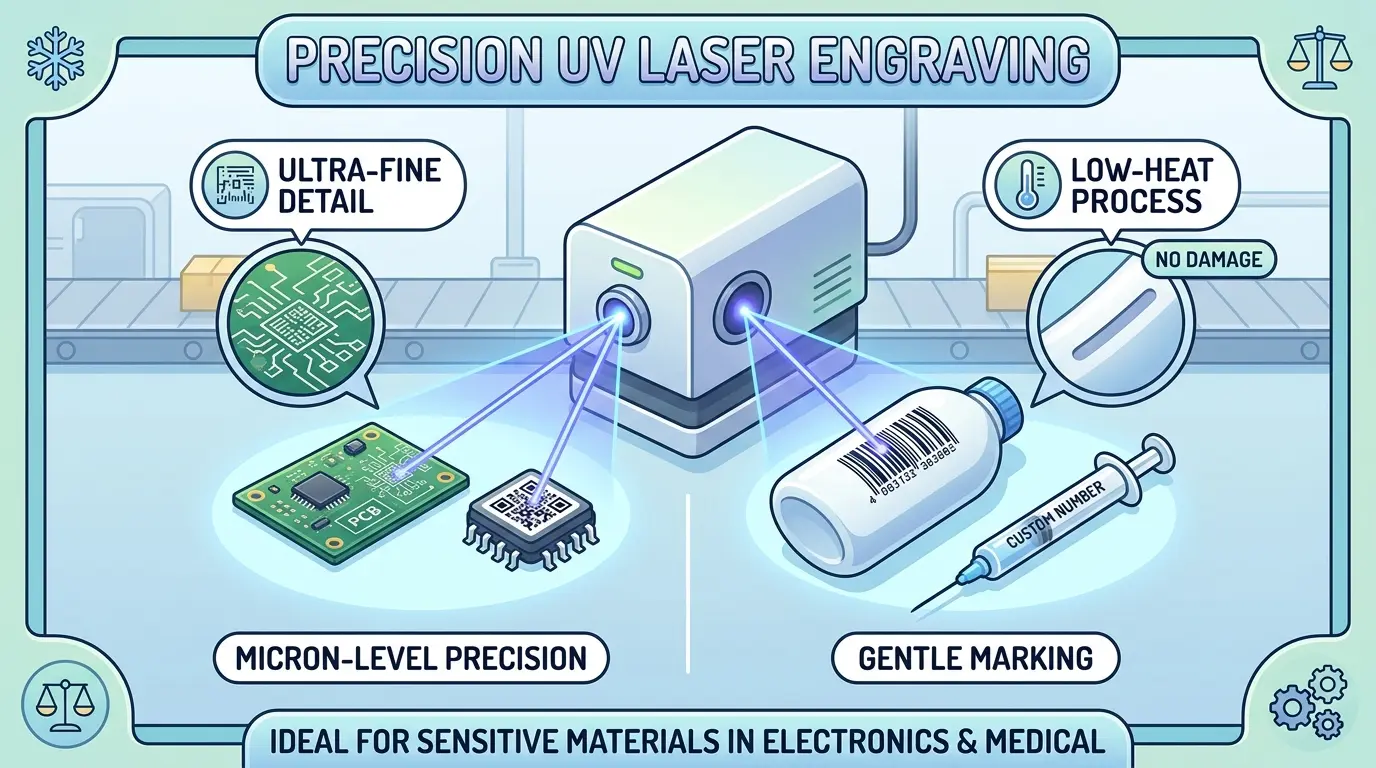
That is why UV laser systems are often considered for applications where the surrounding material matters almost as much as the mark itself. Typical pressure points include:
- Small Text Or Compact Codes On Thin Plastic Parts
- Branding Or Identification On Coated Or Painted Surfaces
- Appearance-Sensitive Products Where the Mark Must Look Controlled, Not Just Readable
- Delicate Substrates Where Excess Heat Can Distort the Finish
- Traceability Marks That Need Better Edge Definition Than Rougher Thermal Processes Provide
The practical advantage is not that UV removes every marking challenge. It is that it often gives buyers a better chance of holding fine detail while keeping the heat-affected area under tighter control.
Many “UV Laser Engraving” Jobs Are Really Fine Marking Jobs
The search term “UV laser engraver” is widely used, but in industrial workflows many of these jobs are closer to fine marking than deep engraving. That distinction matters because buyers can misjudge the machine if they evaluate it on the wrong outcome.
A UV process is commonly chosen when the goal is:
- Fine Characters
- Compact Data Matrix Or QR Codes
- Light Surface Marking With Controlled Cosmetics
- Small Logos Or Branding Fields
- Repeatable Identification On Sensitive Parts
It is less often selected because a shop wants aggressive depth, large filled areas removed quickly, or heavy contour cutting of sheet material. If the production goal is deep cavity engraving or broad, heat-tolerant material removal, a UV workflow may not be the first place to look.
The more accurate question is not “Can this engrave?” The better question is “Does this process give the mark quality we need without creating thermal side effects we do not want?”
Where UV Laser Marking Commonly Fits Best
| Application Area | Why UV Is Commonly Considered | Workflow Benefit | Main Watchpoint |
|---|---|---|---|
| Fine Plastic Components | Helps reduce visible melt, edge distortion, and oversized heat spread | Better mark control on small housings, covers, and precision plastic parts | Plastic behavior still varies by exact polymer and finish |
| Coated Or Painted Surfaces | Supports cleaner, more controlled marking where appearance matters | Useful when branding or ID marks must stay visually tidy | Coating chemistry can change contrast and consistency |
| Films, Labels, And Thin Sensitive Materials | Lower thermal load is often important when the substrate is light or delicate | Reduces the chance that the mark damages the surrounding material | Thin materials still need stable handling and recipe control |
| Glass, Ceramics, And Other Brittle Surfaces | Often evaluated when buyers need a fine surface result with limited surrounding disturbance | Can improve decorative or identification marking on delicate parts | Brittle materials remain sensitive to setup and process stability |
| Compact Traceability Marks | Fine beam control is often useful for dense codes and small-character fields | Supports better readability in high-density marking zones | A readable-looking code may still fail scanner validation |
This table matters because the strongest UV use cases usually share the same logic: the mark is small, the substrate is sensitive, and cosmetic damage around the mark carries real cost.
The Material Still Decides More Than the Laser Label
One of the most common buying mistakes is to treat “plastic” or “sensitive material” as a single category. In practice, it is not. Surface finish, additives, coatings, thickness, color, and even the supplier batch can change the way a part responds.
That means material validation should sit near the center of the buying process. A good sample on one plastic family does not automatically prove stable performance across several plastics or coatings. The same applies to glass-like or brittle decorative materials. Low-heat marking is still a process that interacts with real material variation.
Before a buyer treats UV as the answer, it is worth clarifying:
- Which Exact Materials Will Consume the Most Machine Hours
- Whether the Mark Is Functional, Cosmetic, Or Both
- How Small the Code Or Text Really Needs To Be
- Whether the Part Surface Is Flat, Curved, Coated, Or Textured
- Whether the Part Is Marked Before Or After Finishing Operations
- How Much Visual Variation the Customer Will Tolerate
This is where many projects are won or lost. The process must fit the real substrate queue, not the category name used in a purchasing discussion.
Low Heat Does Not Remove the Need for Process Discipline
A UV laser can help reduce thermal side effects, but it does not eliminate setup risk. In daily production, consistent results still depend on how the cell is run.
The factors that usually matter most are:
- Material Identification
- Surface Cleanliness
- Stable Part Presentation
- Controlled Focus Conditions
- Recipe Separation by Material and Finish
- Verification of Code Readability, Not Just Visual Appearance
- Good Fume Extraction and Housekeeping
This is especially important in mixed production. A line that shifts between coated plastic housings, delicate labels, and appearance-sensitive decorative parts will not stay stable if operators treat them as one interchangeable recipe family. Lower heat can reduce risk, but it does not replace material-specific process control.
When UV Fits Better Than Broader Laser Workflows
For many buyers, the real question is not whether UV works. The real question is when UV fits better than a more general laser workflow.
Buyers also comparing broader non-metal laser cutters and engravers should separate cutting-heavy work from marking-heavy work early, because the process priorities are not the same.
| Production Priority | UV Laser Fit | Broader Non-Metal Laser Fit | What Usually Decides the Better Choice |
|---|---|---|---|
| Fine, Low-Heat Marking on Sensitive Surfaces | Strong Fit | Application Dependent | Cosmetic control and reduced thermal impact matter most |
| Compact Codes and Small Text | Strong Fit | Application Dependent | Mark density and edge definition matter more than material removal rate |
| Deep Engraving Or Larger Filled Marks | Limited | Often Stronger for some non-metal workflows | Depth, removal speed, and finish expectations |
| Sheet Cutting of Wood, Acrylic, Or Similar Substrates | Weak Fit | Strong Fit | The job is driven by contour cutting, not delicate marking |
| High-Mix Appearance-Sensitive Parts | Strong Fit | Application Dependent | Reject cost from heat damage versus the need for broader cutting flexibility |
The tradeoff is straightforward. UV usually becomes more attractive as the job becomes finer, more appearance-sensitive, and more vulnerable to heat. A broader laser workflow becomes more attractive when the work shifts toward cutting, larger mark areas, or more robust non-metal material removal.
Throughput and ROI Should Be Measured Against Reject Cost, Not Only Cycle Time
UV laser marking is often selected because it protects part quality, not because it wins every speed comparison. That matters for ROI. A buyer focused only on raw cycle time may miss the real reason UV makes sense in the first place.
In many low-heat marking applications, the value comes from:
- Fewer Cosmetic Rejects
- Better Small-Code Readability
- Less Rework On Delicate Parts
- More Stable Results On Sensitive Surfaces
- Cleaner Brand Or Traceability Marks
If the line loses money mainly through melted plastics, distorted finishes, or poor code quality, UV can make sense even when it is not the most aggressive material-removal option available. If the line is dominated by large-area engraving, heavy removal, or cutting work, the economics may point elsewhere.
That is why UV laser selection should be tied to the actual failure cost in production, not just to a simple speed benchmark.
Questions Buyers Should Resolve Before Comparing Quotes
Before evaluating suppliers or demonstrations, buyers should answer a few operational questions clearly:
- Is the Main Goal Fine Marking, Cosmetic Branding, Or Machine-Readable Traceability?
- Which Exact Materials Are Most Sensitive to Heat in the Current Workflow?
- How Small Do the Characters Or Codes Need To Be?
- What Percentage of the Queue Is Appearance-Sensitive?
- Will the Part Be Marked Before Or After Painting, Coating, Or Final Cleaning?
- How Much Variation Exists Between Material Lots Or Finishes?
- Is the Current Pain Point Speed, Reject Rate, Or Inconsistent Mark Quality?
These questions usually reveal whether UV is being considered for the right reason. If the underlying problem is thermal damage and fine-detail control, the case for UV tends to strengthen. If the underlying problem is broader cutting capacity or large-area processing, the better answer may be a different machine category.
Practical Summary
A UV laser engraver is most useful when a production line needs fine, controlled, low-heat marking on materials or surfaces that do not respond well to rougher thermal processes. The strongest use cases usually involve small codes, fine text, coated finishes, thin plastics, sensitive decorative parts, and other applications where appearance and heat control matter as much as basic legibility.
The important tradeoff is that UV should not be treated as a universal laser solution. It is usually selected for precise marking and reduced thermal impact, not for every engraving depth or cutting task a shop might face. The best buying decision comes from matching the process to the real mark quality target, the actual material mix, and the cost of rejects when heat-sensitive parts go wrong.