In furniture manufacturing, the question is rarely whether a laser machine can process wood. The harder question is whether laser processing actually improves the component workflow you run every day. A machine that looks impressive on decorative samples can still be the wrong fit if most of your output depends on sheet breakdown, drilling accuracy, edge finishing, and fast cabinet-part throughput.
For manufacturers evaluating laser cutters and engravers for wood furniture work, the practical decision is not “laser or no laser.” It is which component families benefit from non-contact cutting or engraving, where laser adds value without creating extra cleanup or rework, and where conventional woodworking equipment still does the heavier production job better.
Start With the Component, Not the Machine
Wood furniture components do not all place the same demands on a production line. Some parts depend on decorative detail, complex contours, or branded surfaces. Others depend on square sizing, hardware-hole accuracy, stable edge preparation, and repeatable assembly geometry.
That distinction matters because laser is strongest when the component value comes from:
- Fine Detail
- Shape Flexibility
- Frequent Design Changes
- Combined Cutting and Engraving
- Minimal Mechanical Contact on Smaller or Delicate Parts
Laser is less compelling when the component value depends on:
- Large-Panel Throughput
- Integrated Routing or Grooving
- Joinery Preparation
- Hardware-Hole Accuracy
- Finished Production Edges for Standard Cabinet Assembly
If buyers skip this first classification step, they often end up comparing a laser machine against the wrong production need.
Which Furniture Components Usually Fit Laser Processing Best
Laser processing tends to make the most sense when the furniture component has visible design value or when geometry changes more often than conventional tooling can keep up with.
| Component Type | Why Laser Can Fit | Main Production Benefit | Main Watchout |
|---|---|---|---|
| Decorative Door Inserts and Screen Panels | Complex cut patterns and visible detail are often central to the part value | Easier short-run design variation without new hard tooling | Burn marks or residue matter more because the part is customer-facing |
| Thin Accent Pieces and Overlay Components | Small contour parts can be processed without mechanical tool pressure | Cleaner handling of delicate shapes and faster artwork changes | Material stability and part hold-down become important on smaller pieces |
| Engraved Drawer Fronts, Cabinet Faces, and Branding Elements | Surface graphics, logos, or repeating decorative details can be integrated directly into the part workflow | Reduces separate marking steps and supports OEM or custom branding | Surface cleanliness and contrast consistency affect sellable quality |
| Lightweight Organizer Inserts and Interior Decorative Parts | Repeated shapes and detail work can be handled efficiently in mixed-order production | Flexible batch changes across product variations | The process may still need secondary finishing depending on edge expectations |
| Assembly Reference Marking on Hidden Parts | Simple identifiers, orientation marks, or light graphics can help downstream sorting or assembly | Fewer manual labels and less mix-up risk | Marks must remain useful after sanding, coating, or later machining |
The common thread is that laser works best where detail and variation have real value. If the component is mainly a structural rectangle with drilled hardware locations and banded edges, the case for laser gets much weaker.
Where Laser Usually Stops Being the Best Primary Process
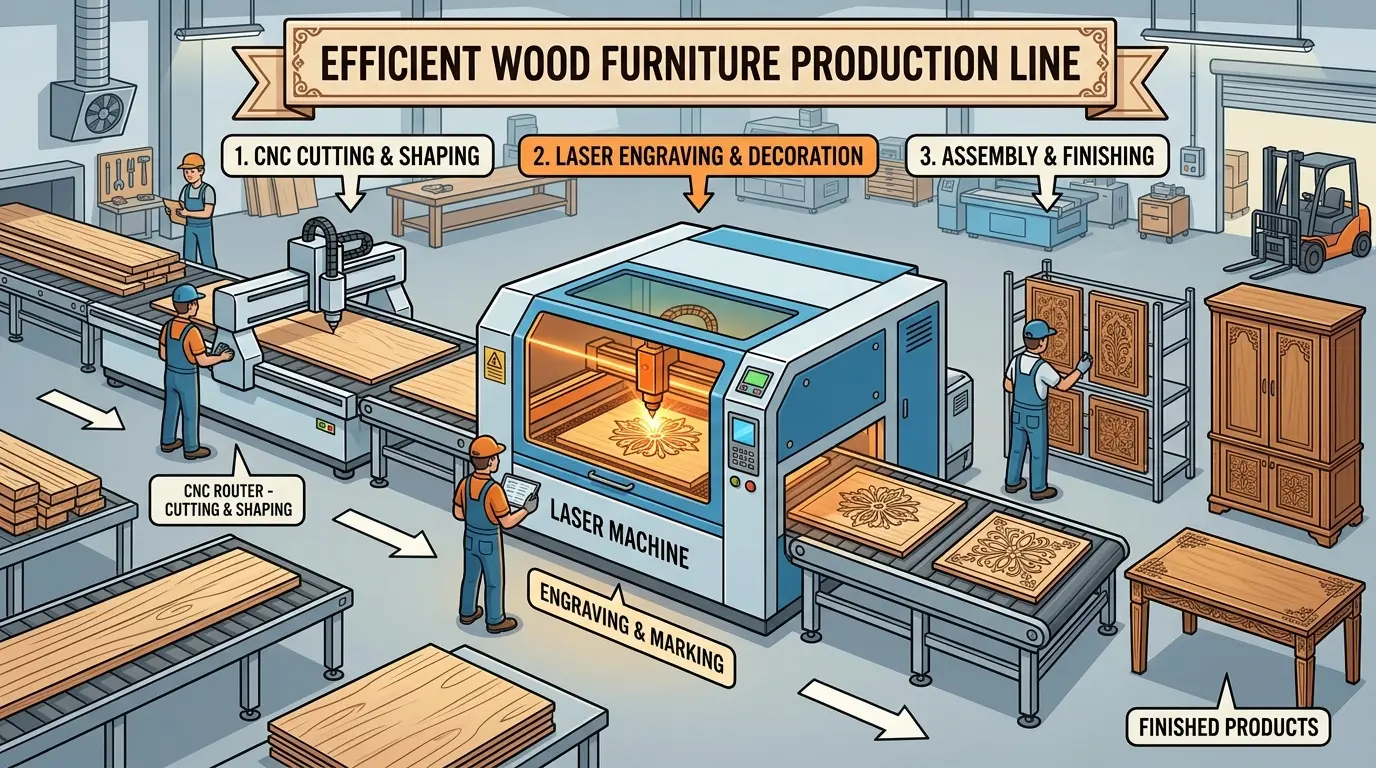
Many wood furniture factories produce a mix of parts, and not all of them belong on a laser machine. In cabinet and panel-furniture production especially, the main bottleneck is often not decorative cutting at all. It is panel breakdown, routed features, hole preparation, or edge finishing.
When the line is built around sheet-based carcass parts, CNC nesting machines are usually closer to the core production requirement because they combine cutting with broader panel-processing tasks. If the real quality issue is shelf-pin accuracy, hinge-hole positioning, or hardware preparation, boring and drilling machines solve a different and often more important problem. And when visible panel edges still need PVC, ABS, or melamine finishing for final assembly quality, the downstream value may sit more with edgebanders than with the cutting method alone.
| Production Need | Laser Fit | Better-Matched Primary Process |
|---|---|---|
| Large Cabinet Sides, Tops, Bottoms, and Shelves | Usually Limited | CNC Nesting or Panel-Sizing Workflow |
| Parts Requiring Integrated Routing, Grooving, or Machined Features | Weak Fit | CNC Machining Workflow |
| Repeated Hardware-Hole Patterns and Cabinet Joinery Prep | Weak Fit | Dedicated Boring or Drilling Workflow |
| High-Volume Structural Components With Hidden Edges | Usually Limited | Conventional Panel Processing |
| Visible Decorative Components With Shape Variety | Stronger Fit | Laser Processing Can Be a Good Complement |
This is the key tradeoff: laser can be a strong complementary process in furniture production without being the main cutting platform for the entire factory.
Material and Finish Quality Change the Real Answer
Wood furniture components are not made from one uniform material. MDF, plywood, veneered panels, laminated boards, and solid wood all behave differently, and those differences show up quickly when parts need visible quality.
In practice, laser results are often shaped by:
- Glue Lines and Density Variation in Engineered Boards
- Surface Residue on Customer-Facing Parts
- Edge Darkening on Visible Profiles
- Veneer Sensitivity and Surface Finish Expectations
- Moisture and Flatness Variation Across Material Batches
That is why sample approval should never stop at one clean demonstration piece. A production evaluation should test the actual board families the factory uses most, including the surfaces customers will see and the component geometries operators will repeat all shift.
For furniture parts, finish expectations usually decide whether laser is a net gain or an added cleanup step. A decorative grille panel may tolerate a slightly darker edge if the design value is high. A premium exposed shelf component may not. A hidden assembly mark may be highly useful even if it is not visually perfect. The process only makes sense when the quality standard of the component matches what laser can deliver consistently on your real materials.
What Laser Adds to a Furniture Workflow
When the application is well matched, laser changes more than the shape of the part. It changes how quickly the factory can move from one design to another and how much of that variation depends on physical tooling.
The strongest workflow gains usually come from:
- Faster Transition Between Design Variants
- Easier Handling of Small Decorative Batches
- Combined Cutting and Engraving in One Queue
- Less Tooling Dependence for Branded or Customized Parts
- Better Fit for Parts Where Mechanical Tool Contact Can Disturb Thin or Delicate Geometry
This matters most in production environments that sell variety: hospitality furniture, branded commercial interiors, decorative cabinet programs, short-run OEM work, and custom projects where surface design changes more frequently than the base material.
It matters less in lines where most value comes from throughput on standard carcass parts. In those environments, laser often improves a small part of the product range rather than transforming the whole plant.
How To Evaluate a Laser Machine for Furniture Components
A useful buying test should follow the component workflow, not the showroom demo. Before approving a machine, production teams should check whether it stays practical across the real mix of parts they intend to move onto the process.
Use questions like these:
- Which Furniture Components Would Actually Move to Laser in Daily Production?
- Are Those Parts Visible to the End Customer or Hidden in Assembly?
- Does the Process Reduce Tooling Changes, or Just Shift Work Into Cleanup?
- Can Operators Hold the Same Quality Across Different Board Batches?
- Does the Machine stay consistent across the full working area, not only at one sample position?
- Will the part still need secondary sanding, sealing, or edge work before it is sellable?
- Is the laser replacing a real bottleneck, or only adding another optional process step?
These questions help keep the decision grounded in factory logic. They also prevent a common mistake: buying a laser machine to solve a flexibility problem when the actual production bottleneck sits somewhere else in the furniture line.
A Practical Selection Rule
If the component earns value from contour detail, engraving, branding, or frequent design variation, laser can be a strong addition to the line. If the component earns value from structural accuracy, routed features, drilled hole patterns, and standardized edge preparation, laser is usually a secondary process at best.
That does not reduce its importance. In the right furniture workflow, laser can handle the kinds of components that are awkward, slow, or tooling-heavy with conventional processes. But it works best when it is assigned to the right part families instead of being expected to replace the entire wood-processing chain.
Practical Summary
Laser machines fit wood furniture production best where components depend on visible detail, frequent design changes, or combined cutting and engraving on non-metallic materials. Decorative inserts, branded faces, contour accents, and selected light-duty interior parts are often better candidates than mainstream structural cabinet components.
The production guide is simple: start with the component family, judge the finish standard honestly, and compare laser against the real bottleneck in the line. When the match is right, laser improves flexibility and reduces tooling friction. When the match is wrong, it adds complexity to a job that should stay on conventional furniture-processing equipment.