An identification mark that looks clean at the demo table can still fail on the factory floor. If a code becomes unreadable after washing, coating, handling, scanner verification, or field service, the problem is not cosmetic. It slows traceability, creates inspection friction, and increases the risk of mismatched parts moving downstream.
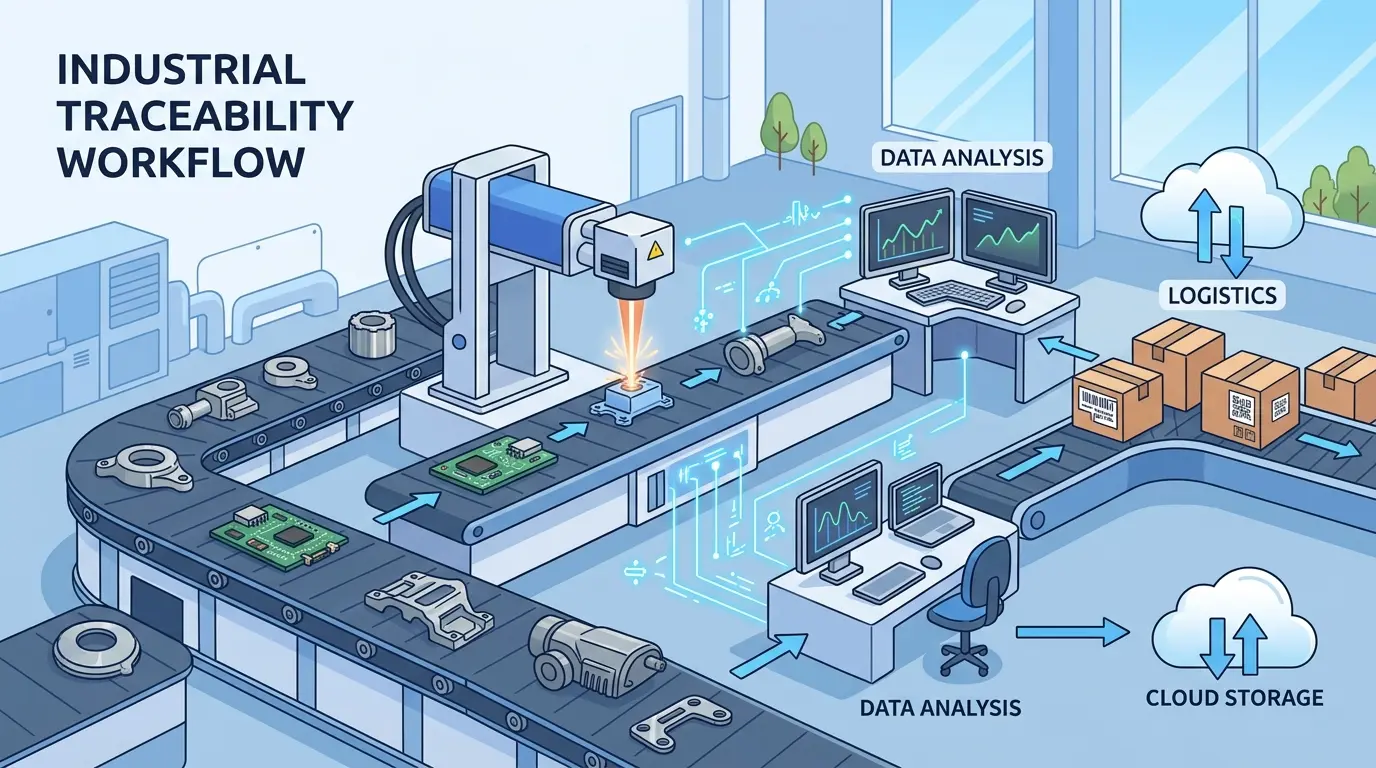
That is why laser marking equipment for industrial identification systems should be evaluated as part of a full workflow, not as a stand-alone machine purchase. The right setup depends on what must be marked, how that mark will be read, what material is involved, and where the marking step sits in production.
Start With the Identification Requirement, Not the Machine Label
Many buyers begin with the source type, the wattage, or the enclosure style. In practice, the better starting point is the identification task itself.
An industrial identification system may need to support serial numbers, lot codes, part numbers, data matrix codes, barcodes, logos, inspection references, or mixed variable data. Those marks may need to survive cleaning, coating, abrasion, outdoor exposure, or repeated handling. Some only need to stay readable through internal assembly. Others must remain legible for the full service life of the part.
| Requirement | What It Means in Production | Equipment Implication |
|---|---|---|
| Permanent Direct Part Marking | The code must remain useful after handling or downstream processing | Material response, mark type, and part presentation matter more than headline machine labels |
| Fast Variable Data Changes | Every part or batch may carry different information | Software integration, recipe control, and file handling become critical |
| Small Codes in Tight Areas | Readable marks must fit within limited surface space | Optics, fixture stability, and verification need tighter control |
| Heat-Sensitive Components | The mark must not damage the substrate or nearby features | Source selection and process window need closer review |
| Large or Installed Parts | Moving the part may be slower than moving the marking head | Station format and workholding strategy matter as much as the laser source |
This is the key correction many teams need to make early: the marking system is there to support traceability and production control, not just to create a visible surface effect.
Material Match Usually Decides the Laser Source
Not every substrate responds to laser energy in the same way. A setup that works well on one part family can produce weak contrast, heat damage, poor edge definition, or unstable code quality on another. That is why source selection should be driven by the real production material, not by a generic idea of what a laser marker should do.
| Source Type | Commonly Evaluated For | Why It Is Often Chosen | Main Watchpoint |
|---|---|---|---|
| Fiber-Based Systems | Many metal-part identification workflows and some plastics that respond predictably | Often suited to durable, high-contrast direct marking on industrial parts | Mixed alloys, coatings, and surface finishes can change results more than buyers expect |
| CO2-Based Systems | Wood, acrylic, paper-based tags, coated non-metal components, and some plastics | Commonly used where non-metal materials are part of the identification workflow | Not every plastic or coated surface responds cleanly, and heat effect must be checked on real parts |
| UV-Based Systems | Fine marking on heat-sensitive plastics, coated components, and delicate substrates | Often reviewed when lower thermal impact and finer detail matter | Higher mark quality on samples still needs throughput and durability validation in production |
The safest qualification method is straightforward: test the actual production material, in the actual surface condition, with the actual code geometry. Clean sample coupons often make a process look more stable than it will be on real batches.
Where identification also involves acrylic tags, engraved covers, or other non-metallic parts, Pandaxis laser cutters and engravers are the closest relevant category reference for that kind of non-metal processing.
Equipment Format Matters As Much As the Laser Source
A strong mark on the wrong station format can still create a weak production result. Industrial identification systems succeed or fail on repeatability, part flow, operator time, and verification discipline. That means the physical layout of the marking equipment deserves the same attention as the laser source.
| Equipment Format | Where It Usually Fits Best | Main Strength | Main Tradeoff |
|---|---|---|---|
| Enclosed Benchtop Station | Cell-based work, batch processing, and controlled manual loading | Stable workholding, easier safety control, and good repeatability | Manual handling can limit throughput if volume rises |
| Integrated In-Line System | Continuous production with standardized part flow | Better fit for high-throughput marking and automated verification | Requires more upfront engineering around motion, timing, and reject handling |
| Flying Marking Setup | Products already moving on a conveyor or line | Reduces stop-and-mark cycle interruptions | Needs stable line speed, predictable surface position, and tight process control |
| Portable or Movable Marking System | Large assemblies, oversized parts, or installed equipment | Brings the process to the part when movement is impractical | Usually gives up some placement consistency and demands stronger operator discipline |
This is where many projects become clearer. If the identification system depends on high scanner pass rates, small codes, and repeated daily output, a fixed and well-controlled station often outperforms a more flexible-looking setup. If the real bottleneck is part handling, a portable or movable format may create more value.
Verification and Data Handling Turn a Mark Into a Real Identification System
A laser marker creates the mark, but it does not create the full identification system by itself. Real traceability depends on what data enters the job, how that data is checked, and what the line does when a code fails.
Before buying, teams should define these workflow questions:
- Where Will Variable Data Come From?
- How Will the System Confirm the Right Job Is Loaded?
- Will a Scanner or Vision Camera Verify Readability Immediately After Marking?
- What Happens to a Part That Fails Verification?
- How Will Recipes Be Managed Across Different Part Families, Surfaces, and Code Sizes?
These questions usually matter more than a single sample mark because they decide whether the system reduces errors or simply creates a more permanent version of them.
The strongest industrial identification workflows usually include:
- Stable Workholding So Focus and Position Do Not Drift Between Parts
- Recipe Control by Material and Part Family Instead of One Universal Setting
- In-Line or Near-Line Verification for Readability, Not Just Visual Inspection
- Data Handoff From ERP, MES, or Production Orders Where Variable Marking Is Required
- A Clear Fail Logic for Rejects, Re-Marking, or Manual Review
For factories reviewing marking as one step inside a larger equipment plan, the broader Pandaxis product catalog can help frame how identification fits alongside upstream cutting, drilling, or finishing processes.
When Laser Marking Fits Better Than Other Identification Methods
Laser marking is often attractive because it can reduce consumables and create a direct part mark, but it is not automatically the best answer for every identification job. An honest comparison with other methods usually improves the equipment decision.
| Identification Method | Best-Fit Use Case | Main Strength | Main Limitation |
|---|---|---|---|
| Laser Marking | Direct part traceability, permanent coding, and mixed serial or logo requirements | Durable identification with no label stock or ink ribbon dependency | Higher initial integration effort and stronger material matching requirements |
| Labels | Flexible information changes and low-temperature applications | Easy to change content and simple to apply in some workflows | Can peel, contaminate, or fail permanence requirements |
| Inkjet Coding | Fast date, lot, or packaging information on moving lines | Good fit for high-speed coding where deep permanence is unnecessary | Lower resistance to wear, solvents, or harsh downstream handling |
| Mechanical Marking | Parts needing a deeper physical mark in harsh service | Can remain readable after heavy wear in the right application | Surface deformation, noise, and slower cycle characteristics may be a problem |
The right choice depends on the actual identification goal. If the mark must stay with the part for life, laser marking often deserves a stronger look. If the content changes constantly and permanence is secondary, labels or ink may still make more operational sense.
Common Buying Mistakes in Industrial Identification Projects
The same errors appear in many marking projects, especially when the buying process is driven by machine comparisons instead of workflow mapping.
- Approving the Process on Ideal Samples Instead of Real Production Parts
- Choosing by Power Rating Alone Instead of Code Size, Optics, and Workholding Stability
- Ignoring Scanner Verification During Trials and Relying Only on Visual Appearance
- Treating Software Integration as a Later Detail Instead of a Core Selection Factor
- Using One Process Window Across Mixed Materials, Coatings, or Surface Finishes
- Buying for Maximum Flexibility When the Real Requirement Is Fixed Repeatability and Throughput
Each of these mistakes tends to show up later as rework, false scanner rejects, unstable contrast, or operator-dependent results. Fixing them early usually saves more than trying to optimize around them after installation.
Practical Summary
Laser marking equipment for industrial identification systems should be selected around traceability performance, not showroom appearance. The right system is the one that matches the substrate, code type, production speed, station format, and verification method used on the real line.
That usually means thinking in four layers at once: material fit, equipment format, data handling, and code verification. When those layers are aligned, laser marking can support cleaner traceability, lower remarking risk, and more reliable production control. When they are not aligned, even a strong machine can become a weak identification system.