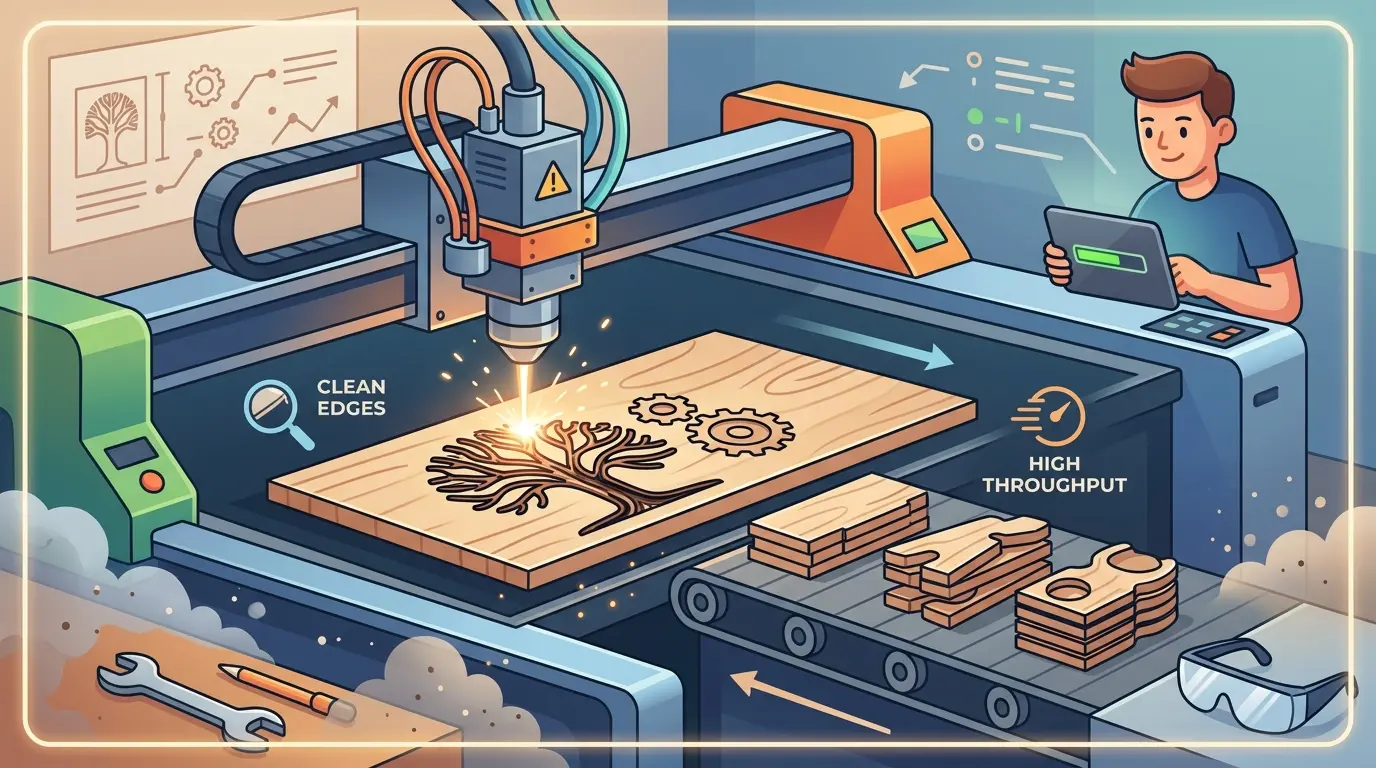
In wood laser cutting, cleaner edges and higher output usually rise or fall together. Shops that focus only on cutting speed often end up with darker edges, more scrap, more inspection, and more manual cleanup. Shops that focus only on appearance can protect quality but choke capacity with overly cautious settings and repeated adjustments.
For producers evaluating laser cutters and engravers for wood and other non-metallic work, the real objective is a stable process window: clean enough edges for the product standard, with repeatable cycle times that hold across a full shift.
Why Edge Quality and Throughput Are Linked
Edge quality problems almost always reduce throughput somewhere else in the workflow. A dark or uneven cut edge may force slower unloading, more inspection, more rejected parts, or extra finishing before assembly. In the same way, a recipe pushed too hard for speed can create incomplete cuts, thermal staining, or inconsistent kerf, which sends the job backward instead of forward.
In practical terms, cleaner edges and better throughput both depend on the same operating conditions:
- Material Consistency
- Stable Focus
- Clean Optics and Nozzle Condition
- Effective Air Assist
- Strong Smoke Extraction
- Efficient Job Layout and Part Handling
When those variables are controlled, a wood laser cutting machine is easier to run at a productive, repeatable pace. When they drift, operators usually compensate by slowing the job down.
Start With Material Before You Touch the Recipe
Many edge-quality issues are blamed on machine settings when the bigger problem is material variation. Wood-based substrates do not respond the same way under heat. Plywood, MDF, veneered panels, laminated sheets, and solid wood can all cut differently even when nominal thickness appears similar.
The main reasons are straightforward:
- Glue Lines In Plywood Can Carbonize Differently Across the Sheet
- MDF Can Generate Heavy Smoke and Fine Residue
- Veneers and Decorative Faces Can Show Heat Effects More Clearly
- Solid Wood Can Vary by Density, Grain, and Moisture Content
That variation matters because a recipe that works well on one batch may produce darker edges or incomplete separation on the next. If cleaner edges are a priority, grouping jobs by material family and thickness is often one of the fastest ways to stabilize output. Mixed-material scheduling may look flexible on paper, but it usually increases setup drift, operator intervention, and inspection time.
What Usually Causes Rough, Dark, or Inconsistent Edges
Most edge defects come from process imbalance rather than a single obvious fault. Common causes include:
- Excessive Heat Dwell From Slow Travel Speed
- Insufficient Energy for Full Separation, Which Leaves Fibers or Causes Secondary Burning
- Poor Focus Position, Which Can Widen the Cut or Increase Taper
- Weak Air Assist, Which Allows Smoke and Debris to Stay in the Cut Zone
- Inadequate Extraction, Which Recirculates Soot Onto the Surface
- Dirty Lenses, Mirrors, or Nozzles That Reduce Process Stability
- Poor Sheet Support or Flatness, Which Changes the Effective Focus Distance
These issues matter beyond appearance. If parts stick in the sheet, edges need hand cleanup, or the operator cannot trust first-pass separation, the line loses time at every downstream step. That is why the fastest visible improvement in throughput often starts with edge stability.
Process Adjustments That Usually Improve Edge Quality Without Killing Output
The goal is not to run the slowest possible recipe. The goal is to find the fastest stable recipe that still achieves full separation and acceptable edge appearance for the application.
| Adjustment | Typical Effect on Edge Quality | Typical Effect on Throughput | Best Used When |
|---|---|---|---|
| Improve Sheet Flatness and Support | Helps maintain a more consistent cut condition across the work area | Reduces unplanned stops and recipe drift | Large sheets or inconsistent panel stock are causing variation |
| Recheck Focus Position | Can reduce taper, roughness, and excessive edge darkening | Improves first-pass reliability | The cut looks wider, dirtier, or less consistent than expected |
| Strengthen Air Assist and Extraction | Helps clear smoke and debris from the cut path | Supports higher repeatability over long runs | Smoke staining or residue is building up during production |
| Clean Optics and Nozzle Components on Schedule | Restores process stability and cut consistency | Prevents gradual quality loss across the shift | Quality starts strong but fades over time |
| Group Jobs by Material and Thickness | Reduces the need for constant recipe changes | Shortens changeovers and lowers operator intervention | The queue contains several wood types or thicknesses |
| Balance Speed and Power for Full Separation | Reduces rework caused by incomplete cuts or excessive burning | Often improves net output more than chasing peak speed | Parts are failing at unloading or need second-pass handling |
The common mistake is treating visible cut speed as the main productivity number. Net throughput depends more on how many good parts leave the station without rework than on how fast the head moves during the best ten seconds of the job.
Throughput Lives in the Workflow, Not Just in the Cut Path
Many factories try to improve laser throughput by changing only the cutting recipe. That can help, but the bigger gains often come from the workflow around the machine.
Look closely at these bottlenecks:
- Sheet Loading and Alignment Time
- Recipe Changes Between Material Batches
- Excessive Travel Moves in the Nest or Layout
- Slow Scrap Removal
- Part Sorting After the Cut
- Inspection and Manual Edge Cleanup
- Unplanned Pauses for Lens, Nozzle, or Extraction Maintenance
If output matters, measure full job cycle time rather than cut-path time alone. A slightly more conservative recipe can outperform an aggressive one if it reduces stops, rejects, and hand-finishing labor.
In many shops, throughput improves when teams:
- Pre-Stage Material So the Machine Is Not Waiting on the Next Sheet
- Standardize Recipes by Material Group Rather Than Tuning Every Job From Scratch
- Separate Visual-Grade Parts From Hidden or Utility Parts So Edge Standards Match the Product
- Reduce Unnecessary Starts, Long Travel Moves, and Interruptions in the Layout
- Keep Extraction and Optics Maintenance on a Fixed Schedule Rather Than a Failure Schedule
That is also why the right machine choice depends on the product mix, not just the desired cut quality.
When Laser Cutting Is the Right Fit and When Another Workflow May Be Better
A wood laser cutting machine is commonly well suited to workflows where detail, non-contact cutting, and repeatable contour quality matter more than raw material-removal rate. It often makes sense for decorative components, shaped parts, signage elements, fine contour work, and mixed cut-and-mark production.
But laser is not automatically the best answer for every wood-based job. For producers comparing laser processing with CNC nesting machines, the better choice depends on what happens before and after the cut.
| Workflow Priority | Laser Wood Cutting | CNC Nesting |
|---|---|---|
| Fine Contours and Detailed Shapes | Strong Fit | Usually Less Efficient for Very Fine Detail |
| Non-Contact Processing of Delicate Geometry | Strong Fit | Mechanical Tool Force May Matter More |
| Integrated Routing and Drilling in Panel Work | Limited | Strong Fit |
| Thick Panel Breakdown for Cabinet Production | Application Dependent | Often Stronger Fit |
| Decorative Cut-and-Engrave Work | Strong Fit | Limited |
| Parts That Need Mechanical Edge Preparation for Downstream Processing | Application Dependent | Often Stronger Fit |
This is an important decision point. If the job is driven by decorative geometry, small-feature precision, and non-contact processing, laser is often a practical fit. If the workflow is dominated by sheet breakdown, routed features, drilling integration, and panel furniture throughput, another process may carry the production load more efficiently.
A Practical Checklist Before You Try to Scale Output
Before chasing more throughput, ask these questions:
- Is The Material Consistent Enough To Hold One Recipe Across the Batch?
- Is The Edge Standard Truly Visible to the Customer, or Hidden After Assembly?
- Are Focus, Air Assist, and Extraction Stable Across the Entire Working Area?
- Are Operators Measuring Good Parts Per Shift Rather Than Only Cutting Speed?
- Is Maintenance Preventive, or Are Quality Problems Triggering Cleanup and Adjustment?
- Does the Layout Reduce Unnecessary Motion and Handling?
- Would Some Jobs Be Better Routed to Another Process Instead of Forcing Everything Through Laser?
These questions matter because cleaner edges are not just a laser parameter problem. They are a production-system problem. Once that is understood, throughput decisions become much easier to defend.
Practical Summary
Cleaner edges and better throughput come from the same discipline: stable material input, stable process conditions, and a workflow that measures finished output instead of headline speed. In wood laser cutting, the fastest recipe is not always the most productive one. A slightly more controlled process often delivers more saleable parts, less inspection, and less rework across the shift.
If your work depends on fine contours, decorative detail, or non-contact processing on wood and similar non-metallic materials, laser can be a strong production tool. If your workflow is dominated by thick panel processing, routing, drilling, and furniture-line integration, the better answer may be a different machine category. The right result comes from matching the process to the job, then tightening the variables that actually control edge quality and throughput.