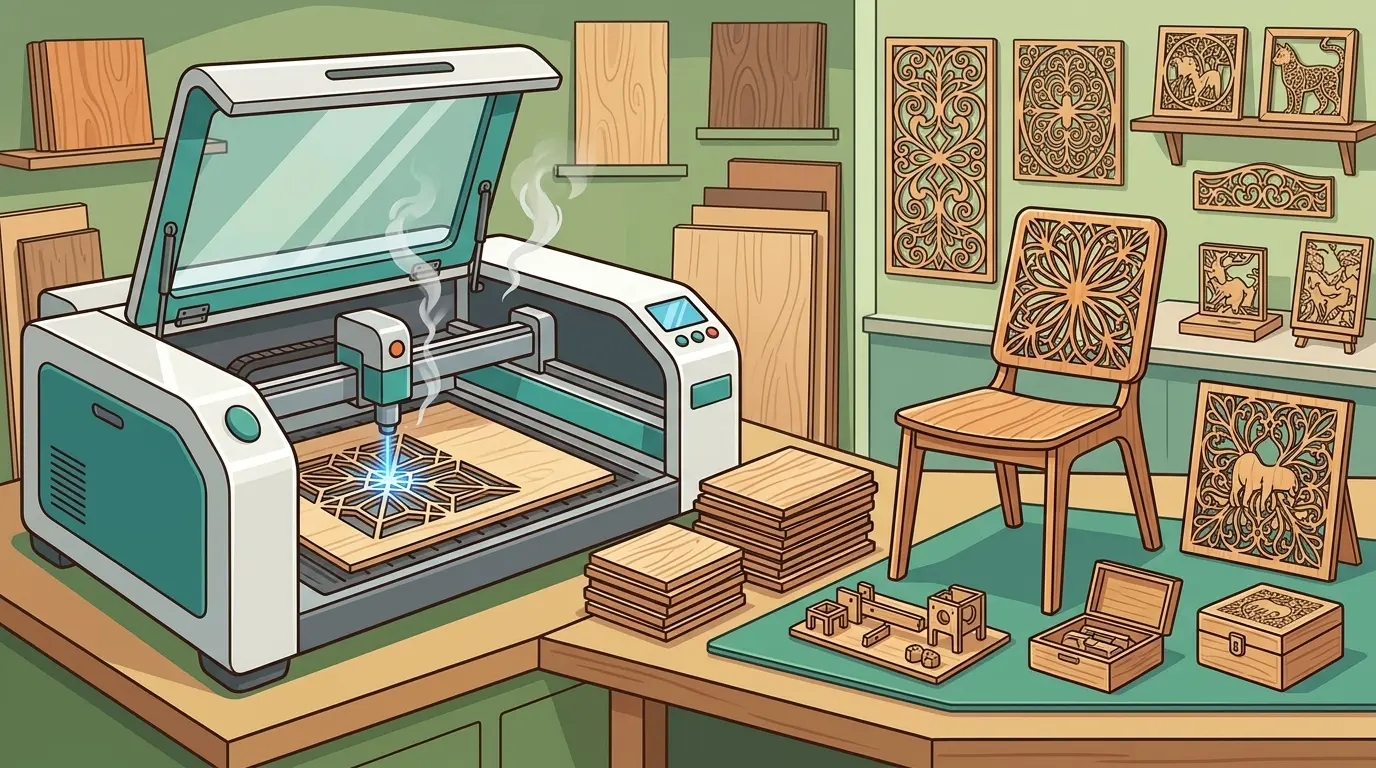
The term wood laser cutter sounds more specific than it really is. A furniture factory may use it to mean decorative components that need clean detail without slowing the main panel line. A decor producer may care most about visible-face quality, contour complexity, and repeatable cut patterns. A craft business may be looking for short-run flexibility, quick changeovers, and reliable personalization rather than maximum sheet throughput.
For buyers evaluating laser cutters and engravers for wood and similar non-metallic materials, the real question is not whether the machine can cut wood at all. The better question is whether the workflow gains enough value from fine detail, non-contact processing, and combined cutting and engraving to justify the machine’s place on the floor.
One Search Term, Three Different Production Priorities
The same keyword often points to very different production realities.
| Production Model | Typical Jobs | What Usually Defines Success | Where Laser Commonly Helps Most | Where Buyers Should Be Careful |
|---|---|---|---|---|
| Furniture Production | Decorative inserts, cutout panels, branded parts, light contour components | Repeatability, clean presentation, reliable integration with the rest of the line | Customer-visible detail work, mixed cut-and-engrave parts, non-contact shaping of lighter components | Treating laser as the main answer for structural panel breakdown, routing, or drilling-heavy work |
| Decor Production | Wall panels, screens, signs, ornamental pieces, display components | Visual consistency, edge appearance, contour precision, manageable cleanup | Detailed geometry, decorative surface work, varied shapes in the same queue | Underestimating residue control, face-quality inspection, and material variation |
| Craft Production | Small-batch products, seasonal items, personalized goods, short-run collections | Fast changeovers, repeatable small-part quality, easy job switching | High-mix work, short runs, rapid design changes, compact part layouts | Overvaluing headline speed when setup, sorting, and small-part handling dominate the shift |
That difference matters because the right buying logic changes with the production model. A factory that ships cabinet components all day will judge the machine differently than a workshop producing decorative wall pieces or a business that rotates through many small craft-style batches.
Where Laser Fits in Furniture Production
Furniture manufacturing is where buyers most often make the wrong assumption. They see a clean decorative sample and start wondering whether laser should become the center of the wood-processing workflow. In many furniture environments, that is too broad a role.
Laser usually makes the most sense when the furniture line includes work such as:
- Decorative Inserts Or Customer-Visible Cut Patterns
- Branded Panels, Labels, Or Design-Focused Surface Details
- Light Contour Parts That Benefit From Non-Contact Processing
- Mixed Cut-And-Engrave Components In Premium Or Custom Product Lines
These jobs reward detail, presentation, and geometry control more than they reward heavy structural machining. That is an important distinction. If the bulk of production hours go into carcass parts, panel sizing, routing, drilling, and assembly-ready components, the core investment logic usually points first toward panel-processing equipment such as CNC nesting machines, not toward laser.
In other words, a wood laser cutter can be highly useful in furniture production without being the machine that carries the whole line. In many cases, it is strongest as a supporting process cell for higher-value visual work, customized features, or parts that would be slower or less elegant to produce through a purely mechanical path.
Why Decor Production Often Gets More Immediate Value
Decor production usually places more emphasis on what the customer sees directly. The part may be a room divider, wall piece, engraved panel, display component, or other item where edge appearance and surface presentation matter almost as much as dimensional fit.
That often makes laser a more natural process match because the value of the part comes from:
- Fine Contour Complexity
- Repeated Visual Consistency
- Clean Alignment Between Cut Geometry And Surface Detail
- The Ability To Move Between Different Shapes Without Major Tooling Change
This does not mean decor work is automatically easy on a laser. The opposite can be true. Because the face is visible, buyers should pay close attention to smoke behavior, residue control, part support, and whether larger decorative panels stay stable enough for uniform results across the working area. A process that looks acceptable on one sample corner can become much less convincing when the full panel is customer-facing.
Decor producers usually get the most from laser when they evaluate the machine as a finish-sensitive production tool rather than as a generic cutting platform.
Why Craft Production Puts More Pressure on Changeovers Than on Raw Speed
Craft-style production is often misunderstood because the parts are smaller. Buyers sometimes assume small parts automatically mean easy throughput. In practice, craft workflows can place more pressure on setup discipline than many larger jobs.
The production queue may include:
- Many SKUs In Short Runs
- Frequent Artwork Or Layout Changes
- Personalized Or Seasonal Variants
- Small Parts That Need Careful Sorting And Stable Support
In that environment, the productive machine is rarely the one that only looks fast in motion. It is the one that helps operators move from one job to the next without excessive adjustment, cleanup, or rework.
For craft production, buyers should pay close attention to whether the process can be standardized. If recipe recall is inconsistent, material support is awkward, or small cut parts become difficult to remove cleanly, the shift loses time in places that do not show up in a brochure headline. That is why changeover discipline, usable workflow control, and repeatable cut quality often matter more than pure visible speed.
What To Evaluate Before Calling Any Wood Laser Cutter Productive
A machine becomes productive only when its strengths match the actual queue. The most useful evaluation points are usually the ones that connect directly to workflow outcomes.
| Evaluation Factor | Why It Matters | Workflow Outcome It Affects |
|---|---|---|
| Product Mix | Furniture, decor, and craft work do not reward the same machine strengths | Better process fit and fewer wrong-machine decisions |
| Cut-And-Engrave Relationship | Some shops need both in the same job, others need only one | Reduced setup friction and more stable job sequencing |
| Visible-Face Quality Standard | Customer-facing surfaces expose residue and inconsistency quickly | Less cleanup, fewer rejects, and better finish acceptance |
| Material Variation | Plywood, MDF, veneered boards, and other wood-based sheets do not react the same way | More consistent output across material changes |
| Part Size And Support | Larger panels and smaller parts create different stability problems | Cleaner release, less part movement, and better repeatability |
| Changeover Frequency | High-mix queues lose time between jobs if the process is hard to standardize | Higher net throughput across a full shift |
| Downstream Process Needs | Some parts still need routing, drilling, or broader panel preparation elsewhere | Better equipment coordination and less misplaced investment |
This table matters because many buying mistakes start when evaluation stays trapped at the feature-name level. Strong buyers ask what the feature changes in production, then decide whether that change actually matters in their product mix.
When Another Process Should Carry More of the Work
The cleanest buying decisions usually come from deciding where laser belongs in the process map, not from trying to make one machine solve every wood job.
| Production Need | Wood Laser Cutter | Mechanical Panel Workflow |
|---|---|---|
| Fine Decorative Cutouts And Surface Detail | Strong Fit | Usually Secondary |
| Mixed Short-Run And High-Variation Designs | Strong Fit | Application Dependent |
| Combined Cutting And Engraving On One Part | Strong Fit | Limited In the Same Workflow |
| Large-Sheet Breakdown For Furniture Lines | Limited | Strong Fit |
| Routing, Joinery Preparation, And Drilling Integration | Limited | Strong Fit |
| Assembly-Ready Structural Furniture Parts | Limited | Strong Fit |
This is where a lot of confusion clears up. A wood laser cutter is often strongest when value comes from detail, presentation, short-run adaptability, or combined cut-and-engrave output. It is usually less convincing as the main engine for structural furniture-part production where the workflow depends on broader sheet processing and downstream machining.
That does not reduce laser’s value. It makes the value more precise. A machine with a clear role in the process usually delivers better return than a machine expected to replace several different process families at once.
Practical Questions Before You Compare Quotes
Before narrowing the shortlist, buyers should be able to answer a few questions clearly:
- Which Jobs Would Move To Laser On Day One Rather Than Someday?
- Are Those Jobs Primarily Furniture Components, Decor Pieces, Or Craft Batches?
- Is Customer-Visible Surface Quality More Important Than Maximum Cutting Pace?
- How Often Will Operators Change Material, Layout, Or Artwork During a Shift?
- Does the Workflow Need Cutting Only, Engraving Only, Or Reliable Alignment Between Both?
- Will the Machine Replace Manual Rework Or Simply Add Another Station To Manage?
- Are Structural Furniture Parts Still Better Routed To a Different Process?
These questions keep the discussion tied to real production hours. They also help buyers judge whether the machine will reduce waste, shorten setup time, improve consistency, or simply move the bottleneck to another part of the floor.
Practical Summary
A wood laser cutter can be a practical production tool for furniture, decor, and craft work, but not for the same reasons in each case. In furniture production, it often works best as a complementary process for decorative or customer-visible components rather than as the main structural panel solution. In decor production, it usually earns attention through visual quality, contour flexibility, and repeatable presentation. In craft production, the real advantage often comes from handling high-mix, short-run work with less tooling friction.
The strongest buying decision starts by asking where laser creates a workflow advantage, not by assuming every wood job belongs on the same machine. When the machine is matched to the real product mix, it is easier to judge every feature by the outcome it improves: cleaner detail, steadier repeatability, reduced rework, or smoother changeovers.