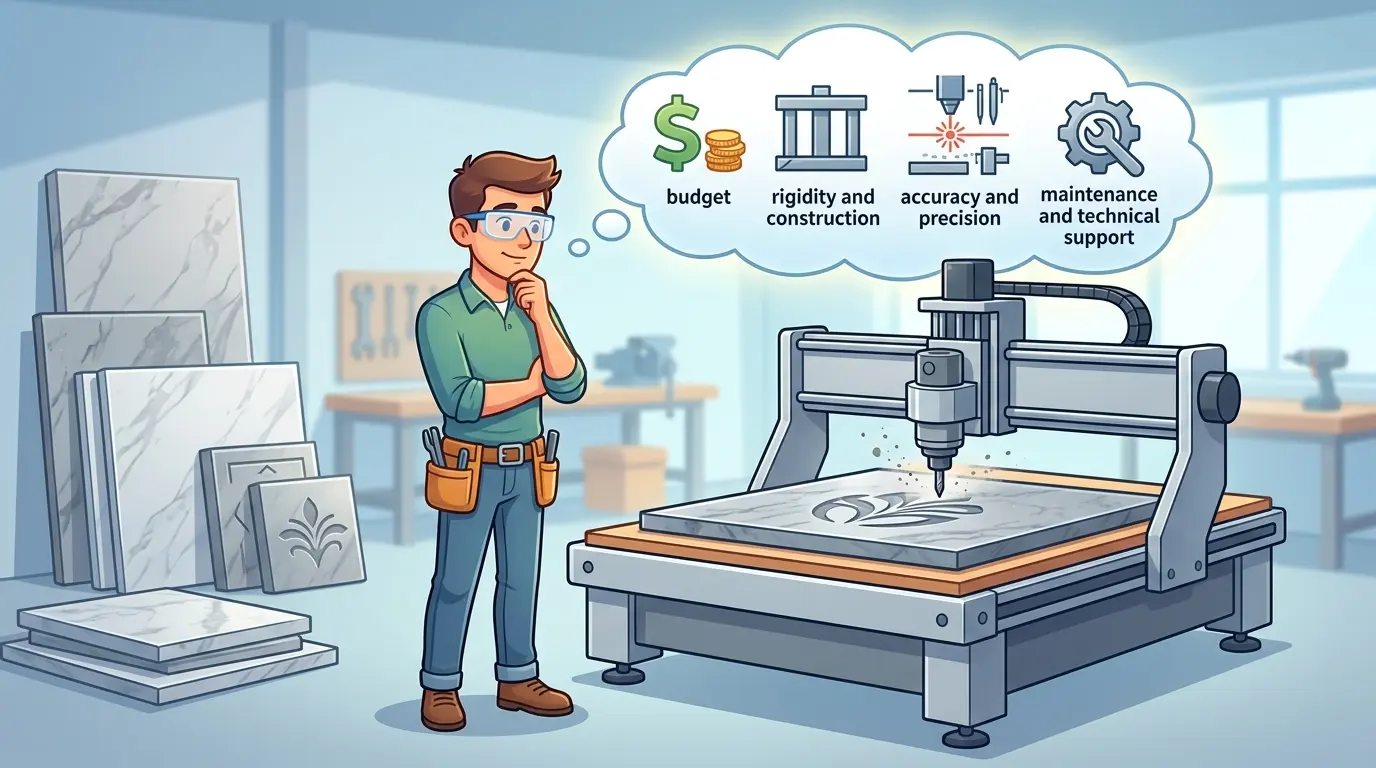
Buying a marble engraving machine often starts with sample photos, decorative patterns, or a short list of machine features. That is usually the wrong place to begin. In real stone production, the better buying decision comes from understanding what kind of engraving you need to produce, how often you need to repeat it, how marble behaves in your workflow, and whether engraving is a standalone process or only one step in a larger fabrication line.
The right machine helps you deliver cleaner detail, steadier repeatability, and less manual correction after engraving. The wrong one either adds complexity you do not need or falls short once real stone handling, setup discipline, and finish expectations enter the picture.
Start With The Kind Of Engraving You Actually Sell
The phrase “marble engraving machine” can describe very different production needs. A shop producing memorial text and repeated lettering is not solving the same problem as a fabricator carving decorative relief panels or adding logos and patterns to architectural stone.
Before comparing machines, define the work clearly.
| Main Job Type | What The Machine Must Do Reliably | Common Buying Risk |
|---|---|---|
| Repeated Lettering And Nameplate Work | Keep line depth, character clarity, and alignment consistent across batches | Overbuying a broader machine platform when the real work is repetitive and narrow |
| Decorative Relief And Carved Patterns | Hold detail across multi-pass engraving and maintain stable surface quality | Buying a machine that looks precise on samples but slows down under deeper or more complex carving |
| Branding, Logos, And Architectural Detail | Stay accurate across larger pieces and varied layouts | Ignoring part positioning and setup time on larger marble pieces |
| Mixed Stone Fabrication With Engraving Included | Fit engraving into a wider process that may also include shaping, routing, or edge work | Buying an engraving-only solution that creates another handoff and another bottleneck |
This first step matters because the right purchase depends less on the label of the machine and more on the mix of jobs flowing through the shop every day.
Decide Whether You Need A Dedicated Engraving Solution Or A Broader Stone Workflow Machine
Some buyers truly need a machine centered on engraving. Others search for a marble engraver when the real requirement is a broader stone-processing platform that can engrave as one function within a larger workflow.
If your work regularly combines engraving with shaping, cutouts, profiling, or related stone-processing steps, reviewing broader stone CNC machines may be more useful than comparing engraving samples alone. If most of your output is centered on repeated text, shallow decorative work, or smaller-format engraved products, a simpler engraving-focused workflow may be the more practical fit.
The key is not to buy extra process range just because it sounds more advanced. It is equally important not to buy a narrow machine if the shop will still need to move the same marble piece through too many separate stations afterward.
Look At Marble Behavior, Not Just Machine Claims
Marble is workable and capable of fine decorative detail, but it is still a brittle natural material with visible variation from piece to piece. Veining, surface finish, edge condition, and the way the part is supported during machining all affect the engraving result.
That means sample images are not enough. Buyers should check how the machine performs on the kind of marble they actually process most often.
Focus on things such as:
- Detail Clarity On The Surface Finish You Sell Most Often
- Consistency Of Depth Across Repeated Parts
- Cleanliness Around Corners, Fine Lines, And Small Character Areas
- Stability Of Results In Veined Or Visually Varied Material
- Whether The Support And Setup Method Helps Reduce Vibration Or Surface Disturbance During Engraving
This matters because marble engraving quality is judged very quickly by the eye. Slight inconsistency in depth or edge cleanliness can make a finished piece look lower value even when the overall design is correct.
Prioritize Repeatability Before Maximum Speed
In stone work, buyers often talk about speed first. In practice, repeatability usually matters more. A machine that engraves one sample quickly is less valuable than a machine that can keep lettering, decorative depth, and visual quality stable across real production.
That is especially true if engraving is followed by paint filling, cleaning, polishing, sealing, or inspection. If the engraved result varies from part to part, the downstream labor cost rises quickly.
Before buying, check whether the machine helps you stabilize:
- Depth Consistency From One Piece To The Next
- Character And Line Definition Across Repeated Jobs
- Part Positioning Accuracy During Setup
- Multi-Pass Reliability On Deeper Decorative Work
- Day-To-Day Output Quality Across Different Operators
The better buying question is not “How fast can it engrave?” It is “How reliably can it engrave the work we actually ship?”
Check Slab Handling, Positioning, And Shop Flow
A marble engraving machine does not operate in isolation. Marble pieces are heavier, more fragile, and more awkward to move than many buyers account for during machine selection. Even if engraving quality is good, the workflow can still fail if loading, alignment, and unloading are inefficient.
Buyers should review the machine against the physical reality of the shop floor:
- The Typical Size And Weight Of Parts Being Engraved
- How Operators Position Smaller Plaques Versus Larger Architectural Pieces
- Whether The Work Area Supports Stable Part Setup Before The Toolpath Starts
- How Finished Parts Move To Cleaning, Inspection, Filling, Or Secondary Stone Operations
- Whether The Layout Creates Congestion Around The Machine During Busy Production Periods
Many expensive mistakes come from buying for spindle motion while ignoring material handling. In stone fabrication, the setup around the machine is often just as important as the motion inside it.
Review Cooling, Slurry Control, And Daily Housekeeping
Stone engraving is not only a precision question. It is also a housekeeping and uptime question. Marble processing creates abrasive residue, and the machine has to live in that environment every day.
Before buying, look carefully at how practical the operating routine will be. Points worth checking include:
- How The Work Area Is Kept Clean During And After Engraving
- How Cooling Or Wet Processing Supports Tool Life And Surface Stability
- How Easily Operators Can Remove Slurry And Residue From The Work Zone
- Whether Daily Cleaning Looks Realistic For Your Team, Not Just Acceptable In A Demo
- How Quickly Wear Or Drift Can Be Detected Before It Starts Affecting Engraving Quality
This section is easy to underestimate, but it directly affects uptime. A machine that delivers attractive samples yet becomes difficult to keep clean and stable in daily stone production may not stay productive for long.
Do Not Underestimate Programming And Job Preparation
For many marble engraving shops, the real bottleneck is not the engraving pass itself. It is the work that happens before machining begins. Text changes, layout adjustments, decorative artwork cleanup, repeated customer revisions, and origin setting can all consume more time than expected.
That means software and job preparation should be evaluated in practical terms:
- How Easily Operators Can Set Up Repeated Text Or Pattern Jobs
- How Quickly Layout Changes Can Be Made For Customer Variations
- Whether The Programming Flow Fits Your Current Team Skill Level
- How Simple It Is To Re-Run Repeat Orders Without Rebuilding The Job Every Time
- Whether Setup Time Remains Reasonable When The Work Mix Includes Custom Pieces
If the machine looks productive only after a long preparation cycle, the buying decision should account for that. In many factories, programming discipline drives throughput just as much as the machine motion does.
Compare The Buying Factors That Actually Change Results
| Buying Factor | Why It Matters | What To Clarify Before Buying |
|---|---|---|
| Engraving Type | Defines whether the job is shallow lettering, decorative relief, or part of a broader stone process | What do you ship most often, and what level of detail do customers actually pay for? |
| Material Mix | Different marble types and finishes do not behave identically in production | Which marble surfaces and part conditions dominate daily work? |
| Repeatability Need | Stone rework is costly, so visual consistency matters more than demo performance | Are you trying to maximize output, reduce variation, or both? |
| Part Size And Handling | Heavy or large-format marble changes alignment, loading, and floor-flow requirements | What are your typical workpiece dimensions and handling constraints? |
| Workflow Scope | Shows whether engraving is a single task or one station in a larger fabrication process | Does the same part also need shaping, cutouts, profiling, or finish operations? |
| Daily Housekeeping | Affects uptime, maintenance discipline, and result stability in a stone environment | Can your team realistically support cleaning and residue management every shift? |
| Programming Demand | Custom text and artwork can consume more time than machining | How often do jobs change, and who prepares them today? |
| Operator Dependence | Determines whether quality stays stable across shifts and staff changes | Does the machine simplify repeat work or still rely heavily on individual technique? |
This is the level at which a buying decision becomes commercially useful. The goal is not to find the most impressive machine. The goal is to find the machine that fits your production logic with the least friction.
Questions To Ask Before You Commit
Before signing off on any marble engraving machine purchase, pressure-test the decision with a few direct questions:
- Are We Buying Mainly For Repeated Engraving, Or For A Broader Stone Fabrication Workflow?
- What Marble Surfaces, Piece Sizes, And Detail Levels Do We Process Most Often?
- Does Repeatability Matter More To Our Business Than Headline Cycle Speed?
- Will Job Preparation And Layout Changes Become A Bigger Bottleneck Than Machining?
- How Will Engraved Pieces Move Into Cleaning, Filling, Polishing, Or Other Secondary Steps?
- Is Our Shop Ready To Support Stone-Specific Cleaning And Daily Maintenance Discipline?
- Are We Solving A Real Production Constraint, Or Buying Around A Small Number Of Attractive Samples?
Good buying decisions usually become clearer after these questions because they force the discussion back toward workflow, labor, and output quality instead of general machine language.
Practical Summary
A marble engraving machine should be selected according to the kind of engraving you sell, the marble you process, the repeatability your customers expect, and the way engraved parts move through the rest of your stone workflow. The most useful buying factors are usually not the loudest ones. They are setup stability, visual consistency, realistic housekeeping, part handling, and whether the machine fits the real mix of work on your floor.
If your shop handles mostly repeated engraving jobs, a focused and stable engraving workflow may be the right answer. If engraving sits inside a larger stone-production process, a broader machine platform may be the more practical long-term fit. The safest purchase is the one that matches your actual production constraints before it matches anyone’s machine headline.