For many fabricators, the real question is not whether laser processing makes sense. It is which laser setup solves the actual production bottleneck first. A shop building frames, supports, welded assemblies, brackets, covers, and enclosures may handle both tube stock and flat sheet every day, but those jobs do not create the same handling, programming, or downstream demands.
That is why tube laser cutting and flat sheet cutting should not be treated as interchangeable investments. Even when the cutting source is similar, the production logic is different. The right choice depends on stock geometry, part mix, secondary operations, and where the shop currently loses the most time.
Why This Decision Is Really About Geometry and Workflow
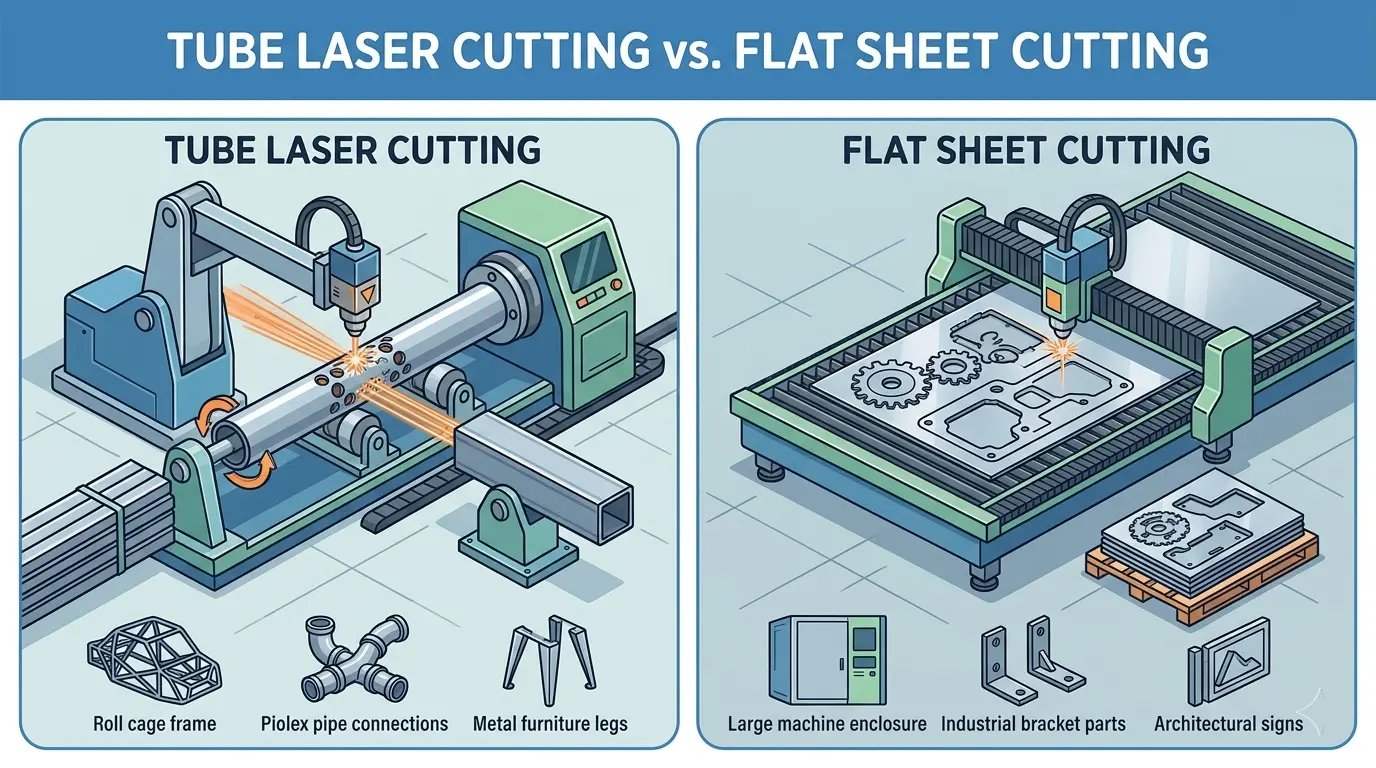
Tube laser cutting is built around profile material such as round, square, and rectangular tube. The machine has to grip, support, rotate, and process the part while keeping features aligned around different faces and along the length of the profile.
Flat sheet cutting is built around sheet or plate stock. The priority shifts toward nesting efficiency, stable sheet handling, part yield, and consistent cutting of two-dimensional shapes that move into bending, welding, forming, or assembly.
That distinction matters because the cutting task is only one part of the workflow. The wrong setup often creates extra drilling, coping, notching, manual layout, handling delays, or outsourced processing after the laser step is complete.
| Setup Type | Best Suited Stock Form | Typical Part Types | What The Machine Must Do Well | Practical Workflow Outcome |
|---|---|---|---|---|
| Tube Laser Cutting | Round, square, and rectangular profiles | Frames, supports, crossmembers, welded structures, feature-rich tube parts | Hold and rotate profiles accurately while processing holes, slots, miters, and end features | Less manual tube preparation and more consistent fit-up in welding and assembly |
| Flat Sheet Cutting | Sheet and plate stock | Brackets, panels, gussets, covers, mounting plates, enclosure parts | Nest sheet efficiently and cut two-dimensional parts cleanly across a broad batch | Better material utilization and smoother transfer into bending or fabrication |
| Combined Strategy | Mixed profile and sheet production | Assemblies that need both cut tube and cut flat components every day | Balance profile processing and sheet-part throughput across two linked workflows | Fewer outsourced steps and tighter control over complete fabrication flow |
Where Tube Laser Cutting Usually Wins
Tube laser cutting tends to deliver the strongest return when a factory processes profile parts that would otherwise require multiple manual steps before welding or assembly. If the job routinely includes holes, slots, fitted intersections, fish-mouth cuts, end geometry, or repeated face-specific features, the gain often comes from eliminating secondary preparation rather than simply cutting faster.
This is especially important when the profile itself drives product performance. In many welded structures, part quality depends on how accurately the tube features line up before the first tack weld. A more controlled profile-cutting workflow can help reduce fixture adjustment, rework, and downstream fitting problems.
Tube laser setups are commonly the better first move when:
- Most revenue comes from profile-based fabricated parts rather than flat blanks.
- Operators spend too much time drilling, coping, marking, or trimming tube after rough cutting.
- Welding teams lose time correcting poor fit-up or inconsistent feature placement.
- Production frequently switches between different profile shapes and cut patterns.
What tube laser cutting does not do well is replace a high-volume flat-part workflow. If most output is still brackets, panels, covers, or bent sheet components, a profile-focused machine may not address the real throughput constraint.
Where Flat Sheet Cutting Usually Wins
Flat sheet cutting is usually the stronger choice when the core workload is built around two-dimensional parts cut from sheet or plate. That includes panels, gussets, base plates, tabs, covers, mounting components, and any production environment where nesting strategy materially affects both cost and throughput.
In those cases, the return comes from how many usable parts the shop can move out of each sheet, how cleanly the parts enter bending or assembly, and how efficiently the workflow handles batch production. The machine is not just cutting outlines. It is helping the factory manage part density, repeatability, and downstream scheduling.
Flat sheet cutting is commonly the better first move when:
- The order mix is dominated by sheet-based parts.
- Material yield and nesting efficiency have a clear effect on margins.
- Bending, forming, or panel assembly depends on consistent flat-part flow.
- Outsourced sheet cutting creates delays in otherwise in-house fabrication work.
This setup is less effective as a replacement for profile processing. A sheet-cutting workflow does not remove the separate handling, drilling, or notching challenges that appear when the real bottleneck sits in tube preparation.
The Hidden Cost Of Choosing The Wrong First Machine
Many buying mistakes happen because the comparison stays too close to headline cutting performance. A faster demo or a more impressive-looking machine does not help much if the shop still depends on manual work in the next step.
The more useful comparison is: what secondary work disappears after the laser is installed?
| If Most Of Your Work Looks Like This | But You Buy This First | The Hidden Cost Usually Shows Up Here |
|---|---|---|
| Welded profile assemblies with repeated tube features | Flat sheet cutting setup | Manual tube layout, drilling, coping, and slower welding preparation |
| Brackets, enclosure parts, and sheet blanks for bending | Tube laser cutting setup | Continued outsourcing or bottlenecks in sheet-part production |
| Mixed assemblies that need both profile and flat components every day | Only one setup with no staging plan | Imbalance between departments and waiting time between internal and outsourced steps |
This is why many factories should evaluate bottlenecks at the assembly level, not only at the machine level. If one missing capability keeps delaying welding, bending, or shipment, that missing step often deserves priority over the more visually impressive purchase.
What Production Managers Should Check Before Comparing Quotes
Before comparing suppliers or configurations, a shop should document what it actually cuts in a normal week or month. That usually gives a clearer answer than any generic specification comparison.
Start with these questions:
- What percentage of our cut parts come from tube or profile stock versus flat sheet?
- Which parts currently need the most manual drilling, coping, layout, trimming, or preparation after cutting?
- Where does downstream rework happen most often: welding, bending, fitting, or final assembly?
- Are we losing more money to poor material yield or to labor-heavy secondary operations?
- Is the current bottleneck caused by raw cutting speed, or by handling and preparation before the next process?
- Do our highest-margin jobs depend more on profile parts or on flat nested components?
- If we outsource one side of the workflow today, which outsourced step causes the most delay or quality risk?
Those questions usually make the decision more practical. They shift the buying discussion away from broad machine claims and toward the actual production constraint the investment needs to remove.
When A Dual-Setup Strategy Makes More Sense
Some manufacturers should not force an either-or answer. If the product line depends heavily on both profile cutting and flat sheet cutting, the better strategy may be staged investment rather than false simplification.
That does not always mean buying two systems at once. It may mean choosing the first machine based on the current bottleneck while planning the second around future balancing of the fabrication flow.
| Production Pattern | Best First Move | Why |
|---|---|---|
| Mostly tube-based fabricated assemblies | Tube laser cutting first | The largest savings usually come from reducing profile preparation and improving fit-up |
| Mostly brackets, panels, and bent sheet parts | Flat sheet cutting first | The main return usually comes from nesting efficiency and faster flat-part flow |
| Balanced mix, but one process is still outsourced | Bring the outsourced bottleneck in-house first | Lead time and scheduling control often improve faster than raw cut speed alone |
| Daily assemblies require both profile and flat components | Plan for a dual-setup roadmap | One machine rarely removes all bottlenecks in a fully mixed fabrication workflow |
This kind of staged thinking is usually more honest than trying to prove one setup can cover every production condition equally well.
Common Buying Mistakes To Avoid
The first mistake is assuming tube laser cutting and flat sheet cutting are just two versions of the same investment. They solve different handling and geometry problems.
The second is comparing machines only by speed, power, or headline performance without calculating how much downstream labor remains after the cut.
The third is ignoring internal product mix. Shops often buy for the part they want to win in the future while underestimating the part family that currently pays most of the bills.
The fourth is overlooking changeover and material handling. A machine may cut well in principle while still creating friction in loading, unloading, orientation control, or batch flow.
The fifth is treating a mixed production environment as though one setup must be universally better. In many factories, the right answer is sequencing the investments correctly rather than forcing one machine to solve two different fabrication problems.
Practical Summary
Tube laser cutting is usually the better fit when profile parts, feature-rich tube preparation, and downstream weld fit-up drive the real production bottleneck. Flat sheet cutting is usually the better fit when nested parts, panel flow, and material yield matter more to overall output.
Neither setup is automatically better outside its use case. The right choice depends on whether the shop is primarily trying to remove profile-preparation labor or improve flat-part throughput.
For teams evaluating laser investment as part of a broader equipment-planning decision, the Pandaxis product catalog offers a wider view of industrial machinery categories.
In the end, the best buying logic starts with the part mix, not the machine headline. Once a factory is clear on which geometry creates the most delay, rework, or outsourced dependency, the right setup usually becomes much easier to identify.